

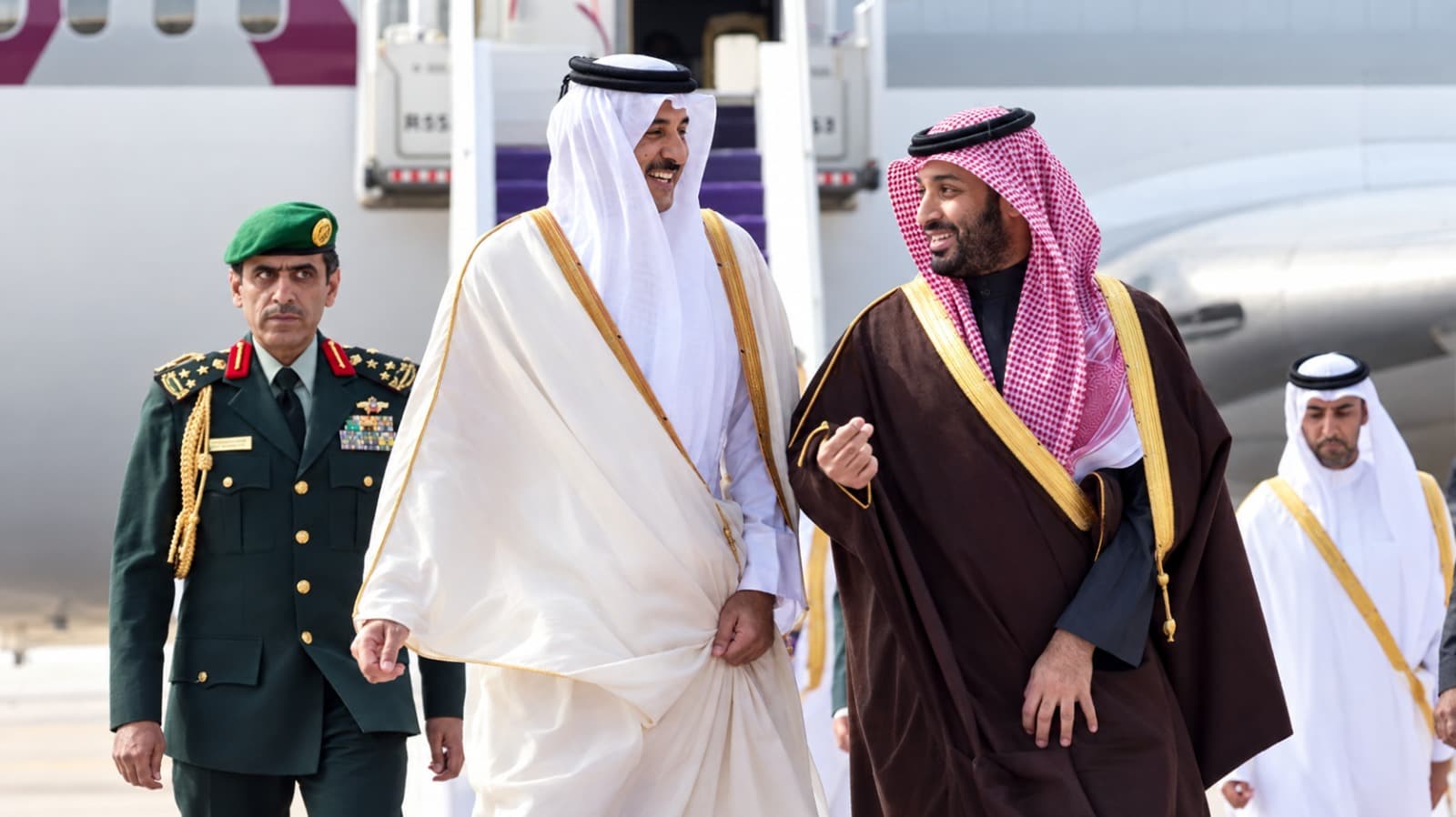
The conversation comes as Gulf states navigate a volatile regional environment shaped by tensions involving Iran, the Strait of Hormuz, Yemen, energy security and wider military risks.
According to Qatar’s state news agency, Sheikh Tamim received a call from Mohammed bin Salman, with the two leaders exchanging views on regional developments and diplomatic efforts aimed at reducing tensions.
Saudi reporting also said the leaders reviewed bilateral relations and discussed regional developments, as well as efforts to strengthen security and stability.
The call underlines the importance of communication between Doha and Riyadh at a time when Gulf governments are trying to prevent existing conflicts from spreading further.
For Qatar, diplomacy remains a key part of its regional strategy.
For Saudi Arabia, close coordination with neighbouring Gulf states is becoming increasingly important as security threats and risks to energy and trade remain elevated.
WHAT HAPPENED?
Sheikh Tamim and Mohammed bin Salman held a telephone conversation focused on bilateral ties and the broader regional situation.
The two leaders exchanged views on developments in the region and discussed diplomatic efforts aimed at easing tensions and strengthening security and stability.
No new agreement was announced.
That distinction matters.
The call shows that Doha and Riyadh are maintaining a high-level diplomatic channel, but it does not mean the two sides have reached a new regional settlement.
For now, the conversation appears to reinforce existing diplomatic contacts at a particularly sensitive moment.
WHY THE TIMING MATTERS
The Gulf is dealing with several overlapping security concerns.
Tensions involving Iran are putting pressure on energy markets and shipping routes. The Strait of Hormuz remains a critical artery for global oil and LNG supplies, while Yemen and continued Houthi activity add another layer of uncertainty.
Gulf governments are also trying to prevent these separate flashpoints from turning into a wider regional confrontation.
Against that backdrop, direct communication between Qatar and Saudi Arabia takes on added importance.
Closer coordination among Gulf states could potentially strengthen diplomatic efforts and make it easier to contain further escalation.
QATAR’S DIPLOMATIC ROLE
Qatar has built a reputation as a go-between in some of the Middle East’s most difficult disputes.
Doha has maintained communication with governments and groups that other countries have sometimes struggled to engage directly. That has given Qatar a role in diplomatic efforts involving the United States and Iran.
Recent reporting has highlighted Qatari efforts to facilitate discussions between Washington and Tehran.
Qatar’s relationships with both the United States and regional governments give it a potentially valuable position.
The challenge for Doha is to keep those channels open while turning communication into meaningful progress.
SAUDI ARABIA’S PRIORITY: REGIONAL SECURITY
For Riyadh, security remains at the heart of the regional agenda.
Saudi Arabia has faced missile and drone threats linked to the wider conflict, while instability around Yemen and the Red Sea continues to create risks.
The kingdom also has a strong interest in protecting its energy infrastructure and keeping export routes open.
A prolonged regional conflict could affect:
Oil exports
Investment
Tourism
Shipping
Infrastructure
Financial markets
That makes de-escalation important not only from a security perspective, but also for Saudi Arabia’s wider economic plans.
THE HORMUZ FACTOR
The Strait of Hormuz remains one of the most important pressure points in the region.
The waterway links the Persian Gulf with the Gulf of Oman and carries a significant share of global energy shipments.
For Qatar, the stakes are particularly high because of its position as a major LNG exporter.
Saudi Arabia also has a major interest in keeping maritime routes open and protecting the movement of oil and other goods.
Any meaningful reduction in tensions around the strait could therefore have consequences far beyond the Gulf, affecting energy prices, shipping costs and inflation.
QATAR AND SAUDI ARABIA: FROM RIFT TO COORDINATION
Relations between Qatar and Saudi Arabia were severely strained during the Gulf diplomatic crisis that began in 2017.
Saudi Arabia and several of its allies imposed diplomatic and economic restrictions on Qatar.
The dispute was eventually eased through the Al-Ula Declaration in 2021, which helped restore diplomatic and economic relations.
Since then, Doha and Riyadh have gradually rebuilt their relationship.
Political and economic contacts have expanded, and the two countries now have considerably more room for cooperation than they did during the height of the dispute.
That history makes the latest contact notable.
The relationship today is very different from the period of open confrontation several years ago.
WHY GULF UNITY MATTERS
The Gulf states do not always see regional issues in the same way.
They have different relationships with Iran, different approaches to regional conflicts and different economic priorities.
But periods of heightened tension can create common interests.
Those include:
Protecting energy infrastructure
Keeping maritime routes open
Preventing a wider war
Maintaining investor confidence
Protecting civilian populations
Supporting diplomatic solutions
Qatar and Saudi Arabia therefore have strong reasons to keep talking even when their wider regional policies do not completely align.
THE IRAN QUESTION
Iran remains central to the region’s security picture.
Saudi Arabia has long regarded Iranian influence as a major strategic concern.
Qatar, meanwhile, has maintained diplomatic and economic ties with Tehran while also remaining a close security partner of the United States.
That gives Doha a somewhat different position from Riyadh.
It can also make Qatar useful as a mediator.
Doha can communicate with Iran while maintaining dialogue with Saudi Arabia, the United States and other Gulf governments.
Whether that position can produce concrete progress remains one of the key questions.
THE US CONNECTION
The United States remains a major security partner for both Qatar and Saudi Arabia.
Qatar hosts Al Udeid Air Base, while Saudi Arabia maintains extensive defence cooperation with Washington.
Both countries therefore have a strong interest in preventing further escalation from threatening US military facilities, energy infrastructure or commercial shipping.
At the same time, Gulf governments have increasingly emphasised diplomacy and regional dialogue as ways to reduce the risk of a broader conflict.
YEMEN REMAINS ANOTHER TEST
Yemen remains a particularly sensitive issue for Saudi Arabia.
The Houthis retain missile and drone capabilities and have previously targeted Saudi territory and regional shipping.
Qatar has generally placed greater emphasis on diplomacy in regional conflicts, while Saudi Arabia has direct security interests in Yemen because of its long border with the country.
Any wider Gulf diplomatic strategy will therefore have to take Yemen into account.
Progress in discussions involving Iran could also have implications for the Houthi conflict.
DIPLOMACY VS. ESCALATION
The latest Qatar–Saudi conversation comes as the region faces two very different possibilities.
THE DIPLOMATIC PATH
US–Iran negotiations make progress
Shipping risks begin to ease
Gulf states coordinate more closely
Energy markets stabilise
Regional tensions gradually decline
THE ESCALATION PATH
Negotiations break down
Military attacks increase
Disruption around Hormuz continues
Oil and gas prices remain volatile
Gulf states face greater security pressure
For both Qatar and Saudi Arabia, avoiding the second scenario is increasingly important.
WHY THIS MATTERS
1. QATAR IS REINFORCING ITS MEDIATION ROLE
Doha continues to position itself as a channel for dialogue during major regional crises.
2. SAUDI ARABIA NEEDS REGIONAL COORDINATION
Riyadh faces security, energy and economic risks if regional instability continues.
3. GULF COORDINATION COULD SUPPORT DE-ESCALATION
Closer communication among Gulf states could give diplomatic efforts greater weight.
4. HORMUZ REMAINS CRITICAL
Any improvement in security around the waterway could quickly affect global energy and shipping markets.
5. THE CALL IS NOT A NEW REGIONAL AGREEMENT
The leaders discussed regional developments and diplomatic efforts, but no comprehensive new settlement was publicly announced.
FACT CHECK METER
ATTLAS FACT CHECK
FACT METER: 94%
STATUS: DEVELOPING
CONFIRMED
Qatar’s Emir Sheikh Tamim bin Hamad Al Thani received a telephone call from Saudi Crown Prince Mohammed bin Salman.
The leaders discussed developments in the region.
They discussed diplomatic efforts aimed at easing tensions and strengthening security and stability.
Bilateral relations between Qatar and Saudi Arabia were also reviewed.
Qatar is playing an active diplomatic role in efforts connected to US–Iran discussions.
NOT YET ESTABLISHED
Whether the call produced a new bilateral agreement.
Whether Qatar and Saudi Arabia agreed on a specific joint diplomatic initiative.
Whether the discussions will lead to a broader Gulf de-escalation framework.
Whether current diplomatic efforts will result in a lasting reduction in regional tensions.
IMPORTANT DISTINCTION
DIPLOMATIC COORDINATION IS CONFIRMED — A NEW REGIONAL DEAL IS NOT.
The conversation shows that senior leaders remain engaged, but additional talks and concrete measures would be needed before it could be described as a broader diplomatic breakthrough.
ATTLAS VERDICT
QATAR–SAUDI CONTACT: CONFIRMED
REGIONAL DIPLOMACY: ACTIVE
DE-ESCALATION EFFORTS: CONFIRMED
NEW AGREEMENT: NOT ANNOUNCED
REGIONAL TENSIONS: HIGH
SITUATION: DEVELOPING
ATTLAS FOCUS: CAN GULF DIPLOMACY CONTAIN THE CRISIS?
QATAR’S ROLE
Doha is working to keep diplomatic channels open between opposing sides.
SAUDI ARABIA’S ROLE
Riyadh is focused on national security while also seeking to prevent further regional escalation.
SHARED INTEREST
Both countries have a strong interest in protecting energy infrastructure, shipping routes and economic stability.
THE CHALLENGE
Diplomacy can only go so far if the main parties are unwilling to compromise.
That remains the biggest uncertainty.
WHAT TO WATCH NEXT
Qatar
Whether Doha announces further mediation efforts involving Iran, the United States or other regional governments.
Saudi Arabia
Whether Riyadh follows the latest conversation with additional diplomatic or security measures.
Iran
Whether Tehran responds positively to regional mediation efforts.
United States
Whether Washington supports or participates in further diplomatic engagement.
Strait of Hormuz
Whether shipping conditions improve or remain under pressure.
Yemen
Whether Houthi attacks continue and whether wider diplomatic efforts have an impact on the conflict.
Gulf cooperation
Whether Qatar, Saudi Arabia and other GCC members move toward a more coordinated position.
THE ATTLAS BOTTOM LINE
The conversation between Qatar’s Emir Sheikh Tamim and Saudi Crown Prince Mohammed bin Salman shows that Doha and Riyadh are keeping their diplomatic channels active at a critical moment for the Gulf.
The two leaders discussed regional developments and efforts to reduce tensions and strengthen security and stability.
For Qatar, the priority is maintaining its role as a diplomatic bridge.
For Saudi Arabia, the focus is protecting national security while limiting the economic and strategic fallout from a wider regional conflict.
Those interests increasingly overlap.
But diplomacy remains fragile.
The latest call is best understood as a sign of active communication rather than a diplomatic breakthrough.
If Qatar’s mediation efforts gain momentum and Saudi Arabia works with its Gulf partners to support de-escalation, the region could move toward greater stability.
If talks fail and military tensions rise, pressure on Gulf governments — and on global energy markets — could increase quickly.
For now, Doha and Riyadh are talking.
The bigger question is whether that conversation can help turn diplomacy into real de-escalation.
ATTLAS WIRE | AWX WORLD NEWS
Real Stories. Lasting Impact.


Comments
No comments yet.