

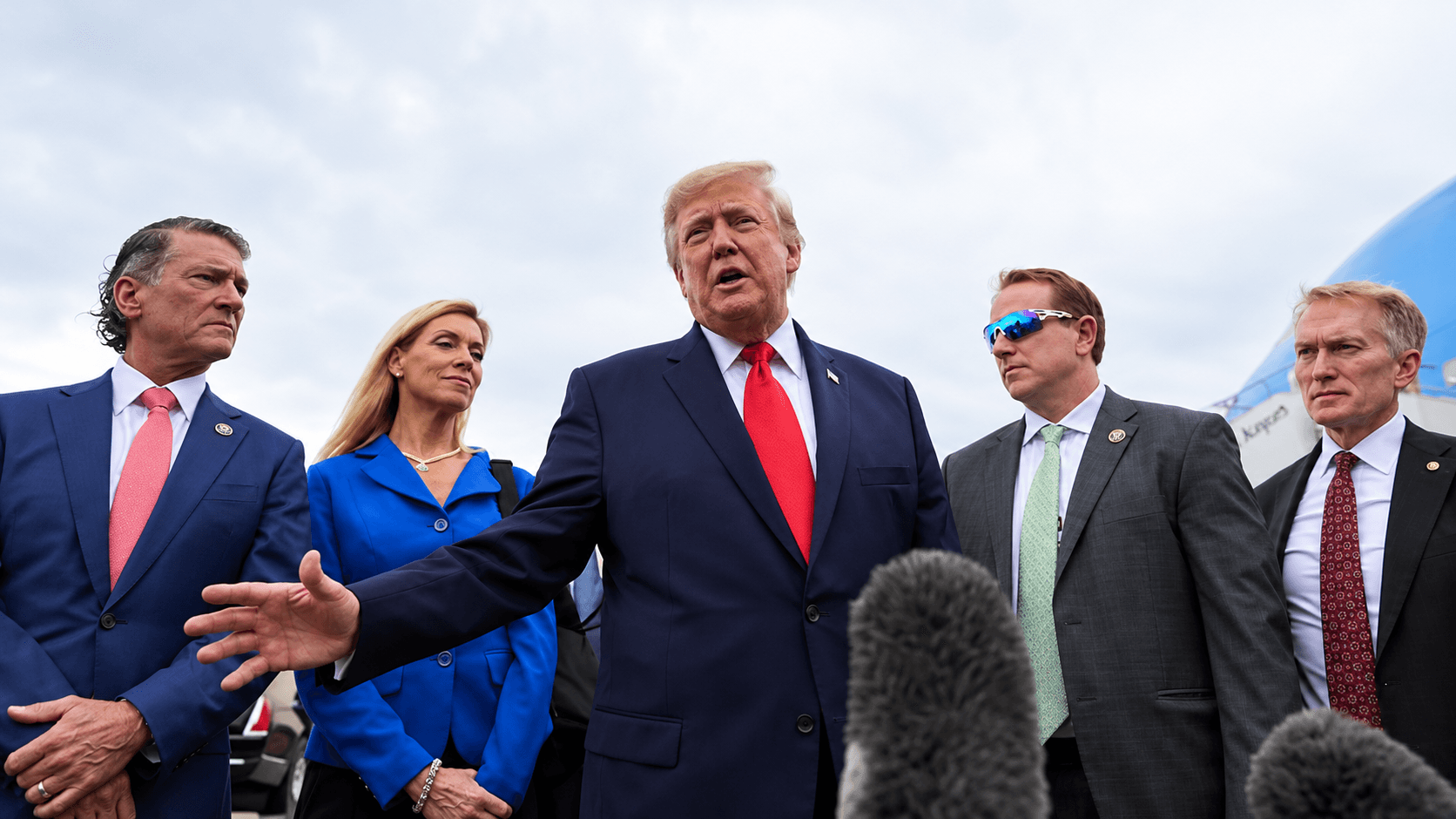
The countdown to America's midterm elections has entered a critical stretch.
President Donald Trump is hitting the campaign trail for a 32-day political push, starting with stops in Texas and Oklahoma as Republicans prepare for a tougher-than-expected battle to hold their congressional majorities.
The message from Trump is simple: Republicans need to show up and vote.
His broader strategy is just as clear. He wants the midterms to be seen as a choice between continuing his political movement and economic agenda or handing Democrats a chance to slow it down.
But there is a challenge.
Trump remains highly influential with the Republican base. At the same time, questions about the economy, prices and his broader approval numbers could create problems for candidates fighting in competitive races.
That makes the next 32 days about more than individual House and Senate contests. They will also test how effectively Trump can transfer his personal political strength to an election in which his own name is not on the ballot.
WHAT HAPPENED?
Trump opened his campaign push on October 1 with appearances in Denton, Texas, and Durant, Oklahoma.
The events marked the beginning of what Trump has described as a 32-day campaign effort leading up to the November 3 midterm elections.
He did not begin in the country's most competitive congressional districts. Instead, the opening stops were in heavily Republican territory.
The reason is straightforward: turnout.
Midterm elections often come down to which party can motivate its core supporters to actually cast their ballots. Trump is trying to make sure Republican voters do not become complacent.
His message to supporters was essentially to treat the election as if he were personally on the ballot.
The political argument is clear:
A vote for Republican candidates is a vote for Trump's agenda.
WHY TEXAS MATTERS
Texas is still firmly Republican, but it is no longer being treated as politically untouchable.
Several races have attracted more attention than expected, including the Senate contest between Republican Ken Paxton and Democrat James Talarico.
Trump has strongly backed Paxton and has already made multiple appearances in Texas on his behalf.
That matters because a Republican Senate loss in Texas would be more than just another difficult race. It could complicate the party's effort to maintain its Senate majority and send a major political shock through one of the country's most reliably Republican states.
Trump's decision to spend significant time in Texas suggests that Republicans are taking no race for granted.
OKLAHOMA SENDS ANOTHER MESSAGE
After Texas, Trump travelled to Oklahoma, another state where Republicans have a strong political advantage.
On the surface, it may seem like an unusual place to begin a national midterm campaign.
But the choice reinforces the campaign's immediate priority:
Turnout.
Trump remains a powerful force among voters who strongly identify with his political movement. The challenge is getting those same voters to turn out when Trump himself is not appearing on the ballot.
His solution is to make Republican candidates part of the broader Trump movement.
That means candidates are being asked to sell not only their own policies, but also the continuation of the president's political programme.
THE ECONOMY IS THE BIGGEST TEST
The biggest threat to Republicans may not come from Democratic campaign speeches.
It may come from household budgets.
Fuel prices, food costs and inflation are already major political concerns, particularly among rural and working-class voters who have strongly supported Trump.
Fuel prices can be especially sensitive.
Truckers, farmers, manufacturers and commuters all feel the impact when gasoline and diesel become more expensive.
Trump has defended his economic record, arguing that his administration is producing results that voters have not fully recognized.
But voters experience the economy differently from politicians.
They see it in grocery bills, fuel receipts, rent payments and monthly household expenses.
If voters feel that everyday life is becoming more expensive, campaign messaging may have a difficult time changing that perception.
TRUMP'S POLITICAL CALCULATION
Trump's decision to campaign personally across the country reflects a larger political calculation.
He wants to remain the central figure in Republican politics.
That makes the midterms about more than Republican candidates. They are also a test of whether Trump's political brand can still mobilize voters two years after his return to the White House.
There are obvious advantages.
Trump can draw large crowds, dominate media coverage and energize voters who might otherwise pay little attention to congressional elections.
He can also give lesser-known candidates direct access to his political base.
But the strategy comes with risks.
If a Republican candidate loses after receiving significant support from Trump, the result can quickly be interpreted as a judgment on Trump's political influence.
That is why Republicans will be watching not only where Trump campaigns, but also what happens after he leaves.
THE GOP HAS A TURNOUT PROBLEM
Midterm elections are traditionally difficult for the party occupying the White House.
Presidential supporters can be less motivated when their preferred candidate is not personally on the ballot.
Trump's response is to make the election about his presidency anyway.
He is asking voters to view congressional races as part of a larger fight over his political agenda.
The goal is to prevent Republican voters from staying home.
Control of Congress matters enormously to the White House. It can determine whether major legislation moves forward, whether appointments are approved and how much of a president's agenda can actually become law.
That makes the midterms far more consequential than a collection of individual House and Senate races.
BUT SOME REPUBLICANS ARE NERVOUS
Trump's influence within the Republican Party is difficult to dispute.
The more complicated question is how much that influence can help candidates in closely contested districts.
A Reuters review published this week found that two-thirds of Republican candidates in competitive House and Senate races had broken with Trump on at least one issue, highlighting the difficult political calculations facing some candidates.
The dilemma is obvious.
Trump can bring Republican voters to the polls.
But in districts where independents and moderate voters could decide the result, a close association with the president can also carry a political cost.
Candidates therefore have to balance two competing questions:
Can Trump bring enough Republican voters to the polls?
And:
Could his presence push away enough swing voters to cancel out that advantage?
There may be no single answer. The calculation could look very different from one state to another.
DEMOCRATS SEE AN OPENING
Democrats are entering the midterm campaign believing that economic frustration and dissatisfaction with the administration could give them opportunities across the country.
The party has expanded its target map to include districts that strongly supported Trump in the 2024 presidential election.
That does not mean Democrats are guaranteed victories.
It does, however, show that the party believes the political battlefield could be wider than originally expected.
The House is especially important.
Republicans hold only a narrow majority, meaning Democrats would not need a sweeping national victory to change control of the chamber.
A relatively small number of Republican losses could be enough.
THE IRAN WAR IS ENTERING THE CAMPAIGN
Foreign policy is also beginning to play a role in the election debate.
The ongoing conflict involving Iran is increasingly connected to domestic political arguments, particularly because of its potential impact on energy prices and concerns about U.S. military involvement.
Republicans argue that Trump's approach is necessary to protect American interests and national security.
Democrats are focusing on the costs and consequences of the conflict as they challenge the administration.
For voters, however, foreign policy can become much more immediate when it affects the price of gasoline or diesel.
That gives the Iran conflict a direct link to the economy — and potentially to the election.
THE BATTLE FOR CONGRESS
The House and Senate remain the ultimate prizes.
Republicans entered the midterm cycle with narrow congressional majorities, leaving Democrats within striking distance.
In the House, only a handful of competitive races could determine which party controls Washington.
The Senate presents a different challenge because individual states can have an outsized impact on the balance of power.
Republicans are defending vulnerable seats while also looking for opportunities to strengthen their position.
As Election Day gets closer, Trump's campaign schedule is expected to increasingly focus on competitive states and races.
That will reveal whether his campaign is mainly about energizing the Republican base in safe territory or directly fighting for the seats that could decide control of Congress.
THE HUMAN SIDE OF THE MIDTERMS
Behind all the campaign rallies, advertisements and political strategy are voters making decisions about everyday life.
Can they afford groceries?
Can they afford gasoline?
Are wages keeping pace with prices?
Is healthcare becoming more affordable?
Are jobs available?
Does the country feel safer?
Those questions may ultimately matter more than any campaign slogan.
Trump can fill arenas. Democrats can raise large sums of money. Campaign consultants can produce millions of advertisements.
But voters will still make their decisions based largely on how they believe the country is doing.
FACT CHECK METER
FACT METER: 97%
STATUS: DEVELOPING
CONFIRMED
Trump launched a 32-day campaign blitz ahead of the November 3 midterm elections.
His opening campaign stops included Texas and Oklahoma.
Trump is strongly backing Republican Senate candidate Ken Paxton in Texas.
Trump and Vice President JD Vance are campaigning to increase Republican turnout and support for GOP candidates.
Republicans face competitive races in states that have traditionally been considered safe territory.
Democrats are targeting a broader group of House districts as they attempt to regain control of Congress.
IMPORTANT DISTINCTION
Trump's campaign appearances can influence turnout, media attention and voter enthusiasm, but they do not guarantee victories for Republican candidates.
Polling, turnout, local candidates, economic conditions and individual state races will ultimately determine the results.
AWX VERDICT
The midterms are becoming a test of Trump's political reach beyond the White House.
The president can energize the Republican base.
The bigger question is whether that energy will be enough to protect vulnerable seats without pushing away independent and swing voters.
AWX FOCUS
Three battlegrounds could define Trump's 32-day campaign:
THE ECONOMY
Fuel, food and household costs could become some of the election's most important issues.
TURNOUT
Republicans need Trump's supporters to vote even though Trump himself is not on the ballot.
SWING VOTERS
Trump's strongest supporters are already largely committed.
The bigger challenge is persuading independents and moderate voters without weakening enthusiasm among the Republican base.
WHAT TO WATCH NEXT
1. TRUMP'S CAMPAIGN MAP
Will Trump remain concentrated in Republican strongholds, or will he move aggressively into competitive districts?
2. TEXAS
The Paxton-Talarico Senate race could become an important test of Trump's influence.
3. HOUSE RACES
With the Republican majority extremely narrow, even a small number of Democratic gains could change control of the House.
4. FUEL PRICES
Higher gasoline and diesel prices could become a significant political liability for Republicans.
5. TRUMP'S APPROVAL NUMBERS
Any further decline could make it harder for Republican candidates to fully embrace the president in competitive districts.
6. DEMOCRATIC TURNOUT
Democrats will need to turn voter dissatisfaction into actual turnout rather than relying on favourable polling alone.
THE AWX BOTTOM LINE
Trump has started the clock.
Thirty-two days.
Dozens of rallies.
Millions of voters.
And one enormous political question:
Can Donald Trump turn his personal popularity among Republican voters into enough votes to protect his party's control of Congress?
Republicans are betting that he can.
Democrats are betting that economic concerns, political controversies and weaker support among some voters will make that much harder.
The opening rallies in Texas and Oklahoma were more than campaign events.
They were the first test of a strategy built around one central idea:
Make the midterms about Trump.
Now voters will decide whether that strategy works.
ATTLAS WIRE | AWX WORLD NEWS
Real Stories. Lasting Impact.


Comments
No comments yet.