

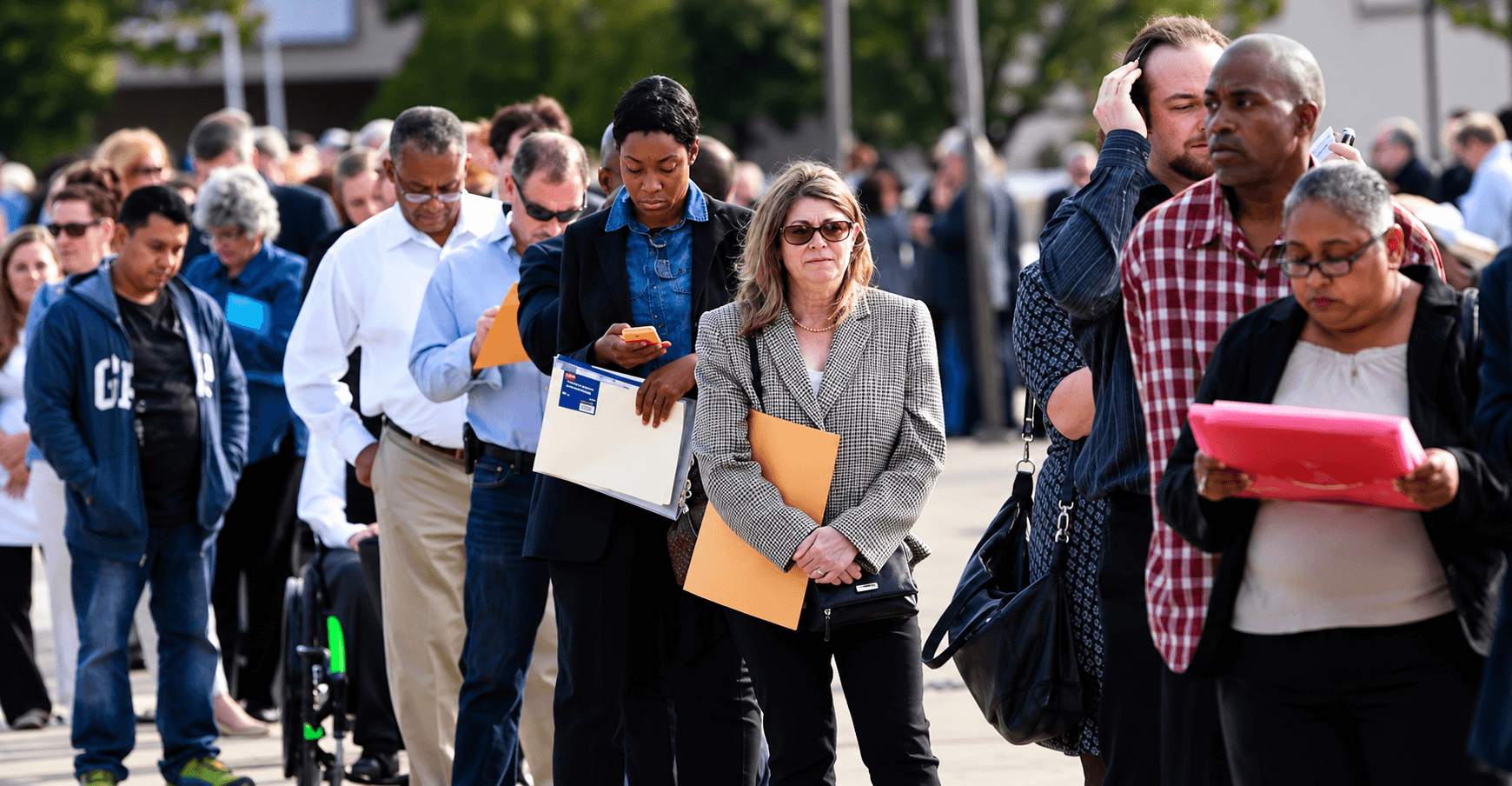
The U.S. labor market is showing more resilience than some recent economic signals might suggest.
New applications for unemployment benefits fell to 197,000 in the latest weekly report, down 1,000 from the previous week's revised figure.
The four-week average also slipped to 200,000, while continuing claims fell to about 1.70 million.
Taken together, the numbers suggest that companies are still reluctant to make large-scale layoffs.
That is significant at a time when businesses are dealing with higher energy costs, inflation concerns, expensive borrowing and increasingly cautious hiring.
The labor market is clearly cooling.
But so far, it is holding up.
For the Federal Reserve, that creates another complicated piece of the puzzle as policymakers weigh a softer hiring environment against continued inflation risks.
WHAT HAPPENED?
The Labor Department reported that 197,000 Americans filed new unemployment claims during the week ending September 26.
The figure was:
1,000 below the previous week's revised 198,000
Below economists' expectations of roughly 200,000
Close to some of the lowest levels seen in decades
The four-week moving average, which helps smooth out week-to-week volatility, fell by 2,500 to 200,000.
Continuing claims also declined, falling by 11,000 to 1.701 million for the week ending September 19.
The broader message is fairly straightforward:
Businesses are still not cutting jobs aggressively.
A LABOR MARKET THAT HAS NOT BROKEN
The latest claims figures stand out because they come against a backdrop of growing concern about the U.S. economy.
Hiring has slowed considerably from the post-pandemic surge.
Businesses are being more careful about expansion, while consumers continue to feel the pressure of higher prices.
Yet widespread layoffs have not materialized.
Reuters reported that the latest claims reading was close to a 57-year low, while announced layoffs by U.S.-based employers fell 18% in September to 43,281.
That combination has created what economists often describe as a "low-hire, low-fire" labor market.
Companies are not rushing to add employees.
At the same time, they appear unwilling to let large numbers of existing workers go.
That can keep the labor market relatively stable, but it creates a very different experience for people looking for their first job or trying to move into a new one.
WHY COMPANIES ARE HOLDING ONTO WORKERS
Part of the explanation goes back to the labor shortages that followed the pandemic.
Many businesses spent years struggling to find enough workers. Employers that cut too deeply now may have to compete for talent all over again if demand picks up.
For that reason, some companies may prefer to keep their existing employees even while putting new hiring on hold.
There is also still enough strength in parts of the corporate sector to absorb higher costs without immediately resorting to major layoffs.
But businesses are not operating without pressure.
Higher energy and material costs are squeezing margins, and if those expenses remain elevated for an extended period, companies could eventually be forced to reduce staff.
So far, however, the data do not show that shift happening on a broad scale.
ENERGY COSTS ARE THE BIG WILDCARD
The labor-market numbers arrive at a particularly uncertain moment for the global economy.
The conflict involving Iran has pushed energy prices higher and added another layer of uncertainty for businesses that rely heavily on fuel and transportation.
Diesel costs are especially important for truckers, logistics companies, manufacturers, farmers and retailers.
If energy prices remain high, businesses have several options — and none are particularly comfortable.
They could raise prices, reduce investment, cut working hours or eventually reduce headcount.
So far, unemployment claims show little evidence of widespread layoffs.
The bigger question is whether that remains true if elevated energy costs continue for months.
THE OTHER SIDE OF THE STORY: HIRING IS STILL WEAK
Low layoffs do not necessarily mean the labor market is healthy across the board.
There is a major difference between keeping a job and finding one.
The latest claims data suggest that existing workers remain relatively protected.
For job seekers, the picture is less encouraging.
The Conference Board reported that the share of consumers describing jobs as "plentiful" fell in September to its lowest level since February 2021. At the same time, the share saying jobs were "hard to get" reached its highest level in more than five and a half years.
That is an important warning sign.
If companies continue to avoid layoffs while also slowing hiring, unemployment may remain relatively stable for some time.
But workers entering the job market could face fewer opportunities.
Over time, that can weigh on wage growth, confidence and consumer spending.
THE JOBS REPORT TELLS A DIFFERENT PART OF THE STORY
Weekly unemployment claims should not be confused with the monthly employment report.
The two reports measure different aspects of the labor market and cover different periods.
The latest claims data cover the week ending September 26, while the monthly employment report has its own reference period.
So the weekly claims figures cannot be used on their own to determine how many jobs were added in September.
What they do show is something more immediate:
There was no obvious surge in layoffs at the end of September.
That is an important sign of resilience, even if overall job creation has weakened.
THE FED HAS A COMPLICATED SIGNAL
For the Federal Reserve, the latest numbers offer both reassurance and uncertainty.
A resilient labor market means there is less immediate pressure to cut interest rates because of rapidly rising unemployment.
But slowing hiring suggests that economic momentum is fading.
Meanwhile, inflation and energy prices remain potential sources of pressure.
That leaves policymakers balancing three competing concerns:
Employment stability.
Slower hiring.
Persistent inflation risks.
If layoffs begin rising sharply, pressure on the Fed to ease monetary policy could increase.
If employment remains relatively strong while inflation stays elevated, policymakers may have more reason to keep rates higher for longer.
The latest claims report gives the Fed some breathing room.
It does not, however, resolve the broader policy debate.
CONSUMERS ARE STILL HELPING SUPPORT THE ECONOMY
Consumer spending remains another important part of the picture.
Americans continue to spend despite widespread frustration over higher prices.
That matters because businesses are more willing to maintain staffing when they believe customers will keep buying their products and services.
As long as demand remains reasonably solid, employers have a reason to keep their current workforce intact.
But that support has limits.
If higher gasoline, food, housing and borrowing costs eventually force households to cut spending, businesses could respond with weaker hiring and, potentially, layoffs.
That is why the labor market cannot be viewed separately from the health of the consumer economy.
THE "LOW-HIRE, LOW-FIRE" ECONOMY
The U.S. labor market increasingly looks like it is stuck in a holding pattern.
Businesses are asking whether they need more workers.
For many, the answer is not yet.
But they are also asking whether they can afford to lose the workers they already have.
Again, for many, the answer is no.
The result is an economy where layoffs remain relatively low but hiring is also limited.
That is good news for people who already have secure jobs.
For recent graduates, unemployed workers and people looking to change careers, it can be a very different story.
It also means the headline unemployment rate may not fully capture the difficulties facing people trying to enter or move through the labor market.
WHY THIS MATTERS FOR AMERICA
A stable labor market supports consumer confidence.
People who remain employed are more likely to keep paying mortgages, rent, car loans and credit-card bills. They are also more likely to eat out, travel, shop and make larger purchases.
That spending supports businesses.
And when businesses have steady revenue, they have more reason to retain workers.
It creates a cycle that can help keep the economy moving.
But the reverse is also true.
If layoffs begin rising:
Jobs fall → consumer spending weakens → business revenue falls → hiring slows further → unemployment rises.
The latest claims data suggest the U.S. economy has not entered that cycle.
At least, not yet.
WHY WALL STREET IS WATCHING
Financial markets are paying close attention to employment data because the labor market has a direct connection to interest-rate expectations.
A labor market that remains too strong could keep inflation elevated and make the Federal Reserve less willing to cut rates.
A sharp deterioration, on the other hand, could increase recession fears.
Investors are therefore looking for something in between.
They want:
Enough jobs to support economic growth.
But not so much demand that inflation accelerates again.
The latest claims figures are relatively close to that middle ground.
Layoffs remain low, suggesting the economy is still stable.
At the same time, cautious hiring suggests businesses are not seeing enough demand to expand aggressively.
THE GLOBAL EFFECT
What happens in the U.S. labor market matters well beyond American borders.
A resilient U.S. economy supports global demand and influences the Federal Reserve's interest-rate decisions.
Those decisions can affect the dollar, Treasury yields and international capital flows.
Emerging markets, including India, can feel the impact through currency movements, foreign investment and borrowing costs.
A relatively stable U.S. labor market could therefore provide some support to the global economy — provided inflation does not force the Fed to maintain restrictive monetary policy for longer.
FACT CHECK METER
FACT METER: 98%
STATUS: DEVELOPING
CONFIRMED
Initial U.S. unemployment claims fell to 197,000 for the week ending September 26.
The previous week's figure was revised to 198,000.
The four-week moving average fell to 200,000.
Continuing claims declined by 11,000 to 1.701 million for the week ending September 19.
Announced U.S. employer layoffs fell 18% in September to 43,281, according to Challenger, Gray & Christmas data cited by Reuters.
Weekly claims remain close to historically low levels.
IMPORTANT DISTINCTION
Falling jobless claims do not mean the U.S. labor market is booming.
Hiring remains cautious, while consumer surveys suggest Americans are becoming increasingly concerned about job availability.
The current data point more toward labor-market stability than rapid employment growth.
AWX VERDICT
America's labor market is cooling — but it is not cracking.
The biggest strength is the absence of a major wave of layoffs.
The biggest weakness is that businesses are becoming less willing to add new workers.
AWX FOCUS
Three numbers deserve particular attention:
197,000
Weekly initial unemployment claims.
The figure remains exceptionally low by historical standards.
200,000
The four-week average.
This gives a clearer view of the underlying trend by reducing the impact of weekly volatility.
1.701 MILLION
Continuing claims.
A sustained increase here would suggest unemployed workers are having a harder time finding new jobs.
WHAT TO WATCH NEXT
1. NEW JOBLESS CLAIMS
Another sustained increase could signal that companies are beginning to respond more aggressively to higher costs.
2. CONTINUING CLAIMS
This could prove even more important because it shows whether people who have lost jobs are finding new work.
3. MONTHLY PAYROLLS
Upcoming employment reports will provide a broader picture of whether the low-layoff environment is translating into continued job creation.
4. ENERGY PRICES
Persistently high oil and diesel prices could put increasing pressure on corporate margins.
5. CONSUMER SPENDING
A significant pullback by households could make businesses even more cautious about hiring.
6. FED POLICY
The central bank will continue weighing labor-market resilience against inflation risks.
THE AWX BOTTOM LINE
The U.S. labor market is sending a message that Wall Street will be watching closely:
Workers are staying employed.
New unemployment claims remain near historically low levels.
Layoffs are limited.
Continuing claims are falling.
But beneath that resilience is a more cautious economy.
Companies are no longer hiring at the pace seen during the post-pandemic boom. Workers are increasingly saying that jobs are harder to find, while businesses face higher energy and material costs.
That makes the current labor market stable, but not invulnerable.
There may be little room for another major economic shock before companies are forced to make harder decisions.
For now, though, the main takeaway is positive:
America's job market is bending under economic pressure — but it is not breaking.
ATTLAS WIRE | AWX WORLD NEWS
Real Stories. Lasting Impact.




Comments
No comments yet.