

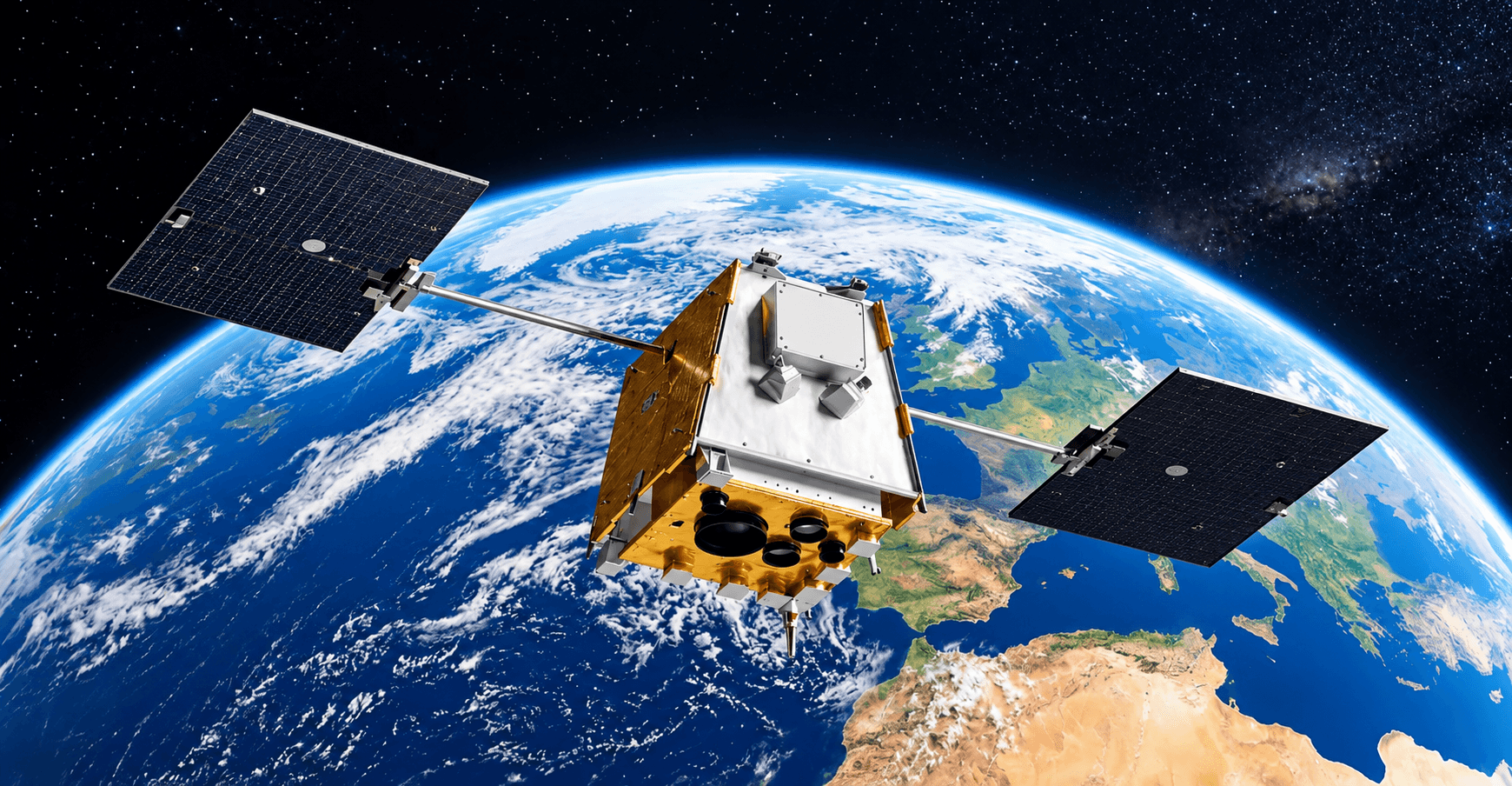
The United Arab Emirates has taken another step towards building a homegrown commercial space industry. Altair-1, an AI-enabled Earth-observation satellite developed by Abu Dhabi-based Orbitworks, has successfully reached orbit, marking an important moment for the country’s ambitions in satellite manufacturing and space technology.
The satellite launched on 1 October 2026 aboard SpaceX’s Transporter-18 rideshare mission from Vandenberg Space Force Base in California. After deployment, Altair-1 established contact with Earth and entered commissioning, the stage when engineers test its systems and prepare it for operational use. Orbitworks announced the milestone publicly on 2 October.
Altair-1 is the first spacecraft in a planned network of ten AI-enabled Earth-observation satellites. The constellation is designed to collect information about activity on Earth and process some of that data in space, potentially helping customers receive useful intelligence faster.
For the UAE, the mission represents more than a successful launch. It reflects a broader effort to build local engineering expertise, attract commercial customers and establish a space industry capable of competing in international markets.
The immediate priority is to complete commissioning and demonstrate that the satellite can perform reliably. After that, attention will turn to building out the remaining constellation.
WHAT HAPPENED?
Altair-1 was designed, assembled and tested at Orbitworks’ satellite manufacturing facility in Abu Dhabi before being shipped to the United States for launch.
The spacecraft arrived in California in August and flew as part of SpaceX’s Transporter-18 mission, which carried multiple payloads into orbit. Following deployment, Altair-1 established communications with Earth and began its initial system checks.
The achievement highlights a growing role for the UAE in commercial space manufacturing. Rather than relying entirely on spacecraft built abroad, the country is developing the ability to design, assemble and test commercial satellites at home.
Orbitworks is a joint venture between Marlan Space, a UAE-based company under International Holding Company (IHC), and Loft Orbital, a space infrastructure company with experience in satellite integration and operations.
The project also fits into the UAE’s wider push to develop advanced industries, encourage private-sector investment and diversify its economy.
However, getting a satellite into orbit is only the first stage. Engineers must still verify its systems and establish how well it performs before its full operational capabilities can be assessed.
WHAT MAKES ALTAIR-1 DIFFERENT?
Artificial intelligence that works in orbit
Most traditional Earth-observation satellites collect images and measurements before sending the data back to Earth for processing. Ground-based systems then analyse that information to identify important changes or events.
Altair is designed to handle more of this work directly in orbit.
Its onboard computing systems are intended to analyse data closer to the point of collection. This could reduce the amount of raw information that needs to be transmitted to Earth and help shorten the time between observing an event and producing useful intelligence.
The approach is known as edge computing. It can be particularly valuable in space, where communications capacity is limited and some situations require a quick response.
For example, AI-assisted analysis could help identify unusual heat patterns associated with a possible wildfire. Satellite observations could also support monitoring of ports, infrastructure and maritime routes.
These are potential applications, not proof that every capability is already working in operational conditions. Actual performance will depend on the satellite’s sensors, software, communications systems and commissioning results.
Five types of sensing in one programme
The Altair programme is designed to combine five sensing capabilities, giving users different ways to examine activity on Earth.
Optical imaging: Captures visual information about land, buildings, infrastructure and other features.
Shortwave infrared: Helps identify certain materials and conditions that may not be obvious in ordinary visible-light images.
Thermal sensing: Detects heat patterns that could support fire monitoring and the assessment of temperature-related changes.
Hyperspectral sensing: Examines narrow bands of light to help distinguish materials and assess environmental conditions.
Radio-frequency sensing: Detects or analyses radio-frequency activity that may be useful for monitoring and situational awareness.
Together, these capabilities could provide a more detailed picture than a single type of sensor can deliver on its own. Their real-world value will depend on how effectively the information is combined and interpreted.
Orbitworks says its goal is to provide customers with analysis-ready intelligence rather than simply delivering raw satellite imagery.
THE NEXT TARGET: A TEN-SATELLITE CONSTELLATION
Altair-1 is the first step in a much larger plan.
Orbitworks intends to launch nine additional satellites through 2027. Once the full constellation is deployed and operating as planned, it is designed to revisit any point on Earth roughly every four hours.
More frequent observations could make the network useful for tracking situations that change quickly. A single satellite can observe a location only during certain passes, while a constellation can increase the frequency of observations and improve the chances of detecting new developments.
The planned network could support several areas:
Disaster response: Satellite observations could help authorities assess wildfires, flooding and damage after major disasters.
Maritime monitoring: Data could support the monitoring of vessel movements and activity around ports and shipping routes.
Environmental protection: Repeated observations could help track changes in vegetation, land use and environmental conditions.
Agriculture and food security: Satellite information could assist with crop monitoring and assessments of changing land conditions.
Infrastructure management: Operators could use repeated observations to identify changes at selected sites and determine where further inspection may be needed.
National security: Earth-observation data could contribute to situational awareness and intelligence gathering, subject to applicable laws and the system’s actual capabilities.
The four-hour revisit interval remains a goal for the complete constellation. It does not mean Altair-1, operating alone, can currently provide that frequency of coverage.
WHY THE MISSION MATTERS FOR THE UAE
The UAE has spent years investing in space exploration, scientific research and advanced technology as part of its economic diversification strategy.
Altair-1 adds a commercial manufacturing component to those efforts. Producing satellites locally can help develop specialist engineering skills, create opportunities for technology suppliers and support businesses working in electronics, software and data analysis.
The project also supports the broader ambitions of the UAE National Space Strategy 2031, which seeks to strengthen the country's position in the international space sector.
UAE officials have welcomed the launch as a sign of the country's growing ability to develop and manufacture advanced space technologies. The programme combines local industrial infrastructure with international expertise, potentially giving UAE-developed systems a route into overseas markets.
The commercial opportunity, however, will depend on more than technical progress.
A sustainable space business needs customers, repeat orders and services that can compete on reliability and cost. Successful launches are important, but companies must also demonstrate that their products solve real problems and deliver value over time.
Orbitworks is looking to turn Altair's technology into a commercial service that customers can access in different ways.
WHO COULD USE ALTAIR'S DATA?
Orbitworks says customers will be able to own an Altair satellite and its data or access the system through service arrangements, including tasking and licensing.
The company has identified several anchor customers and end users, including French government entities, the Abu Dhabi Maritime Academy and the Abu Dhabi Fund for Development.
It has also reported discussions with prospective customers in North America, Africa and Asia. Those conversations suggest potential interest beyond the UAE, although discussions should not be confused with signed contracts unless agreements are formally confirmed.
The service model could appeal to organisations that need specialised satellite intelligence but do not want to bear the cost and complexity of building and operating their own spacecraft.
Governments, researchers and commercial operators could use timely satellite information to support planning, monitoring and decision-making. The usefulness of that information will depend on its accuracy, resolution, frequency and delivery speed, as well as the price customers pay to access it.
For Orbitworks, converting interest into long-term commercial relationships will be an important test of the programme's viability.
THE FACILITY BEHIND THE SATELLITE
Altair-1 was built at Orbitworks' manufacturing facility in Khalifa Economic Zones Abu Dhabi (KEZAD), which opened in November 2025.
The 50,000-square-foot site includes a 15,000-square-foot cleanroom and specialist equipment for satellite testing. Its facilities include electromagnetic-interference chambers, thermal-vacuum systems and vibration-testing equipment.
Orbitworks says the site is designed to produce up to 50 satellites a year when operating at full capacity. That figure represents its stated production capability, not the number of satellites it is currently manufacturing annually.
If demand grows and the company expands production, the facility could help establish a repeatable manufacturing process for future missions. Producing more satellites can help improve engineering procedures, build technical expertise and potentially reduce production time and costs.
The benefits could extend to component manufacturers, software developers, testing providers and other specialist businesses supporting the space industry.
Still, available production capacity does not automatically translate into orders. Scaling up will depend on customer demand, manufacturing quality and the ability to meet the requirements of different missions.
THE CHALLENGES AHEAD
The successful launch is an important milestone, but several hurdles remain before Altair can establish itself as a dependable commercial service.
Commissioning and reliability: Altair-1 must complete its system checks before its operational performance can be properly evaluated. Its hardware and software must also prove reliable in the harsh conditions of space.
Deploying the full constellation: The remaining nine satellites must be manufactured, tested, launched and integrated into the network. Delays could push back the timeline for achieving the planned coverage.
Winning paying customers: Orbitworks will need to turn early interest into sustained commercial contracts and show that its services offer a clear advantage over competing providers.
Data quality and speed: AI-generated intelligence is only useful if the underlying observations are accurate and the analysis is reliable. Customers will also need information quickly enough to act on it.
Security and responsible use: Satellite imagery and radio-frequency data can raise questions about privacy, national security and access to sensitive information. Appropriate safeguards and compliance procedures will be important.
Global competition: Established Earth-observation companies and newer AI-focused satellite businesses are competing for customers. Altair will need to demonstrate its value through performance, pricing, coverage and reliability.
The launch gives Orbitworks a strong starting point. The next phase will determine whether the company can turn that achievement into a sustainable business.
FACT CHECK METER
FACT METER: KEY MILESTONES REPORTED
STATUS: LAUNCH CONFIRMED — COMMISSIONING UNDER WAY
CONFIRMED: Altair-1 launched aboard SpaceX's Transporter-18 rideshare mission on 1 October 2026. Following deployment, the satellite established communications with Earth and entered commissioning. Orbitworks says the spacecraft was built and tested at its Abu Dhabi facility.
CONFIRMED: Altair-1 is the first satellite in a planned ten-spacecraft, AI-enabled Earth-observation constellation. The remaining nine satellites are planned for deployment through 2027.
IMPORTANT DISTINCTION: Successful deployment and signal acquisition do not establish that all systems have completed commissioning or that every planned AI application has been demonstrated in operational conditions.
IMPORTANT DISTINCTION: The approximately four-hour revisit interval is a target for the complete constellation, not a confirmed capability of Altair-1 operating alone.
AWX VERDICT: Altair-1 marks a meaningful step forward for the UAE's commercial space ambitions. Its long-term success will depend on reliable operations, the deployment of the wider constellation and the ability to turn its technology into services customers are willing to pay for.
WHAT TO WATCH NEXT
1. Commissioning results: Updates on the satellite's sensors, onboard computing and communications systems will help establish whether it is ready for operational service.
2. The remaining nine satellites: Progress through 2027 will show whether Orbitworks is on track to deliver the planned constellation and its improved observation frequency.
3. New customer agreements: Signed contracts and evidence of operational use will help demonstrate whether commercial demand is growing.
4. AI performance in orbit: Evidence of accurate detection, dependable processing and faster delivery will be essential to proving the system's practical value.
5. Manufacturing growth: Additional orders and increased production would indicate whether Orbitworks can build a sustainable satellite manufacturing business.
6. International partnerships: Cooperation with foreign technology companies, research organisations and government customers could help expand the UAE's reach in the global space market.
THE AWX BOTTOM LINE
Altair-1 has put a UAE-built commercial satellite into orbit, giving Abu Dhabi's growing space industry an important achievement to build on.
The spacecraft is designed to do more than capture images. By combining multiple sensing capabilities with onboard computing and AI-assisted analysis, the programme aims to turn satellite observations into useful intelligence more quickly.
But the launch is only the beginning. Altair-1 must complete commissioning, the remaining satellites must follow and customers must see consistent value in the service.
If Orbitworks can deliver on those goals, the programme could strengthen the UAE's position in commercial satellite manufacturing and create opportunities for a new export-focused technology business.
For now, Altair-1 represents a shift from ambition to action: a locally developed commercial satellite is in orbit, and the next challenge is to prove what it can deliver.
ATTLAS WIRE | AWX WORLD NEWS
Real Stories. Lasting Impact.


Comments
No comments yet.