

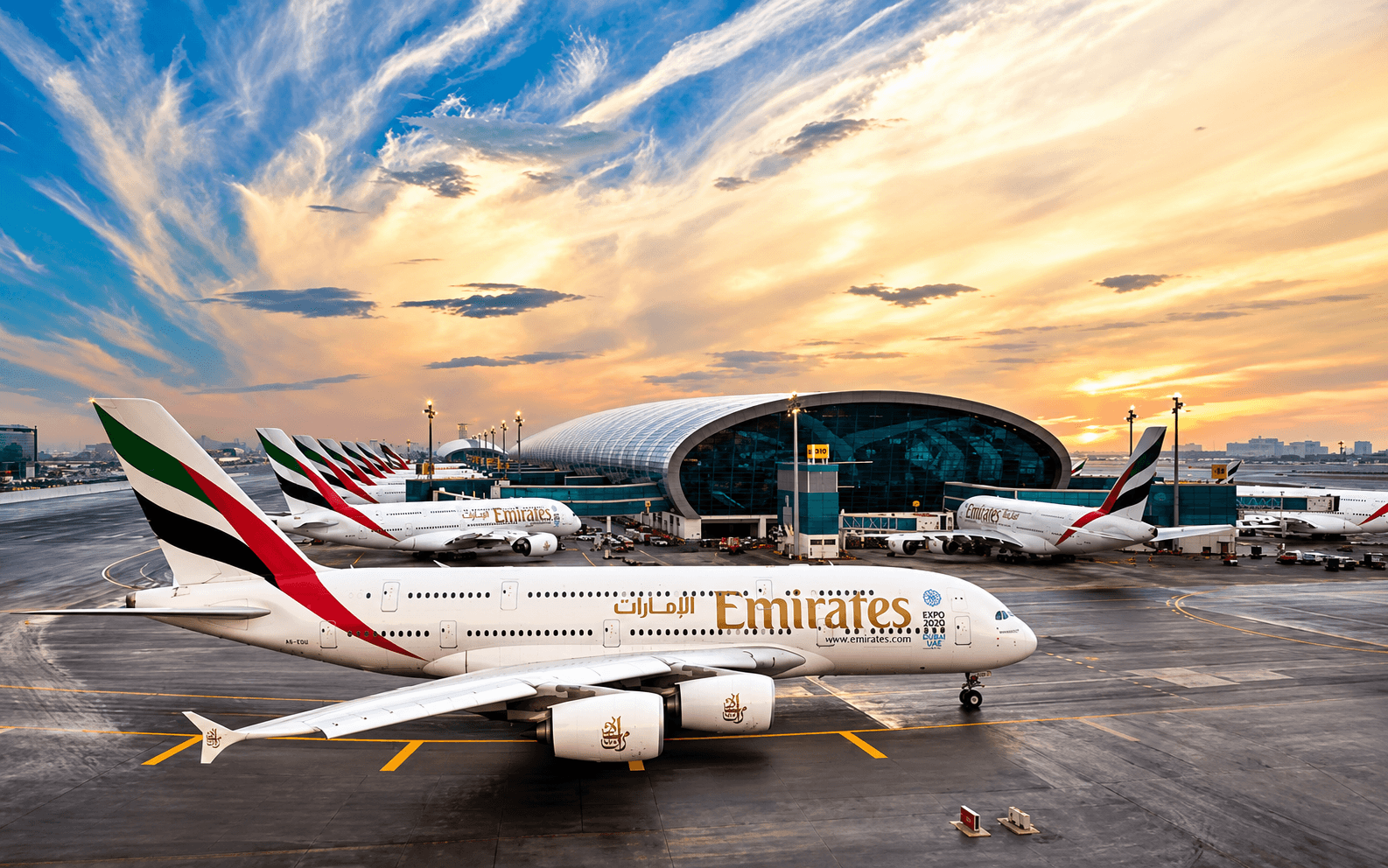
The UAE's aviation sector is facing another difficult stretch.
Airlines had started rebuilding their networks after months of disruption linked to the Iran war. Now, renewed regional tensions are forcing carriers to review routes again, delay some planned resumptions and take longer paths through the region.
Dubai International Airport and Abu Dhabi's Zayed International Airport remain open and operational, but the recovery is far from uniform.
Emirates, Etihad, flydubai and Air Arabia continue to operate parts of their networks, while several international carriers are keeping services suspended or running reduced schedules.
For airlines still flying through the region, avoiding sensitive airspace can mean longer routes, higher fuel bills and more complicated aircraft and crew planning.
The result is a new reality for Gulf aviation:
The Gulf is flying again — but it is not back to normal yet.
Recent schedule changes and cancellations at Dubai and Abu Dhabi show that airlines are still making decisions on a route-by-route basis. Carriers including Lufthansa, SWISS, British Airways and Singapore Airlines are taking different approaches to their UAE operations.
WHAT IS HAPPENING?
The UAE's major airports continue to handle international traffic despite an unsettled regional security environment.
But airline schedules remain subject to change.
At Dubai International Airport, recent disruptions have affected services operated by Emirates, flydubai and other carriers.
Abu Dhabi has also seen changes to some regional and international services.
The reasons vary.
Some changes are linked directly to security restrictions. Others reflect aircraft availability, airspace limitations, operational considerations or the economics of flying longer routes.
That distinction is important.
The UAE's aviation system has not shut down.
Instead, airlines are operating within a network where restrictions and security assessments can change quickly.
AIRLINES ARE TAKING DIFFERENT ROUTES
The biggest change is not simply the number of cancelled flights.
It is the way airlines are trying to keep routes operating.
Some carriers are avoiding Iranian and Iraqi airspace. Others are reducing frequencies or delaying their return to the UAE.
Several are reviewing planned resumptions before committing aircraft to the routes.
KLM, for example, continues to avoid Iranian, Iraqi and Israeli airspace, along with parts of the Arabian Gulf.
Turkish Airlines has resumed services to Dubai and Abu Dhabi while continuing to suspend flights to Tehran.
The different approaches underline how airlines are making their own risk assessments rather than following one regional timetable.
DUBAI REMAINS THE MAIN RECOVERY STORY
Dubai is showing some of the clearest signs of recovery.
Several international carriers are gradually returning as airlines prepare for the winter travel season.
Lufthansa plans to restart Munich–Dubai services on October 25 and Frankfurt–Dubai services on October 26.
SWISS is scheduled to resume Zurich–Dubai flights on October 27.
Eurowings plans to return to Dubai from November 1, while Austrian Airlines is scheduled to resume Vienna–Dubai operations in December.
Together, these services are expected to add as many as 36 weekly flights between Dubai and several major European cities.
That is an encouraging sign for Dubai.
But it does not mean the recovery is complete.
Several international carriers remain cautious about restoring their full schedules.
SOME CARRIERS ARE STILL WAITING
Singapore Airlines has pushed back its Dubai service resumption, while other international airlines have extended their suspensions.
British Airways is planning to resume Dubai services in November, initially operating one daily flight.
Its Abu Dhabi service is not expected to return until later.
Finnair has extended its suspension of Dubai and Abu Dhabi services into the winter period.
Air Canada has pushed its Dubai return into January 2027.
Virgin Atlantic has postponed its Dubai return even further.
The contrast is becoming increasingly clear.
UAE-based airlines are rebuilding relatively quickly.
Some foreign carriers are taking a more cautious approach.
Security concerns are part of the equation, but so are fleet deployment, fuel costs, insurance, crew availability and passenger demand.
THE ROUTE AROUND THE ROUTE
For airlines, avoiding risky airspace does not always mean cancelling a flight.
Sometimes, it simply means taking a longer route.
That comes with a price.
Longer flights require more fuel. They also increase flight times, reduce aircraft utilisation and can complicate crew planning.
In some cases, aircraft rotations that worked before the conflict no longer make commercial sense.
That has become particularly relevant for narrow-body aircraft.
Wizz Air recently delayed several planned Abu Dhabi routes until January 10, 2027, citing the continued closure of Iraqi airspace.
The airline said longer routings and technical refuelling stops for its Airbus A321neo aircraft would make the affected routes commercially unviable under current fuel prices.
That highlights how the problem has changed.
The question is no longer simply:
“Is the route safe?”
It is also:
“Does the route still make economic sense?”
FUEL COSTS ARE ADDING PRESSURE
Longer flight paths are coming at a difficult time for airlines.
Jet-fuel costs have risen amid the wider regional conflict and disruption across energy markets.
Every additional hour in the air means additional fuel consumption.
For airlines operating with tight margins, those extra costs can quickly turn a profitable route into a loss-making one.
The economics can deteriorate when:
Flight times increase.
Fuel prices rise.
Aircraft utilisation falls.
Crew costs increase.
Insurance premiums climb.
Passenger demand weakens.
That helps explain why some carriers would rather wait for conditions to improve than immediately restore suspended services.
FLYDUBAI FACES A DIFFERENT PROBLEM
Dubai-based flydubai is dealing with another issue.
The carrier suspended its Israel services following a serious cockpit incident aboard flight FZ1073.
The aircraft was travelling from Dubai to Tel Aviv when it diverted to Saudi Arabia after the incident.
An investigation is continuing.
Reuters reported that the incident has added another complication to the recovery of regional aviation following months of war-related disruption.
For flydubai, Israel remains an important regional market.
But the suspension illustrates how a single security incident can affect an airline's network even while broader operations are beginning to recover.
DUBAI AND ABU DHABI ARE NOT THE SAME STORY
The recovery is also playing out differently at the UAE's two main international hubs.
Dubai is currently seeing a stronger return from several international markets.
Abu Dhabi, meanwhile, is facing a slower recovery on some routes.
Wizz Air, for example, postponed six Abu Dhabi routes that had been scheduled to begin in late October.
The airline cited the latest European aviation-security assessment and continued restrictions on Iraqi airspace.
The affected routes include Krakow, Katowice, Sofia, Cluj, Larnaca and Budapest.
That matters for Abu Dhabi as it continues to build its position as an international connecting hub.
Every delayed route affects more than passenger numbers. It can also influence tourism, airport revenues and the wider aviation ecosystem.
THE WINTER SCHEDULE WILL BE CRITICAL
October and November could prove to be an important test for the UAE's aviation recovery.
The country typically enters one of its busiest travel periods as temperatures fall and international tourism picks up.
Airlines are therefore making decisions now about aircraft allocation, schedules and capacity for the winter season.
The planned return of Lufthansa, SWISS, Eurowings and Austrian Airlines to Dubai is a positive signal.
But the continued suspension of other carriers shows that confidence has not fully returned.
The winter schedule could become a dividing line:
Either more airlines return and schedules settle — or continued geopolitical uncertainty keeps the recovery fragmented.
PASSENGERS FACE A NEW KIND OF UNCERTAINTY
For travellers, the problem is no longer limited to outright cancellations.
A flight scheduled today could be changed tomorrow.
A route may return but operate at a lower frequency.
A carrier may resume a service but use a different flight path.
Connections that once took a few hours may require longer transit times.
Airlines are consequently advising passengers to check their flight status before travelling to the airport.
For connecting passengers, the uncertainty can be particularly difficult.
A delayed inbound flight can lead to a missed connection.
A cancelled regional service can force passengers to look for alternative hubs.
And when available capacity is limited, ticket prices can rise.
UAE'S BIG AVIATION ADVANTAGE
Despite the disruption, the UAE retains a major advantage:
Scale.
Dubai and Abu Dhabi are deeply connected to global aviation networks.
They have major airport infrastructure, large airline fleets, established international brands and enormous connecting markets.
That gives UAE-based carriers more flexibility than many foreign airlines.
Emirates, Etihad, flydubai and Air Arabia can adjust capacity across broad networks instead of relying on individual international routes.
The UAE's location between Europe, Asia and Africa also gives its aviation sector a strategic advantage.
Its major hubs are difficult to replace.
THE BIGGER REGIONAL PROBLEM
The UAE is not dealing with this situation alone.
Airlines across the Middle East are facing similar challenges.
Saudi Arabia, Qatar, Bahrain, Kuwait, Oman and other regional markets are all operating within the wider security environment.
When part of the region's airspace becomes unavailable, the effects can spread well beyond the original area of concern.
A Europe–Asia flight may have to avoid an entire corridor.
A Gulf–India service may need a different routing.
A regional flight may require an additional fuel stop.
The aviation map is effectively being redrawn in real time.
WHY THIS MATTERS
Aviation is one of the UAE's most important economic engines.
Dubai's tourism, business and logistics sectors depend heavily on reliable international connectivity.
Abu Dhabi is also strengthening its position as a global aviation and connecting hub.
If airlines continue delaying their returns, the impact could reach far beyond airport operations.
Hotels could see fewer international visitors.
Tour operators could face weaker demand.
Cargo schedules could become less predictable.
Business travellers could face longer journeys.
Airlines could also find themselves operating aircraft on less efficient rotations.
There is, however, a reason for optimism.
If security conditions stabilise, the UAE could recover quickly.
The return of several European carriers suggests that international airlines continue to see strong long-term value in the market.
FACT CHECK METER
FACT METER: 96%
STATUS: DEVELOPING
CONFIRMED
UAE airports remain operational despite continuing regional aviation disruption.
Emirates, Etihad, flydubai and Air Arabia continue operating portions of their networks.
Several international airlines remain suspended or are operating reduced schedules.
Lufthansa, SWISS, Eurowings and Austrian Airlines are scheduled to progressively restore Dubai services.
Wizz Air has postponed several Abu Dhabi routes until January 2027.
Airlines are avoiding or rerouting around parts of Middle Eastern airspace.
IMPORTANT DISTINCTION
The UAE aviation system is not closed.
The current situation is better described as a fragmented recovery under continuing security constraints.
Some routes are returning, while others remain suspended for weeks or months.
AWX VERDICT
UAE aviation is recovering, but airlines are still building their networks around risk.
The challenge is no longer simply reopening airports.
It is making those routes operationally reliable and commercially sustainable.
AWX FOCUS
The UAE has already shown that its aviation sector can withstand a major regional shock.
Now comes the more difficult stage:
Normalisation.
Restarting a route is one thing. Keeping it running reliably is another.
Airlines need predictable airspace.
They need manageable fuel costs.
They need crews and aircraft in the right places.
Most importantly, they need confidence that a route operating today will still be viable tomorrow.
That is why carriers are moving carefully.
Some are returning.
Some are waiting.
Others are reshaping their networks altogether.
The Gulf's aviation map is being rebuilt one route at a time.
WHAT TO WATCH NEXT
1. DUBAI WINTER CAPACITY
Will more international carriers restore services ahead of the peak travel season?
2. ABU DHABI ROUTES
Will Wizz Air and other carriers bring back postponed services?
3. AIRSPACE RESTRICTIONS
Will restrictions affecting Iraqi, Iranian and other regional airspace ease?
4. FUEL COSTS
Can airlines absorb the additional expense of longer routings?
5. FLYDUBAI–ISRAEL SERVICES
When will the Dubai–Tel Aviv route return?
6. INTERNATIONAL AIRLINES
Will carriers such as Singapore Airlines, Air Canada and British Airways bring forward their UAE returns?
7. SECURITY ASSESSMENTS
Will continued aviation-security warnings delay the broader recovery?
THE AWX BOTTOM LINE
The UAE's aviation sector is flying again — but it is flying differently.
Dubai and Abu Dhabi remain connected to the world as airlines gradually restore services and rebuild passenger capacity.
But the recovery is uneven.
Some carriers are adding flights.
Others are delaying their return.
Some are avoiding sensitive airspace.
Others are accepting longer routes, higher fuel consumption and more complicated operations.
For the UAE, the challenge is no longer simply getting aircraft back into the sky.
It is rebuilding a dependable global network in a region where the security picture can change overnight.
The coming winter will be critical.
If airspace conditions improve, Dubai and Abu Dhabi could accelerate their recovery.
If tensions rise again, airlines could pull back once more.
**The Gulf is open for aviation.
But every route is still being tested.**
ATTLAS WIRE | AWX WORLD NEWS
Real Stories. Lasting Impact.


Comments
No comments yet.