

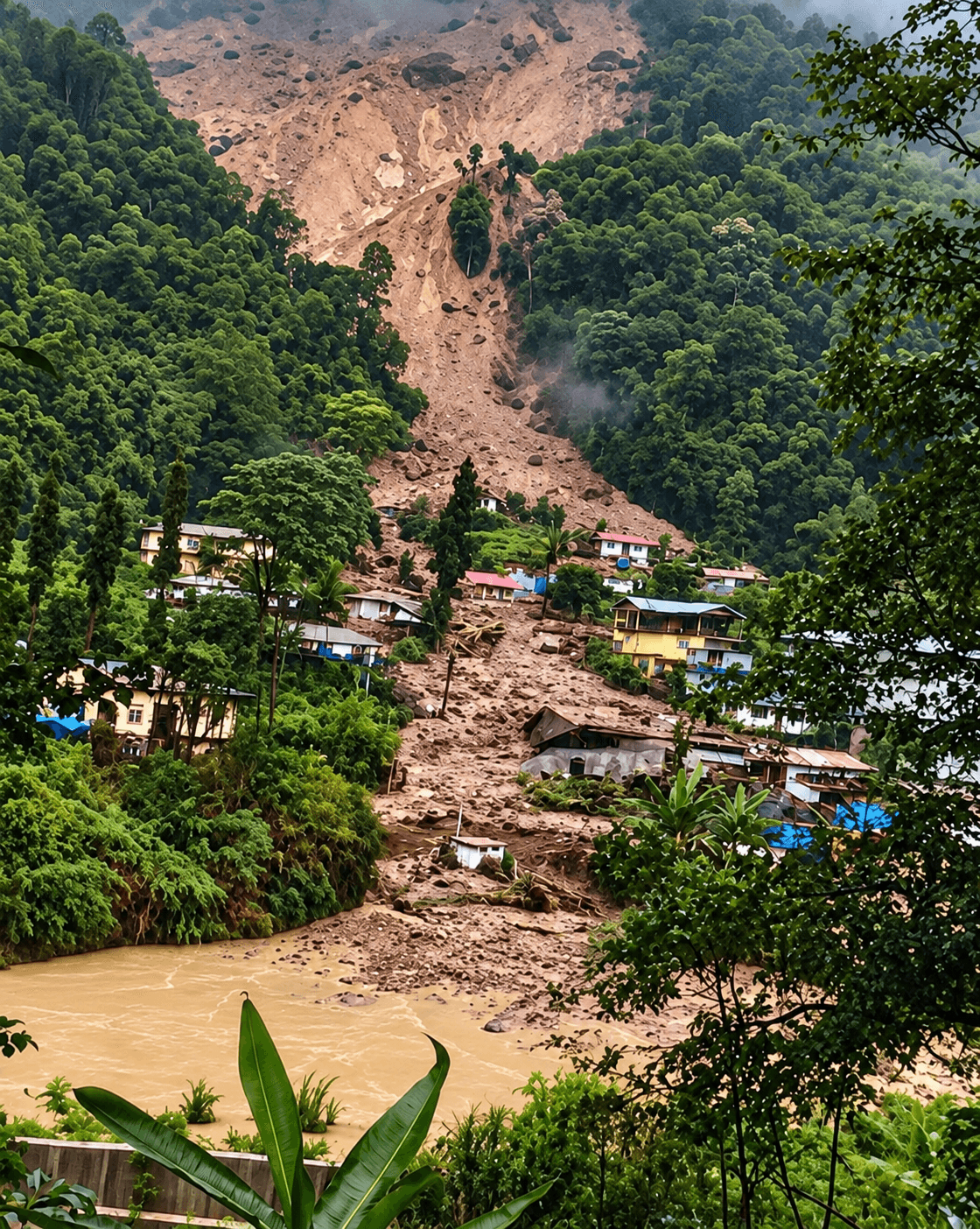
A major landslide hit Rimbi village in Gyalshing district of West Sikkim late Thursday night, sending mud, rocks and debris down the hillside toward a residential area.
Several homes were damaged or destroyed, while government quarters belonging to the Power Department were also affected.
More than 30 houses have reportedly been impacted, with some reports putting the figure at around 35 structures that were damaged, collapsed or left dangerously tilted.
No casualties have been reported so far.
However, authorities warn that the immediate danger has not passed.
Sikkim Chief Minister Prem Singh Tamang described the situation as serious and directed officials to remain on high alert as heavy rainfall continues across the region.
WHAT HAPPENED?
The landslide occurred in Rimbi village in the Yuksom-Tashiding area of Gyalshing district.
Continuous rainfall saturated the steep hillside, eventually triggering a large movement of mud, rocks and debris toward homes and other structures.
Several houses were damaged, while some were reportedly destroyed or left structurally unsafe.
Government accommodation used by the Power Department was also affected.
More than two dozen families have been moved to safer locations, with displaced residents being provided temporary relief arrangements.
For authorities, the immediate priority is to keep people away from unstable areas while assessing the full extent of the damage.
WHY IS THE SITUATION SERIOUS?
The latest landslide is not an isolated incident.
Rimbi and nearby Singlitam have experienced repeated slope movement since August, raising concerns about the stability of the area.
Authorities had previously identified parts of the region as vulnerable, with dozens of households located within or close to affected zones.
Earlier evacuations were also carried out after continued ground movement threatened homes and infrastructure.
The latest incident therefore appears to be an escalation of a problem that has been developing for weeks.
With more rain possible, officials are concerned that already-weakened slopes could move again.
HEAVY RAINFALL IS THE TRIGGER
Heavy rainfall is one of the most common triggers of landslides in mountainous regions such as Sikkim.
When large amounts of water seep into soil and fractured rock, the ground becomes heavier and the forces holding a slope together can weaken.
On steep Himalayan terrain, that can lead to the sudden movement of soil, rocks and debris.
In Rimbi, repeated rainfall has already contributed to slope instability.
Any further spell of heavy rain could therefore increase the risk of additional landslides.
HOMES AND INFRASTRUCTURE AT RISK
The damage is not limited to individual homes.
Landslides and debris flows have affected roads and other public infrastructure in different parts of Sikkim, creating additional challenges for emergency teams.
Blocked roads can slow down access to affected communities and make it harder to move food, medicines and other essential supplies.
For many remote Himalayan settlements, road connectivity is a lifeline.
Clearing debris and restoring access will therefore be an important part of the emergency response.
AUTHORITIES ON HIGH ALERT
Chief Minister Prem Singh Tamang has directed officials to closely monitor the situation and take all necessary steps to protect residents.
Teams are assessing damaged buildings and keeping watch over slopes considered vulnerable to further movement.
Residents have been advised to remain alert, follow official instructions and avoid unnecessary travel through landslide-prone areas.
Officials are also watching for warning signs such as fresh cracks, shifting ground, falling rocks and unusual changes in water flow.
The concern is that another major slide could happen with little warning if the rainfall continues.
A LONGER-TERM WARNING
The Rimbi landslide highlights a wider challenge facing communities across the Sikkim Himalaya.
The region's steep terrain, complex geology and intense seasonal rainfall can create conditions in which slopes become highly unstable.
Once a landslide occurs, the disturbed ground can be even more vulnerable to subsequent rainfall.
The cycle can be difficult to break:
Heavy rain → slope instability → landslide → weakened terrain → greater vulnerability to further rain.
That means the challenge for authorities goes beyond responding to the latest incident.
Officials will also need to determine which areas remain unsafe, whether residents can eventually return home and where longer-term relocation or stronger protective measures may be necessary.
THE HUMAN COST
While no deaths have been reported from the latest landslide, the impact on affected families is significant.
Homes have been damaged.
Families have been displaced.
Road access has been threatened.
Public infrastructure has also suffered damage.
For residents who have already lived with landslide activity for several weeks, the latest incident brings renewed uncertainty.
For now, the priority is to keep people away from unstable slopes while providing shelter and assistance to those who have been displaced.
WHY THIS MATTERS
1. RESIDENTIAL AREAS HAVE BEEN HIT
The landslide moved into an inhabited area, damaging numerous homes and putting additional properties at risk.
2. THE RISK IS NOT OVER
Continued rainfall could trigger further slope movement in an area that has already experienced repeated instability.
3. FAMILIES HAVE BEEN DISPLACED
Several affected households have been moved to safer locations while authorities assess the continuing danger.
4. CONNECTIVITY IS VULNERABLE
Landslides can block roads, slowing emergency response and making it harder to deliver essential supplies.
5. SIKKIM FACES A REPEATING HAZARD
The latest incident follows weeks of landslide activity in and around Rimbi and Singlitam.
FACT CHECK METER
AWX FACT CHECK
STATUS: DEVELOPING
CONFIRMED
A major landslide struck Rimbi village in West Sikkim.
Continuous heavy rainfall contributed to the latest landslide.
Multiple houses and government structures were damaged.
More than 30 houses have been reported affected.
Several families have been moved to safer locations.
No deaths have been reported so far.
Chief Minister Prem Singh Tamang has described the situation as serious and directed authorities to remain on high alert.
NOT INDEPENDENTLY VERIFIED
The final number of houses that have been completely destroyed.
The full financial value of the damage.
The total number of residents who may eventually need evacuation.
Whether additional major landslides will occur.
LOCAL AUTHORITIES' POSITION
Authorities are treating the area as high-risk and are monitoring unstable slopes while relief operations, damage assessments and efforts to restore connectivity continue.
WEATHER RISK
Continued rainfall remains the main immediate concern because additional water could further weaken already-unstable slopes.
AWX VERDICT
LANDSLIDE: CONFIRMED
PROPERTY DAMAGE: SIGNIFICANT
LOSS OF LIFE: NONE REPORTED SO FAR
FURTHER LANDSLIDE RISK: HIGH
SITUATION: DEVELOPING
WHAT TO WATCH NEXT
Rainfall
Whether heavy rain continues across West Sikkim and raises the risk of additional slope failures.
Rimbi
Whether more homes become unsafe and whether authorities order further evacuations.
Rescue and relief
Whether temporary shelters and assistance are expanded for displaced families.
Roads
Whether blocked routes can be cleared and normal connectivity restored.
Geological stability
Whether officials detect new cracks, ground movement or additional mudslides around residential areas.
Weather warnings
Whether authorities issue fresh alerts as rainfall conditions change.
Government response
Whether affected families receive longer-term housing, compensation or rehabilitation support.
THE AWX BOTTOM LINE
The Rimbi landslide is a serious warning from one of India's most landslide-prone mountain regions.
Heavy rainfall has already damaged homes and public infrastructure, while weeks of repeated slope movement have left residents facing continued uncertainty.
The most positive development so far is that no loss of life has been reported.
But the danger has not passed.
The ground remains unstable, and further rainfall could trigger additional movement.
For residents, the immediate priority is staying away from vulnerable slopes and following evacuation instructions when issued.
For authorities, the challenge is broader: assess the damage, restore road connectivity and determine which homes and areas remain too dangerous for people to return.
For now, Rimbi remains a developing disaster situation.
ATTLAS WIRE | AWX WORLD NEWS
Real Stories. Lasting Impact.




Comments
No comments yet.