

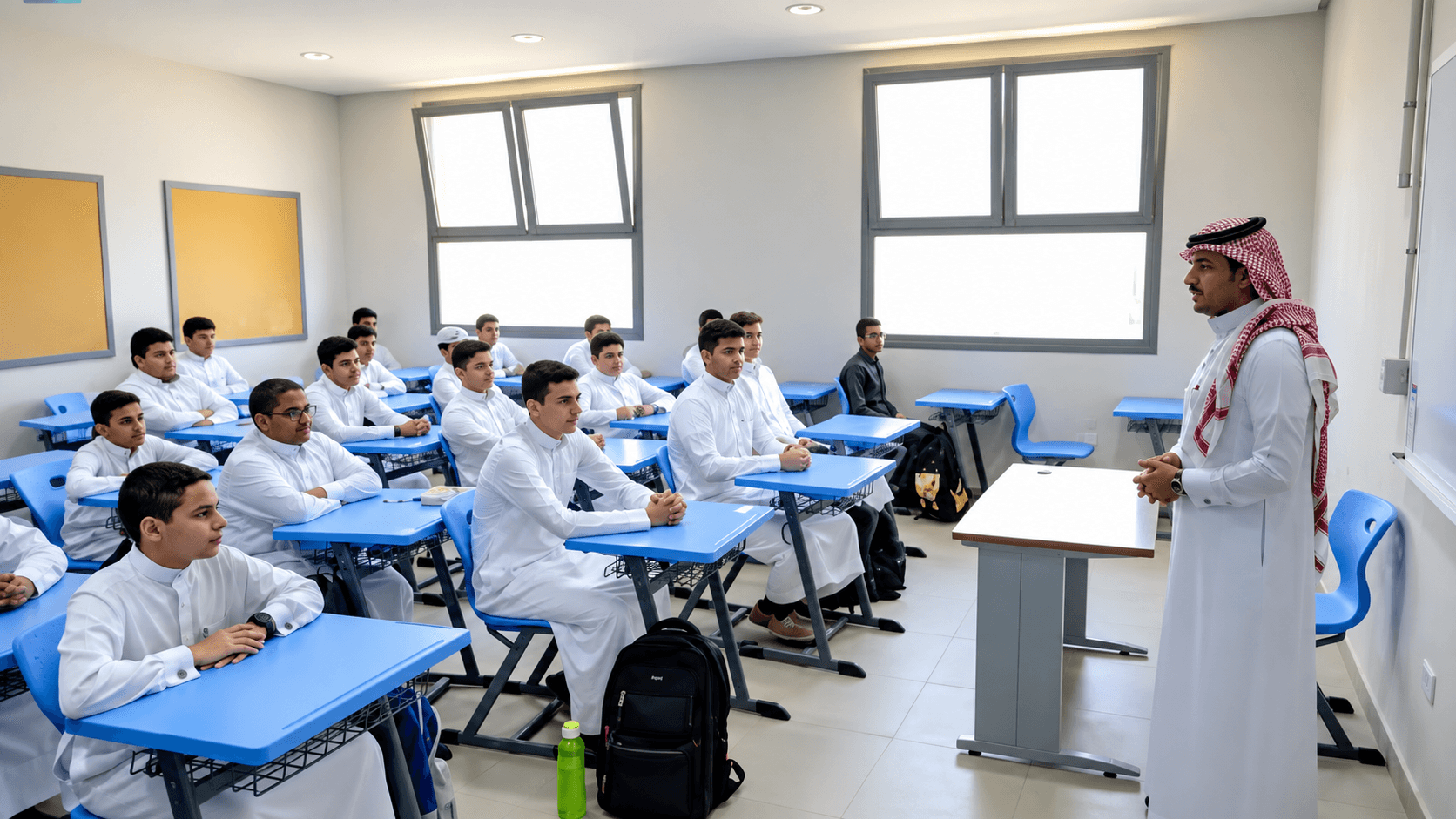
Parents across Riyadh were informed by schools that in-person classes would be suspended temporarily and lessons would be conducted online. Reports described the move as a last-minute decision, although authorities have not publicly provided a detailed explanation for the timing.
The shift comes as Saudi Arabia faces renewed security concerns linked to drone and missile activity by the Houthis.
For families in Riyadh, the situation is no longer simply a matter of regional politics or military developments.
It is affecting everyday life.
Schools are online.
Parents are adjusting their schedules.
Students are studying from home.
And authorities are closely monitoring the situation for signs of further escalation.
WHAT HAPPENED?
Schools in Riyadh moved to remote learning for approximately one week, with parents receiving notifications that students would not attend classes in person.
The decision followed heightened security concerns after Saudi authorities reported intercepting drones directed toward the capital.
However, the precise security assessment behind the education decision has not been publicly explained in detail.
That distinction is important.
The move to remote learning has been reported, but the full operational reasoning behind the decision remains unclear.
WHY RIYADH?
Riyadh is Saudi Arabia’s political and economic centre, home to government institutions, major businesses, financial companies and millions of residents.
Any missile or drone threat approaching the capital therefore carries implications well beyond the immediate military situation.
The reported attacks have raised concerns about:
Civilian safety
Public infrastructure
Air travel
Schools and universities
Business operations
Emergency preparedness
Moving classes online allows education to continue while reducing the number of children and teachers travelling to and gathering at school campuses.
THE HOUTHI THREAT
The Houthis, based in Yemen, have increasingly relied on drones and missiles during periods of heightened regional tension.
Saudi authorities have reported intercepting incoming threats aimed at different parts of the kingdom.
For residents, even intercepted missiles and drones can have an immediate impact. Emergency alerts, disruptions to transport and heightened security measures can create anxiety and uncertainty, particularly when threats are directed toward populated areas.
The latest incidents are also adding pressure on Saudi Arabia to maintain strong air-defence capabilities and closer regional security coordination.
WHY ARE SCHOOLS MOVING ONLINE?
Remote learning gives authorities a way to reduce civilian exposure while keeping education running.
Instead of closing schools completely, students can continue their lessons from home while large gatherings at school campuses are temporarily avoided.
The approach can help by:
Reducing movement
Fewer students and teachers need to travel across the city.
Limiting large gatherings
School campuses have fewer people present while the security situation remains uncertain.
Maintaining education
Classes can continue through online platforms rather than being suspended entirely.
Providing flexibility
Authorities can reassess conditions before deciding whether students should return to classrooms.
Because the measure is temporary, it can also be reversed if security conditions improve.
WHAT DOES IT MEAN FOR PARENTS?
For families, however, the change brings its own challenges.
Parents may need to arrange childcare or supervision while continuing to work. Students must adapt to online classes, digital assignments and a different daily routine.
Teachers also have to adjust lessons and classroom activities for remote learning, potentially with little notice.
For younger students, the transition can be particularly demanding because online learning often requires more involvement from parents or guardians.
So while the move reduces potential exposure to security risks, it also creates new pressures at home.
WHY THE TIMING MATTERS
The decision comes amid increased Houthi military activity and renewed concerns about missile and drone threats to Saudi Arabia.
The wider situation has also raised security concerns around the Red Sea and Bab el-Mandeb, key routes for regional and international shipping.
The United Nations has warned that renewed fighting in Yemen could become increasingly connected to the wider regional conflict.
That makes the school decision significant beyond the education sector.
It shows how developments on the battlefield can quickly begin affecting ordinary civilian routines in Gulf cities.
SAUDI AIR DEFENCES UNDER PRESSURE
Saudi Arabia has invested heavily in air-defence systems designed to protect major cities, infrastructure and strategic facilities.
The reported interception of incoming drones highlights the continuing importance of those systems.
But repeated attacks create a broader challenge.
Authorities must not only detect and intercept incoming threats, but also manage their potential impact on civilian populations.
That includes:
Emergency warnings
Airspace management
Public communications
Civil-defence preparedness
Protection of critical infrastructure
The decision to move schools online can therefore be seen as one part of a wider precautionary response.
THIS IS ABOUT MORE THAN EDUCATION
If security concerns persist, their effects could extend beyond schools.
Authorities could potentially face pressure to review other public activities, including:
Large public gatherings
Sports events
Government operations
Air travel
Business schedules
Public transportation
Whether any additional measures are introduced will depend on the severity and frequency of future incidents.
For now, the impact on schools is one of the clearest signs that the security situation is beginning to affect daily life in the capital.
THE REGIONAL CONNECTION
The Houthi threat is part of a much wider regional security picture.
The group has close ties to Iran and has become increasingly active as tensions across the Middle East have risen.
Saudi Arabia, meanwhile, has been strengthening its security partnerships.
Military chiefs from Saudi Arabia, Pakistan and Turkey recently met in Riyadh to discuss closer defence cooperation, including responses to regional threats.
Pakistan has also pledged to support Saudi Arabia against Houthi attacks under a recently established defence agreement involving Saudi Arabia, Pakistan and Turkey.
That points to security concerns extending well beyond the Saudi-Yemen border.
THE ECONOMIC IMPACT
Security concerns can also affect the economy even when physical damage is limited.
Businesses may face higher security and insurance costs. Airlines can encounter operational uncertainty, while investors may demand higher risk premiums as regional instability increases.
Prolonged uncertainty can also weigh on consumer confidence and business planning.
Riyadh is one of the region’s most important commercial centres, so continued disruption could have wider economic consequences.
THE HUMAN SIDE
For children, the immediate reality is straightforward:
School has moved home.
But behind that simple change is a much larger regional security crisis.
Students may wonder why they cannot attend school. Parents may worry about whether the situation could deteriorate further. Teachers must continue teaching while adapting to an uncertain environment.
For families across Riyadh, the decision is a reminder that regional conflicts can affect everyday life even when they are happening far from the front lines.
WHY THIS MATTERS
1. SECURITY CONCERNS ARE AFFECTING DAILY LIFE
The move to remote education shows how regional tensions can influence ordinary civilian routines.
2. RIYADH REMAINS A HIGH-PRIORITY SECURITY AREA
The capital’s political and economic importance makes any missile or drone threat particularly significant.
3. REMOTE LEARNING PROVIDES A TEMPORARY SAFETY MEASURE
Students can continue their education without gathering at physical school locations.
4. THE HOUTHI CONFLICT HAS REGIONAL IMPLICATIONS
The violence is affecting Saudi Arabia while also contributing to wider security concerns around regional shipping routes.
5. FURTHER ESCALATION COULD LEAD TO MORE PRECAUTIONS
If attacks continue, authorities may consider additional measures affecting public life.
FACT CHECK METER
AWX FACT CHECK
FACT METER: 93%
STATUS: DEVELOPING
CONFIRMED
Schools in Riyadh shifted to remote learning for approximately one week.
Parents received notifications about the temporary move to online education.
The decision came amid heightened concerns over Houthi missile and drone activity.
Saudi authorities reported intercepting drones directed toward the Riyadh region.
The wider Yemen conflict has intensified significantly.
NOT YET FULLY ESTABLISHED
The precise operational security assessment that prompted the school decision.
Whether remote learning will continue beyond the announced week.
Whether other public institutions will adopt similar measures.
Whether additional Houthi attacks will target Riyadh.
IMPORTANT DISTINCTION
REMOTE LEARNING IS REPORTED — BUT THE FULL SECURITY RATIONALE HAS NOT BEEN PUBLICLY DETAILED.
The timing clearly coincides with heightened regional security concerns, but authorities have not publicly disclosed every operational consideration behind the decision.
AWX VERDICT
RIYADH SCHOOLS GOING REMOTE: CONFIRMED
HOUTHI THREAT: ACTIVE
CIVILIAN SECURITY CONCERNS: ELEVATED
EXTENSION OF REMOTE LEARNING: UNKNOWN
REGIONAL ESCALATION: DEVELOPING
AWX FOCUS: WHAT HAPPENS NEXT?
SCHOOLS
Will in-person classes resume after the temporary remote-learning period?
SECURITY
Will Saudi authorities report further missile or drone interceptions?
FAMILIES
Will parents receive additional instructions if the security situation changes?
RIYADH
Will other public activities face temporary restrictions?
HOUTHIS
Will the group launch further attacks against Saudi territory?
REGIONAL DIPLOMACY
Can Saudi Arabia and its partners prevent the Yemen conflict from contributing to a wider regional escalation?
WHAT TO WATCH NEXT
Saudi authorities
Any new security warnings or changes to school arrangements.
Education authorities
Whether remote learning continues beyond the announced period.
Houthis
Any further missile or drone launches toward Saudi territory.
Riyadh
Whether civilian activity returns to normal or additional precautions are introduced.
Yemen
Whether fighting intensifies around key areas and maritime routes.
Regional powers
Whether Saudi Arabia, Pakistan, Turkey and other partners deepen security cooperation.
Diplomacy
Whether international mediation can help contain the wider conflict.
THE AWX BOTTOM LINE
The decision to move schools in Riyadh to remote learning shows how quickly a regional security crisis can spill into everyday civilian life.
The move comes amid heightened concerns following reported Houthi missile and drone attacks involving Saudi Arabia, including threats directed toward the Riyadh region.
For authorities, keeping students away from large school gatherings provides an additional precaution while the security situation remains uncertain.
For families, however, the change is a visible reminder that developments in Yemen and the wider Middle East can have consequences far beyond the battlefield.
The immediate question is whether remote learning will remain temporary.
The larger question is whether the Houthi threat will continue to grow or whether regional tensions will begin to ease.
For now, classrooms in Riyadh have moved online.
What happens next will depend largely on whether the region moves toward de-escalation — or faces another round of attacks.
ATTLAS WIRE | AWX WORLD NEWS
Real Stories. Lasting Impact.


Comments
No comments yet.