

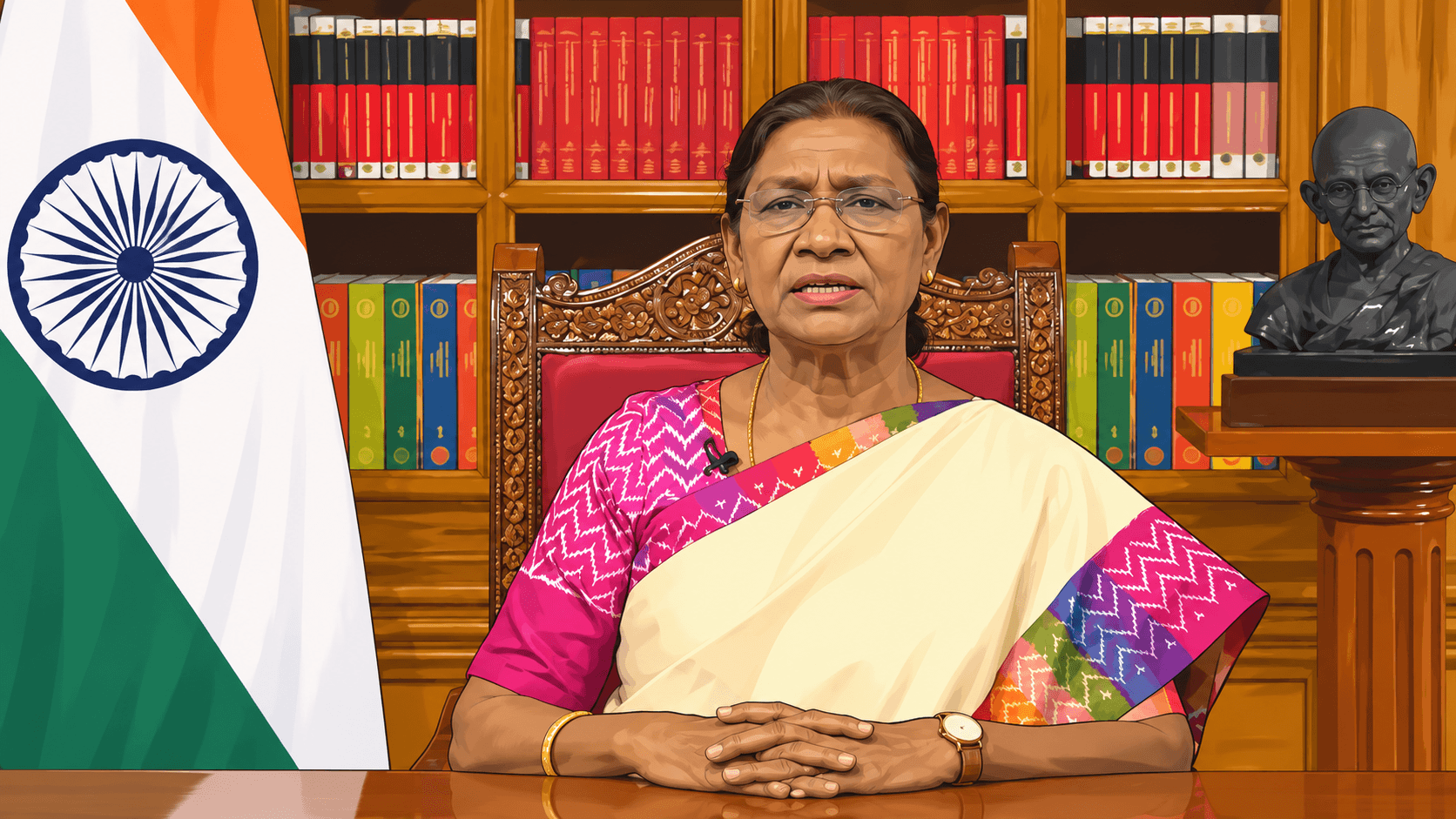
West Bengal’s West Bengal Public Safety and Control of Anti-Social Activities Bill, 2026 has run into a legal hurdle after President Droupadi Murmu returned it for reconsideration.
The Centre’s objection centres on a provision dealing with people involved in offences under the Narcotic Drugs and Psychotropic Substances Act, 1985.
According to the Centre’s position, that provision could overlap with the preventive-detention framework already provided under the Prevention of Illicit Traffic in Narcotic Drugs and Psychotropic Substances Act, 1988, commonly known as the PITNDPS Act.
The dispute brings Article 254 of the Constitution, which deals with conflicts between central and state laws, into focus.
For the West Bengal government, the presidential return is a setback. But it does not end the legislation. The state can reconsider the disputed provisions, make amendments and place the Bill before the Assembly again before seeking presidential assent.
WHAT HAPPENED?
The West Bengal government introduced the anti-goonda Bill in the state Assembly in June 2026, saying it was aimed at tackling anti-social and organised criminal activity.
The proposed law seeks to give authorities additional powers to deal with habitual offenders and people involved in activities considered a threat to public order.
One provision concerning narcotics-related offences, however, drew objections from the Centre.
President Murmu has now returned the Bill instead of granting assent.
As a result, the proposed legislation has not become law in its current form.
The state government must now decide whether to amend the disputed provisions and bring the legislation back before the Assembly.
WHY DID THE CENTRE OBJECT?
The main disagreement concerns the Bill’s definition of a “goonda.”
One provision reportedly covers people who commit, attempt to commit, abet, promote, finance or facilitate offences punishable under the NDPS Act.
The Centre has argued that this could overlap with the preventive-detention powers already available under the PITNDPS Act, 1988.
In practical terms, the concern is that two separate legal frameworks could operate over similar drug-related conduct.
The Centre has therefore recommended removing the reference to NDPS Act offences from the disputed provision, with the stated aim of avoiding duplication and a possible conflict between central and state laws.
WHAT IS ARTICLE 254?
Article 254 of the Constitution deals with situations where a law made by a state legislature is inconsistent with a law passed by Parliament.
There are circumstances in which a state law can prevail despite such an inconsistency if it receives presidential assent.
But presidential assent does not remove every possible constitutional or legal question surrounding a provision.
In this case, the Centre’s concern is that the disputed provision could establish a parallel preventive-detention mechanism in an area already covered by central legislation.
That is why Article 254 has become an important part of the debate surrounding the Bill.
WHAT DOES THE BILL SEEK TO DO?
The proposed legislation is intended to give the West Bengal government additional tools to tackle anti-social activity and organised criminal networks.
It covers habitual offenders and activities considered harmful to public order. The Bill also provides for preventive measures aimed at restricting the activities or movement of people who fall within its scope.
Supporters of the legislation say stronger preventive powers are needed to deal with repeat offenders and organised crime.
Critics, however, have questioned the breadth of those powers and warned about the possibility of misuse.
If the Bill returns to the Assembly in an amended form, those concerns are likely to remain part of the debate.
WHY THE PRESIDENT’S DECISION MATTERS
The President’s decision is significant because the Bill had already gone through the state legislative process but had not received the presidential assent required for it to proceed in its current form.
By returning the legislation, the President has effectively sent it back into the state’s legislative process.
The West Bengal government can now:
Amend the disputed provision.
Reconsider other parts of the Bill if necessary.
Pass an amended version through the Assembly.
Send the revised legislation back for presidential consideration.
The process is therefore likely to take additional time.
THE PREVENTIVE DETENTION QUESTION
Preventive detention is one of the most sensitive aspects of the proposed legislation.
Unlike ordinary criminal punishment, preventive detention allows authorities, subject to constitutional and statutory safeguards, to restrict a person’s liberty to prevent an anticipated threat.
Because such powers directly affect individual liberty, they are subject to significant legal and constitutional scrutiny.
The proposed Bengal legislation has already attracted attention from legal observers and civil-rights groups.
An earlier challenge before the Calcutta High Court was dismissed as premature because the Bill had not received presidential assent and had not yet become law.
The latest presidential decision changes the immediate position by formally returning the legislation to the state for reconsideration.
WHAT HAPPENS NEXT?
The state government has indicated that the Bill can be brought back before the Assembly after the disputed provisions are amended.
If the NDPS-related provision is removed or modified, the revised legislation could once again be placed before the Assembly and subsequently sent for presidential consideration.
That gives the government a clear legislative path forward.
But the political debate surrounding the Bill is unlikely to end.
Opposition parties and civil-rights groups are expected to continue questioning whether the proposed legislation gives the administration powers that are too broad.
The government, meanwhile, is likely to maintain that stronger legal measures are necessary to deal with anti-social and organised criminal activity.
THE POLITICAL DIMENSION
The anti-goonda Bill has become part of a wider political debate in West Bengal.
The government has presented the proposed law as a measure aimed at tackling anti-social and criminal activity.
Opposition parties, however, have questioned the broad definitions and preventive powers contained in the legislation and raised concerns about possible selective use.
That makes the wording of any revised Bill particularly important.
If the legislation returns to the Assembly, lawmakers are likely to focus on:
The definition of a “goonda”
The scope of preventive-detention powers
Judicial safeguards
Administrative oversight
The treatment of narcotics-related offences
Protection against possible political misuse
The debate over those safeguards could prove just as significant as the original Bill.
WHY THIS MATTERS
1. THE BILL HAS NOT RECEIVED FINAL ASSENT
President Murmu has returned the legislation for reconsideration rather than approving it in its current form.
2. CENTRAL-STATE LAW CONFLICT IS AT THE CENTRE OF THE DISPUTE
The Centre has raised concerns that the NDPS-related provision could overlap with existing central legislation.
3. WEST BENGAL CAN TRY AGAIN
The state can amend the Bill, pass it through the Assembly again and seek presidential consideration once more.
4. PREVENTIVE DETENTION REMAINS A SENSITIVE ISSUE
The proposed powers raise questions about individual liberty, legal safeguards and the limits of executive authority.
5. THE DISPUTE COULD FEED A LARGER FEDERALISM DEBATE
The case highlights the constitutional balance between Parliament and state legislatures when both enact laws touching similar areas.
FACT CHECK METER
AWX FACT CHECK
STATUS: DEVELOPING
CONFIRMED
President Droupadi Murmu has returned West Bengal’s anti-goonda Bill for reconsideration.
The Bill is titled the West Bengal Public Safety and Control of Anti-Social Activities Bill, 2026.
The Centre has raised concerns about the Bill’s reference to offences under the NDPS Act, 1985.
The Centre has pointed to the existing preventive-detention framework under the PITNDPS Act, 1988.
The dispute has raised questions connected to Article 254 of the Constitution.
The state government can amend the disputed provisions and seek presidential consideration again.
NOT YET ESTABLISHED
Whether the amended Bill will ultimately receive presidential assent.
Whether the state will remove the NDPS reference completely.
Whether other provisions will face additional legal challenges.
Whether the revised legislation would withstand future constitutional scrutiny.
CENTRE’S POSITION
The Centre’s concern is that the disputed provision could overlap with the existing central preventive-detention framework dealing with narcotics-related activities.
STATE GOVERNMENT’S POSITION
The state government has indicated that the legislation can be amended to address the legal concerns and subsequently returned to the Assembly.
AWX VERDICT
PRESIDENTIAL RETURN: CONFIRMED
LEGAL CONFLICT: IDENTIFIED
BILL: NOT FINALLY APPROVED
FUTURE OF LEGISLATION: DEVELOPING
WHAT TO WATCH NEXT
West Bengal Government
Whether the government accepts the Centre’s recommendation and removes or modifies the disputed provision.
State Assembly
Whether an amended Bill is introduced and passed again.
President’s Office
Whether the revised legislation is subsequently sent back for presidential consideration.
Courts
Whether fresh constitutional challenges emerge if the amended legislation becomes law.
Opposition
Whether political parties step up criticism of the proposed preventive powers.
Civil-Rights Groups
Whether concerns over detention powers and safeguards lead to further legal action.
Centre-State Relations
Whether the dispute develops into a broader debate over legislative powers and federalism.
THE AWX BOTTOM LINE
President Droupadi Murmu’s decision has put West Bengal’s proposed anti-goonda legislation on hold in its current form.
At the heart of the dispute is a straightforward but important legal question: can the state introduce additional preventive powers in an area where Parliament has already created a central legal framework?
The Centre believes the disputed NDPS provision could result in overlapping legal mechanisms.
West Bengal now has the option of changing the provision, taking the amended Bill through the Assembly and seeking presidential consideration again.
So, for now, this is a delay — not necessarily the end of the legislation.
The next major step will be the state government’s response and whether an amended Bill returns to the Assembly.
For the moment, Bengal’s proposed anti-goonda law is back on the drawing board.
ATTLAS WIRE | AWX WORLD NEWS
Real Stories. Lasting Impact.




Comments
No comments yet.