

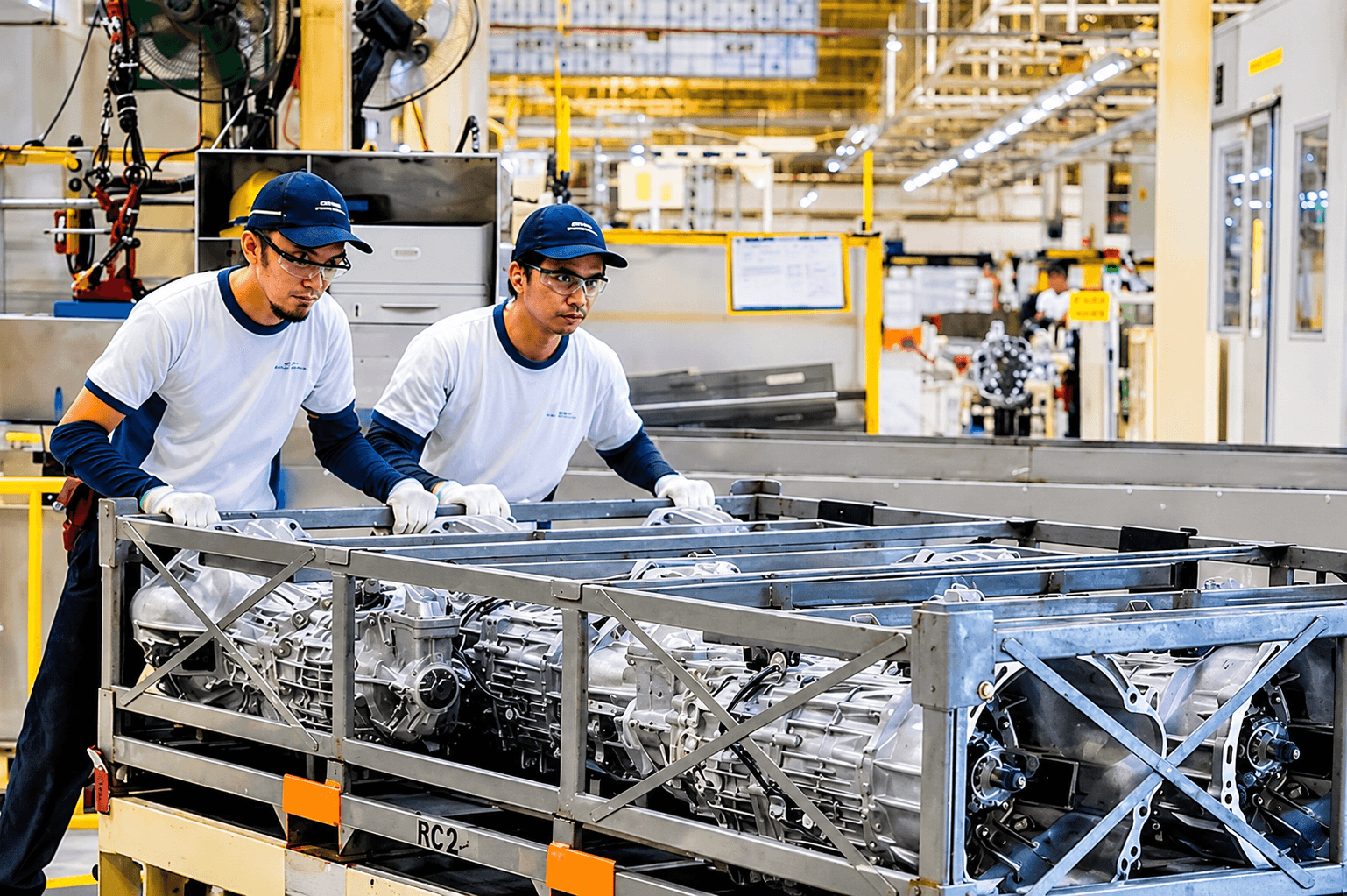
The Philippines’ manufacturing sector is beginning to lose some of its momentum.
Factories are dealing with softer orders, uncertain demand in overseas markets and rising production costs — a combination that is forcing many businesses to take a more cautious approach.
The issue extends beyond the Philippines.
The country is an important part of Asia’s manufacturing network, particularly in electronics and semiconductor-related production. Its factories are connected to supply chains serving customers around the world.
If weak demand persists, manufacturers across the region could find themselves operating more cautiously for longer.
The question now is straightforward:
Is this simply a temporary slowdown in Philippine manufacturing — or an early sign that Asia’s export-driven industrial engine is beginning to lose steam?
WHAT IS HAPPENING?
Philippine manufacturers are operating in a more uncertain global environment.
Companies are closely watching new orders, export demand and the cost of everything from energy to imported materials.
Businesses that rely heavily on international customers are particularly vulnerable when overseas demand weakens.
Electronics and electrical products are among the country’s key export industries, leaving the Philippines closely tied to the global technology cycle.
When overseas orders fall, factories can quickly respond by cutting production, reducing overtime or delaying expansion plans.
WHY THE PHILIPPINES MATTERS
The Philippines has established an important position in Asia’s manufacturing and electronics supply chain.
Its industrial base includes:
Semiconductor assembly
Electronics
Electrical components
Industrial manufacturing
Business-process industries
That makes the country worth watching when assessing regional demand.
A slowdown in Philippine factories does not automatically mean Asia is heading into a broad industrial downturn. But if similar weakness appears across several manufacturing economies, the signal becomes harder to ignore.
ASIA’S MANUFACTURING CHALLENGE
The Philippines is dealing with problems that are being felt across much of Asia.
Manufacturers are navigating:
Softer external demand
Higher operating costs
Trade uncertainty
Supply-chain disruptions
Currency fluctuations
Changing consumer spending
At the same time, competition for new manufacturing investment is becoming more intense.
China remains the region’s industrial powerhouse, while Vietnam, Thailand, Malaysia and Indonesia are all trying to capture a larger share of global supply chains.
The Philippines therefore has to compete at a time when multinational companies have more options than ever.
THE EXPORT CONNECTION
Philippine manufacturing is heavily tied to international trade.
When demand from the United States, Europe or other Asian economies slows, the effects can eventually reach factories in the Philippines.
Electronics are especially sensitive to these shifts.
A smartphone, computer, vehicle or industrial machine may contain components produced in several different countries. A slowdown in consumer demand at the end of that chain can therefore work its way backward through suppliers.
That makes export orders an important indicator for the Philippine industrial sector.
ELECTRONICS UNDER THE MICROSCOPE
Electronics remain one of the country’s most important manufacturing activities.
The Philippines has a significant role in semiconductor assembly, testing and related operations. That gives the country an opportunity to benefit as technology companies diversify their production networks.
But the same exposure creates a vulnerability.
Technology demand can change quickly.
When orders for chips and electronic products increase, manufacturers can ramp up production. When demand weakens, those same companies may quickly scale back output.
For Philippine manufacturers, the global technology cycle remains a critical factor.
THE CHINA+1 OPPORTUNITY
One of the Philippines’ biggest potential advantages is the global China+1 strategy.
Multinational companies have been looking for additional production locations outside China to reduce concentration and supply-chain risks.
The Philippines could benefit from that shift.
But it is far from the only option.
Companies are also considering:
Vietnam
Malaysia
Thailand
India
Indonesia
The result is a highly competitive race for new factories and investment.
Supply-chain diversification may create opportunities, but countries still have to prove they can offer the infrastructure, skills, costs and reliability manufacturers need.
LABOUR COSTS ARE ONLY PART OF THE EQUATION
The Philippines has a large workforce, which can be an important advantage for manufacturers.
But labour costs are only one part of the investment decision.
Companies also consider:
Worker productivity
Technical skills
Infrastructure
Energy prices
Taxes
Logistics
Regulatory efficiency
For advanced manufacturing, a relatively inexpensive workforce is not enough on its own.
Companies want to know whether they can operate efficiently and predictably for years after making a major investment.
ENERGY COSTS ADD TO THE PRESSURE
Reliable and affordable electricity is essential for manufacturing.
For energy-intensive industries, higher power costs can quickly affect production margins.
That can make Philippine factories less competitive against facilities elsewhere in Asia.
For multinational companies deciding where to build their next plant, energy reliability can be just as important as wages.
A MORE COMPLICATED GLOBAL TRADE ENVIRONMENT
Manufacturers are also having to navigate a more complicated trading system.
Tariffs, export controls and geopolitical tensions have made supply-chain planning more difficult.
That uncertainty can affect investment decisions.
Rather than concentrating production in one country, companies may choose to spread operations across several locations.
That can create opportunities for the Philippines, but it can also mean investment arrives gradually rather than through a single major manufacturing expansion.
THE US FACTOR
The United States remains an important market for Asian exporters.
A slowdown in American consumer or industrial demand can therefore have consequences well beyond US borders.
Trade policy is another variable.
Changes in tariffs can alter the economics of exporting Philippine-made products to the US, potentially influencing where multinational companies decide to locate production.
For Philippine manufacturers, American demand remains an important part of the equation.
CHINA STILL MATTERS
China remains deeply embedded in Asia’s manufacturing system.
Even factories located elsewhere in the region often depend on Chinese suppliers for:
Components
Raw materials
Machinery
Chemicals
Intermediate goods
A slowdown in Chinese industrial activity can therefore have ripple effects across Southeast Asia.
At the same time, Chinese manufacturers are competing directly with companies in other Asian markets, adding another layer of pressure for Philippine producers.
JAPAN AND SOUTH KOREA
Japan and South Korea also play an important role in regional manufacturing.
Companies from both countries have built operations across Southeast Asia, particularly in automotive, electronics and industrial production.
Continued investment by Japanese and South Korean companies could create opportunities for the Philippines.
But if global demand weakens significantly, those companies may become more cautious about expanding capacity.
CAN SERVICES ABSORB SOME OF THE PRESSURE?
The Philippines has an important buffer that some manufacturing-heavy economies do not have: a large services sector.
Business-process outsourcing, information technology and related services are major contributors to economic activity.
That means weaker manufacturing does not automatically translate into an economy-wide crisis.
Services can help absorb some of the shock.
Still, manufacturing remains important for exports, industrial development, technology transfer and foreign investment.
THE EMPLOYMENT QUESTION
A prolonged factory slowdown would eventually raise concerns about jobs.
Companies facing weaker orders may first reduce overtime, slow hiring or cut temporary positions.
If conditions deteriorate further, some businesses could postpone expansion or reduce their workforce.
For policymakers, that makes manufacturing and employment data worth watching closely.
THE INVESTMENT QUESTION
Foreign investment remains one of the Philippines’ biggest opportunities.
New manufacturing facilities can bring jobs, technology, export income and training. They can also create networks of local suppliers and encourage infrastructure development.
But investors need confidence before committing significant capital.
That means reliable infrastructure, predictable regulations, competitive operating costs and dependable access to international markets.
The Philippines has an opportunity to attract more supply-chain investment, but it has to compete for it.
WHY THIS COULD MATTER FOR ASIA
The Philippines is only one part of the regional manufacturing picture.
If factory activity weakens across several Asian economies at the same time, it could point to a broader slowdown in global demand.
If weakness remains concentrated in a handful of industries, the impact could be much more limited.
That is why investors will be watching whether the current pressure spreads.
TEMPORARY PAUSE OR DEEPER SLOWDOWN?
There are two broad possibilities.
SCENARIO ONE: TEMPORARY
Factories could simply be going through a short-term adjustment caused by inventory changes, weaker orders or normal fluctuations in demand.
If global demand improves, production could pick up again.
SCENARIO TWO: STRUCTURAL
A longer period of weak orders could point to deeper challenges involving trade, competitiveness and global demand.
If companies remain cautious for several quarters, investment and employment could come under greater pressure.
That would be a more serious concern.
WHY THIS MATTERS
1. PHILIPPINE EXPORTS ARE EXPOSED
A prolonged manufacturing slowdown could weigh on export growth.
2. ELECTRONICS REMAIN CRITICAL
The semiconductor and electronics industries are closely connected to global technology demand.
3. ASIA IS COMPETING FOR FACTORIES
Vietnam, Malaysia, Thailand, India and Indonesia are all competing for new supply-chain investment.
4. CHINA REMAINS A MAJOR FACTOR
Regional manufacturers continue to depend heavily on Chinese suppliers and markets.
5. JOBS COULD COME UNDER PRESSURE
If factory weakness lasts, hiring, overtime and eventually employment could be affected.
FACT CHECK METER
AWX FACT CHECK
FACT METER: 92%
STATUS: DEVELOPING
CONFIRMED
The Philippines is an important participant in Asian electronics and semiconductor supply chains.
Manufacturing activity is closely linked to international export demand.
Electronics and semiconductor-related industries are important components of Philippine exports.
Southeast Asian economies are competing for supply-chain investment and manufacturing diversification.
Global trade uncertainty can influence manufacturing and investment decisions.
IMPORTANT DISTINCTION
A slowdown in manufacturing does not mean the Philippine economy is automatically heading into recession.
Manufacturing is only one part of the economy, while the country’s large services sector provides an important source of economic activity.
NOT YET ESTABLISHED
Whether the current weakness will continue for several quarters.
Whether weaker factory activity will spread across the wider manufacturing sector.
Whether major multinational companies will postpone planned Philippine investments.
Whether the current weakness represents a broader Asian manufacturing downturn.
AWX VERDICT
PHILIPPINE MANUFACTURING: UNDER PRESSURE
EXPORT DEMAND: KEY RISK
ELECTRONICS: CLOSELY WATCHED
FOREIGN INVESTMENT: IMPORTANT
REGIONAL COMPETITION: INTENSE
RECESSION: NOT ESTABLISHED
SITUATION: DEVELOPING
AWX FOCUS: ASIA’S MANUFACTURING ENGINE
PHILIPPINES
Strong in electronics and semiconductor assembly, but exposed to shifts in global demand.
VIETNAM
Expanding its manufacturing base as companies diversify production beyond China.
MALAYSIA
A major regional hub for semiconductors, electronics assembly and testing.
THAILAND
Using its automotive and electronics industries to attract technology and manufacturing investment.
INDONESIA
Using its large domestic market and natural resources to expand its industrial base.
CHINA
Still the region’s dominant manufacturing centre and a critical supplier of components and intermediate goods.
THE KEY QUESTION
Can Southeast Asia keep attracting factories if global demand remains weak?
WHAT TO WATCH NEXT
Factory orders
Whether new export orders begin to recover or weaken further.
Electronics
Whether demand for chips and electronic products improves.
China
Changes in Chinese industrial activity and domestic demand.
United States
Consumer spending and changes in trade policy.
Investment
New announcements from multinational manufacturers.
Employment
Whether companies begin reducing hiring, overtime or working hours.
Regional competition
How Vietnam, Malaysia, Thailand and Indonesia respond to the changing investment environment.
Supply chains
Whether multinational companies accelerate their China+1 strategies.
THE AWX BOTTOM LINE
The Philippines is entering a more difficult period for manufacturing at a time when Asia’s industrial landscape is changing quickly.
Global companies are looking for more diversified supply chains, giving Manila an opportunity to attract new investment.
But opportunity alone is not enough.
Manufacturers need competitive energy costs, skilled workers, reliable infrastructure, efficient logistics and dependable access to international markets.
If global demand recovers, Philippine manufacturers could benefit from the continued diversification of supply chains.
If demand stays weak, companies are likely to remain cautious, delay expansion and keep production under tighter control.
For now, the signal from Philippine factories is one of caution.
The machines are still running — but the pace is slowing.
Across Asia, investors will be watching closely to see whether that slowdown proves temporary or becomes the first sign of a much broader manufacturing downturn.
ATTLAS WIRE | AWX WORLD NEWS
Real Stories. Lasting Impact.


Comments
No comments yet.