

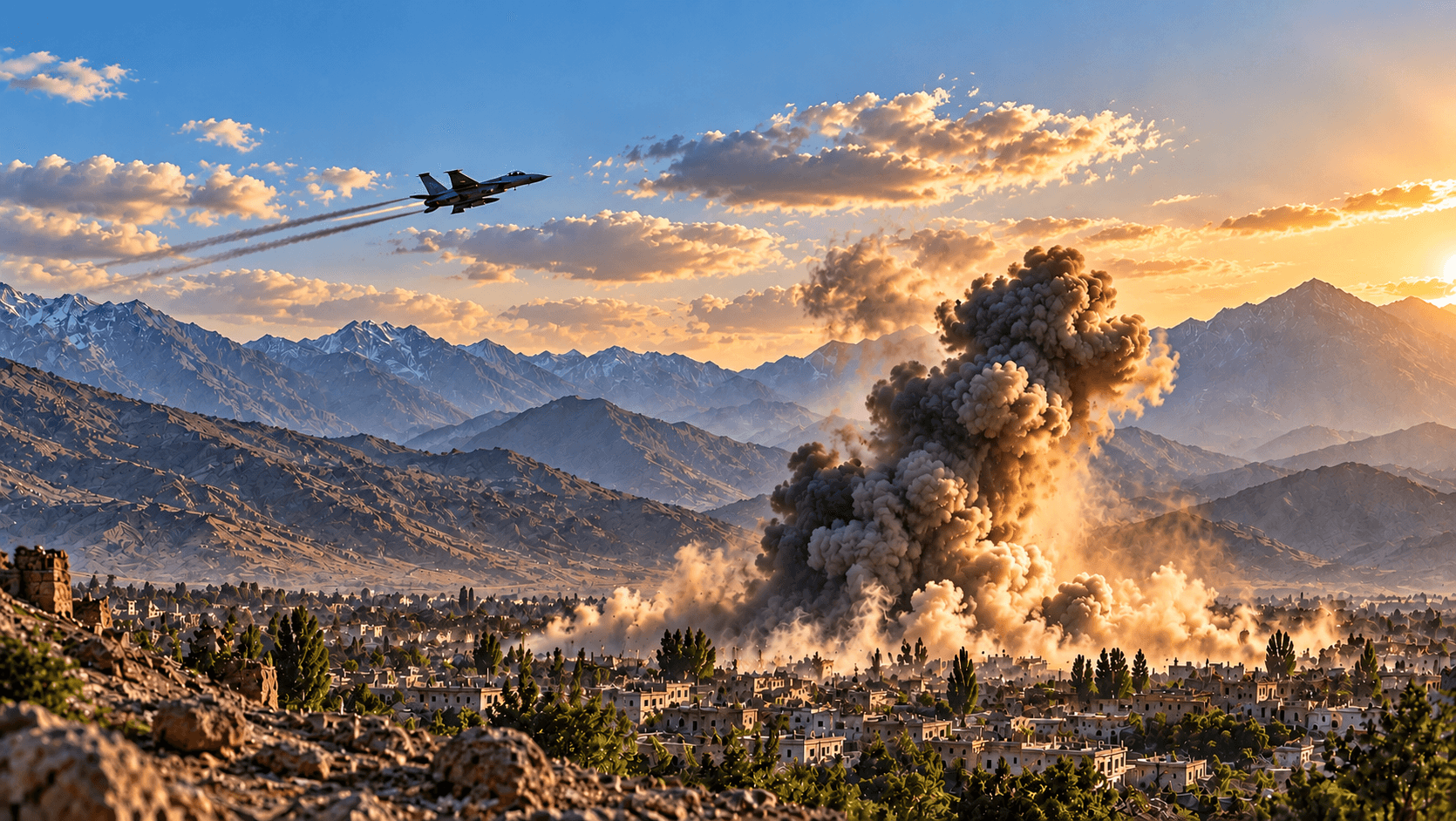
Pakistan carried out fresh airstrikes inside Afghanistan early Monday, hitting locations in the eastern provinces of Kunar and Paktika, according to officials on both sides.
Pakistani security officials said the operation targeted suspected militant hideouts and claimed that 28 suspected militants were killed. Afghan authorities gave a sharply different account, saying three civilians from the same family were killed and four others injured.
The casualty figures could not be independently verified.
The strikes mark another escalation in the increasingly strained relationship between Islamabad and Kabul, following months of accusations over militant activity along the Afghanistan–Pakistan border.
WHAT HAPPENED?
Afghan officials said Pakistani aircraft struck several locations in eastern Afghanistan during the early hours of Monday.
In Nurgal district in Kunar province, Afghan authorities said an airstrike hit a house in the Patan area.
Hamdullah Fitrat, deputy spokesperson for Afghanistan's Taliban government, said the strike destroyed the home of a villager identified as Noor Ahmad. Ahmad and two members of his family were reportedly killed, while four other relatives were injured.
Afghan officials also reported strikes in Barmal district of Paktika province.
Two locations in the Rakhah and Tor Kundi areas were reportedly hit. Afghan authorities said a shop and an unoccupied house were destroyed, but no deaths were reported in those strikes.
PAKISTAN'S ACCOUNT
Pakistan's account is significantly different.
Pakistani security officials said the aircraft targeted suspected militant hideouts inside Afghanistan and claimed that 28 suspected militants were killed.
The strikes followed a series of deadly attacks against Pakistani security forces in areas near the Afghan border.
However, Pakistan's military had not immediately issued a public statement confirming the reported casualty figure, according to the Associated Press. The Pakistani officials who provided the figure spoke anonymously because they were not authorized to speak publicly.
That distinction is important.
At the time of publication, the figure of 28 militant deaths remains a Pakistani claim and has not been independently verified.
WHY DID PAKISTAN STRIKE?
The strikes came amid a rise in militant violence inside Pakistan.
On Friday, a coordinated attack targeted a police compound in Kohat, Khyber Pakhtunkhwa. The attack involved a suicide bomber and armed attackers.
The Associated Press reported that at least 21 people were killed and more than 100 wounded, with many of the casualties among police personnel and worshippers.
The attack intensified Pakistani accusations that militant groups operating from Afghan territory are responsible for attacks inside Pakistan.
Pakistan has repeatedly accused Afghanistan's Taliban authorities of allowing militant organisations, including Tehrik-e-Taliban Pakistan (TTP), to operate from Afghan territory.
The Taliban government rejects those allegations and says militancy inside Pakistan is an internal Pakistani issue.
The TTP is a separate organisation from the Afghan Taliban, although the two are allied, according to the Associated Press.
KABUL'S RESPONSE
Afghan officials condemned the strikes as an attack on Afghan territory.
Taliban government spokesman Zabihullah Mujahid said Afghanistan would respond to what he described as Pakistani aggression.
Kabul has also rejected Pakistan's accusations about militant sanctuaries and called for the dispute to be addressed through dialogue and security cooperation.
The latest strikes could further reinforce a cycle that has emerged over the past year:
Militant attack in Pakistan → Pakistani accusations against groups based in Afghanistan → Pakistani military action across the border → Afghan condemnation and threats of retaliation.
THE HUMAN COST
The reported deaths come against a broader backdrop of civilian casualties linked to cross-border violence.
The United Nations Assistance Mission in Afghanistan (UNAMA) previously confirmed that at least 28 civilians were killed and 49 injured in Pakistani airstrikes in Paktya, Paktika and Kunar provinces on June 28, 2026.
UNAMA said women and children were among those killed or injured and called on all parties to respect the principles of distinction, precaution and proportionality under international humanitarian law.
Those findings provide independently documented context for the wider dispute. They do not, however, establish the circumstances or casualty figures surrounding Monday's strikes.
THE BIGGER CONFLICT
Relations between Afghanistan and Pakistan have deteriorated sharply during 2026.
Islamabad says armed groups operating from Afghan territory are behind attacks inside Pakistan.
Kabul rejects the accusation and objects to Pakistani military operations on Afghan soil.
The dispute has already involved airstrikes, drone attacks and artillery fire.
Reuters has reported that hundreds of people were killed in cross-border violence during the first half of 2026.
The situation is particularly sensitive because the two countries share a long and difficult border, where militant networks, tribal communities and major trade routes span both sides.
WHY THIS MATTERS
1. THE CONFLICT IS MOVING ACROSS THE BORDER
Pakistan is not limiting its response to security operations inside its own territory. It has shown a willingness to conduct military operations against targets it says are located inside Afghanistan.
2. CASUALTY ACCOUNTS ARE CONTESTED
Pakistan says 28 suspected militants were killed.
Afghanistan says three civilians were killed and four others injured.
The two sides are therefore presenting fundamentally different accounts of the same operation. Neither casualty account has been independently established in full.
3. RETALIATION REMAINS A RISK
Afghan officials have warned that further Pakistani military operations could trigger a response.
That raises the possibility of another round of cross-border attacks at a time when regional actors have been seeking to ease tensions between Islamabad and Kabul.
AWX FACT CHECK METER
STATUS: DEVELOPING
REPORTED
Pakistani airstrikes were reported in eastern Afghanistan.
Kunar and Paktika were among the locations identified.
Afghan officials reported three civilian deaths and four injuries.
Pakistani security officials reported 28 suspected militants killed.
NOT INDEPENDENTLY VERIFIED
The Pakistani claim that 28 militants were killed.
The precise identities and affiliations of those reportedly killed.
The full extent of damage caused by the strikes.
AFGHAN CLAIM
Afghan authorities say the Kunar strike killed three members of one family and injured four relatives.
PAKISTANI CLAIM
Pakistani security officials say the strikes targeted militant hideouts and killed 28 suspected militants.
AWX VERDICT
FACTUAL CORE: VERIFIED
CASUALTY CLAIMS: CONTESTED
SITUATION: DEVELOPING
WHAT TO WATCH NEXT
The key question is whether Monday's strikes remain a limited military operation or lead to another round of cross-border escalation.
Pakistan:
Any official military statement confirming the targets and casualty figures.
Afghanistan:
Whether Kabul announces or carries out any military response.
Militant groups:
Whether any organisation claims responsibility for the attacks that preceded Pakistan's strikes.
Regional diplomacy:
Whether China, Qatar, Turkey or other regional actors step up efforts to bring Islamabad and Kabul back to negotiations.
Civilian impact:
Independent verification of casualties and damage in Kunar and Paktika.
THE AWX BOTTOM LINE
Pakistan says it was targeting militant infrastructure linked to attacks inside Pakistan.
Afghanistan says Pakistani aircraft struck civilian locations and killed members of a family.
The two accounts reflect a much wider security confrontation between Islamabad and Kabul.
For now, the strikes themselves have been reported by officials on both sides, but the competing casualty claims remain disputed.
AWX will update this report as independently verified information becomes available.
ATTLAS WIRE | AWX WORLD NEWS
Real Stories. Lasting Impact.


Comments
No comments yet.