

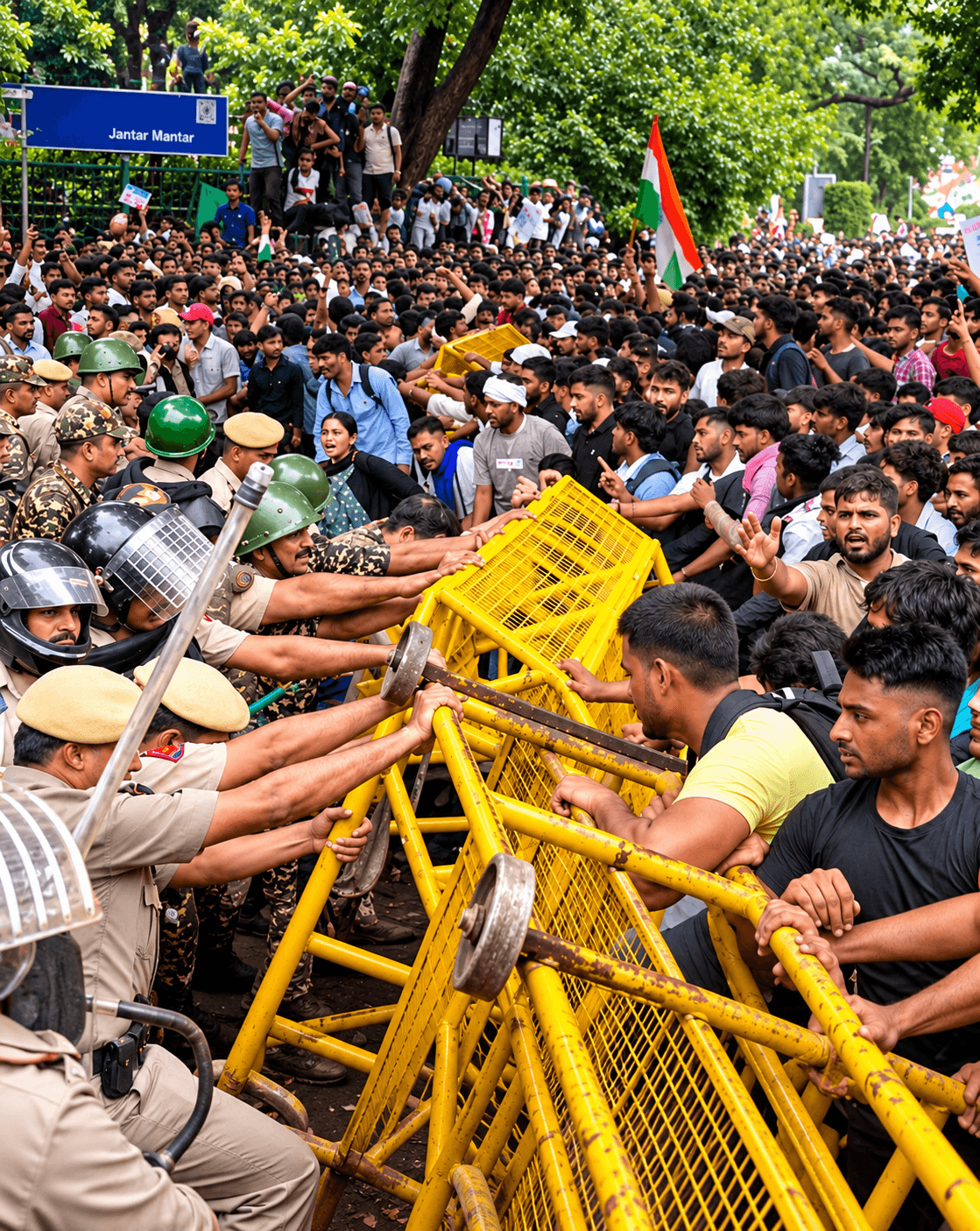
Jantar Mantar has emerged as the latest flashpoint in New Delhi's growing political dispute over electoral rolls, with security tightened around the protest zone as demonstrators challenge the Election Commission's handling of the issue.
The protest is linked to the ongoing debate over the Special Intensive Revision (SIR) of electoral rolls. Opposition parties and activists have raised concerns about the possibility of eligible voters being removed from the lists and have called for greater transparency in the process.
Authorities have increased security across parts of central Delhi, using barricades and restrictions to control access and prevent large gatherings from spreading beyond designated areas.
The Election Commission, meanwhile, has defended the revision exercise and rejected allegations of wrongdoing or politically motivated action.
The central question is now:
Can protesters press their demands without the confrontation escalating into a wider standoff with police and authorities?
WHAT IS HAPPENING?
Security has been tightened around Jantar Mantar as protesters gather to voice their opposition to the Election Commission's handling of electoral-roll revisions.
Additional police personnel have been deployed, while barricades and access restrictions are being used to manage movement around the area.
The measures are also affecting parts of central Delhi, where authorities are trying to prevent large or unauthorised gatherings from moving into restricted zones.
For the protesters, Jantar Mantar remains an important platform for demanding accountability. For police, the immediate concern is keeping the demonstration contained and preventing disruption to surrounding areas.
WHY ARE PROTESTERS TARGETING THE ELECTION COMMISSION?
At the heart of the dispute is the Special Intensive Revision, or SIR, of electoral rolls.
Opposition parties and activists have questioned whether the process could result in legitimate voters being removed from electoral lists. They are demanding clearer safeguards, greater transparency and accountability from election authorities.
Some demonstrators have also called for action against senior Election Commission officials, including demands for their resignation.
The Election Commission has rejected allegations that the revision is intended to target particular voters, communities or political groups.
WHAT IS THE SIR DEBATE?
The Special Intensive Revision is designed to review and update electoral rolls.
Election authorities use such exercises to identify problems including:
Duplicate voter entries
Incorrect or outdated information
Ineligible registrations
Names of deceased voters
Supporters argue that keeping electoral rolls accurate is essential for credible elections.
Critics, however, say the verification process must be designed carefully so that eligible voters are not excluded simply because they face difficulties providing documents or proving their eligibility.
That tension has turned what would normally be an administrative exercise into a much broader political dispute.
WHY JANTAR MANTAR?
Jantar Mantar is one of Delhi's best-known locations for political demonstrations.
Its location near Parliament, government offices and major commercial areas gives protests held there considerable visibility.
But the location also presents logistical and security challenges.
Large demonstrations can affect:
Traffic
Public transport
Government operations
Emergency access
Movement through central Delhi
As a result, authorities routinely impose restrictions when large demonstrations are expected.
POLICE RESPONSE
Police have increased their presence around sensitive areas and put up security barriers to control access.
The restrictions are aimed at preventing demonstrators from entering areas where public gatherings are prohibited or where additional security precautions are in place.
If protesters attempt to cross restricted lines, police could resort to detentions or other crowd-control measures.
The response is likely to remain under close political scrutiny, particularly if more protesters are detained.
PROTESTERS' POSITION
Protesters say questions surrounding electoral rolls deserve public scrutiny.
They argue that citizens should be able to peacefully demand answers from the institutions responsible for conducting elections.
Opposition groups have also criticised the restrictions placed on demonstrations, saying they make it harder for people to raise concerns publicly.
For many protesters, the dispute goes beyond an administrative review of voter lists.
Their argument is that the issue ultimately concerns a basic democratic right: the right to vote.
ELECTION COMMISSION'S POSITION
The Election Commission has maintained that reviewing electoral rolls is a routine part of maintaining accurate voter records.
Election authorities argue that voter databases need to be periodically checked to identify errors, duplicate entries and ineligible registrations.
The commission has rejected claims that the revision exercise is politically motivated.
That leaves the dispute centred on two competing concerns:
Maintaining accurate electoral rolls
versus
Protecting eligible voters from wrongful exclusion.
WHY VOTER DELETIONS MATTER
For a voter, being left off the electoral roll can have serious consequences.
Even an administrative error can prevent an otherwise eligible citizen from participating in an election.
At the same time, election authorities need reliable voter records to prevent duplication and maintain the integrity of the electoral system.
The difficult question is how to achieve both goals without allowing legitimate voters to fall through the cracks.
THE POLITICAL PRESSURE IS GROWING
The Jantar Mantar demonstration is part of a wider political campaign questioning the Election Commission's handling of electoral-roll revisions.
Opposition parties are increasingly using rallies, public meetings and demonstrations to put pressure on election authorities.
If more political groups join the campaign, the issue could move beyond a Delhi protest and become a larger national political controversy.
FROM PROTEST TO INSTITUTIONAL CONFRONTATION
What began as a dispute over voter records is increasingly becoming a broader confrontation involving several institutions and groups.
The key players include:
Political parties
Election authorities
Police
Civil-society organisations
Voters
Courts
Each side is approaching the issue from a different angle.
Protesters are demanding accountability.
Election authorities are emphasising accuracy and administrative integrity.
Police are focused on maintaining public order.
Courts could ultimately become involved if legal challenges are filed over electoral-roll procedures or restrictions on demonstrations.
CAN THE PROTEST ESCALATE?
Several developments could push tensions higher.
LARGE TURNOUT
A significantly larger crowd could put additional pressure on police and security arrangements.
DETENTIONS
Further detentions could trigger stronger criticism from opposition parties and civil-society groups.
OPPOSITION UNITY
If more political parties join the campaign, the dispute could quickly gain national attention.
LEGAL ACTION
Petitions challenging electoral-roll procedures could shift part of the dispute from the streets to the courts.
EXTENDED RESTRICTIONS
If restrictions around Jantar Mantar continue for an extended period, those measures could themselves become a political issue.
THE COMMUTER IMPACT
The political confrontation is also having an effect on ordinary Delhi residents.
Security measures around Jantar Mantar can lead to:
Traffic diversions
Barricades
Additional police checks
Metro access restrictions
Longer travel times
For commuters travelling through central Delhi, the disruption can be significant even if they have no connection to the demonstration.
WHY THIS MATTERS
1. THE ELECTION COMMISSION IS UNDER POLITICAL SCRUTINY
The controversy has placed India's election administration at the centre of a major political dispute.
2. VOTER LISTS DIRECTLY AFFECT DEMOCRATIC PARTICIPATION
Any controversy surrounding voter deletions can affect public confidence in the electoral process.
3. JANTAR MANTAR HAS BECOME A POLITICAL FLASHPOINT
The location gives protesters visibility while creating significant logistical and security challenges for authorities.
4. POLICE ACTION COULD SHAPE WHAT HAPPENS NEXT
Detentions or tighter restrictions could contain the demonstration — or fuel further political mobilisation.
5. THE DISPUTE COULD MOVE TO THE COURTS
If disagreements over electoral-roll revisions continue, legal challenges could become an important part of the next phase.
FACT CHECK METER
AWX FACT CHECK
FACT METER: 92%
STATUS: DEVELOPING
CONFIRMED
• Security has been tightened around Jantar Mantar amid political demonstrations.
• The protests are linked to concerns surrounding electoral-roll revisions and the Election Commission.
• Opposition groups have raised questions about possible voter deletions.
• The Election Commission has defended the electoral-roll revision process.
• Police have introduced security and crowd-management measures in central Delhi.
IMPORTANT DISTINCTION
"JANTAR MANTAR SEALED" SHOULD NOT NECESSARILY BE INTERPRETED AS A PERMANENT CLOSURE OF THE AREA.
Security measures can include temporary barricades, restricted access and limits on public gatherings.
The exact scope and duration of the restrictions may change as the situation develops.
CONTESTED
• Claims that eligible voters are being deliberately removed from electoral rolls.
• Allegations that the revision process is politically motivated.
• Whether the security restrictions are proportionate to the expected demonstration.
AWX VERDICT
SECURITY RESTRICTIONS: CONFIRMED
PROTEST OVER ELECTORAL ROLLS: CONFIRMED
ELECTION COMMISSION UNDER POLITICAL PRESSURE: CONFIRMED
CLAIMS OF SYSTEMATIC VOTER EXCLUSION: CONTESTED
SITUATION: DEVELOPING
AWX FOCUS: THE JANTAR MANTAR STANDOFF
PROTESTERS
Demanding greater transparency and accountability from election authorities.
ELECTION COMMISSION
Defending the need for accurate and regularly updated electoral rolls.
POLICE
Trying to prevent unauthorised gatherings and maintain public order.
POLITICAL PARTIES
Using the controversy to challenge the Election Commission's handling of the electoral-roll process.
VOTERS
Watching closely to see whether changes to electoral rolls could affect their ability to participate in elections.
THE KEY QUESTION
Will the confrontation lead to greater transparency over electoral-roll revisions — or deepen the political divide over India's election institutions?
WHAT TO WATCH NEXT
Police response
Whether additional protesters are detained or removed from restricted areas.
Protest turnout
Whether the demonstration grows beyond its initial size.
Political parties
Whether additional opposition groups join the campaign.
Election Commission
Whether officials provide further clarification about the revision process.
Courts
Whether fresh petitions challenge electoral-roll decisions or restrictions on demonstrations.
Metro and traffic
Whether restrictions around central Delhi are extended.
Public reaction
Whether concerns about electoral rolls spread beyond political organisations.
THE AWX BOTTOM LINE
The confrontation at Jantar Mantar is becoming a broader test of public confidence in India's political and electoral institutions.
Protesters say they want answers about voter lists and the Election Commission's actions.
Authorities say security restrictions are necessary to maintain public order.
The Election Commission maintains that electoral-roll revision is necessary to keep voter records accurate.
At the heart of the dispute is trust.
If voters believe their names can disappear from electoral rolls without adequate explanation, confidence in the electoral process can suffer. If authorities are unable to manage demonstrations safely, concerns over public order can grow.
The challenge is to address both concerns without allowing either one to overshadow the other.
Jantar Mantar may be under heavy security today, but the larger dispute is about something much bigger: public confidence in the electoral process.
ATTLAS WIRE | AWX WORLD NEWS
Real Stories. Lasting Impact.




Comments
No comments yet.