

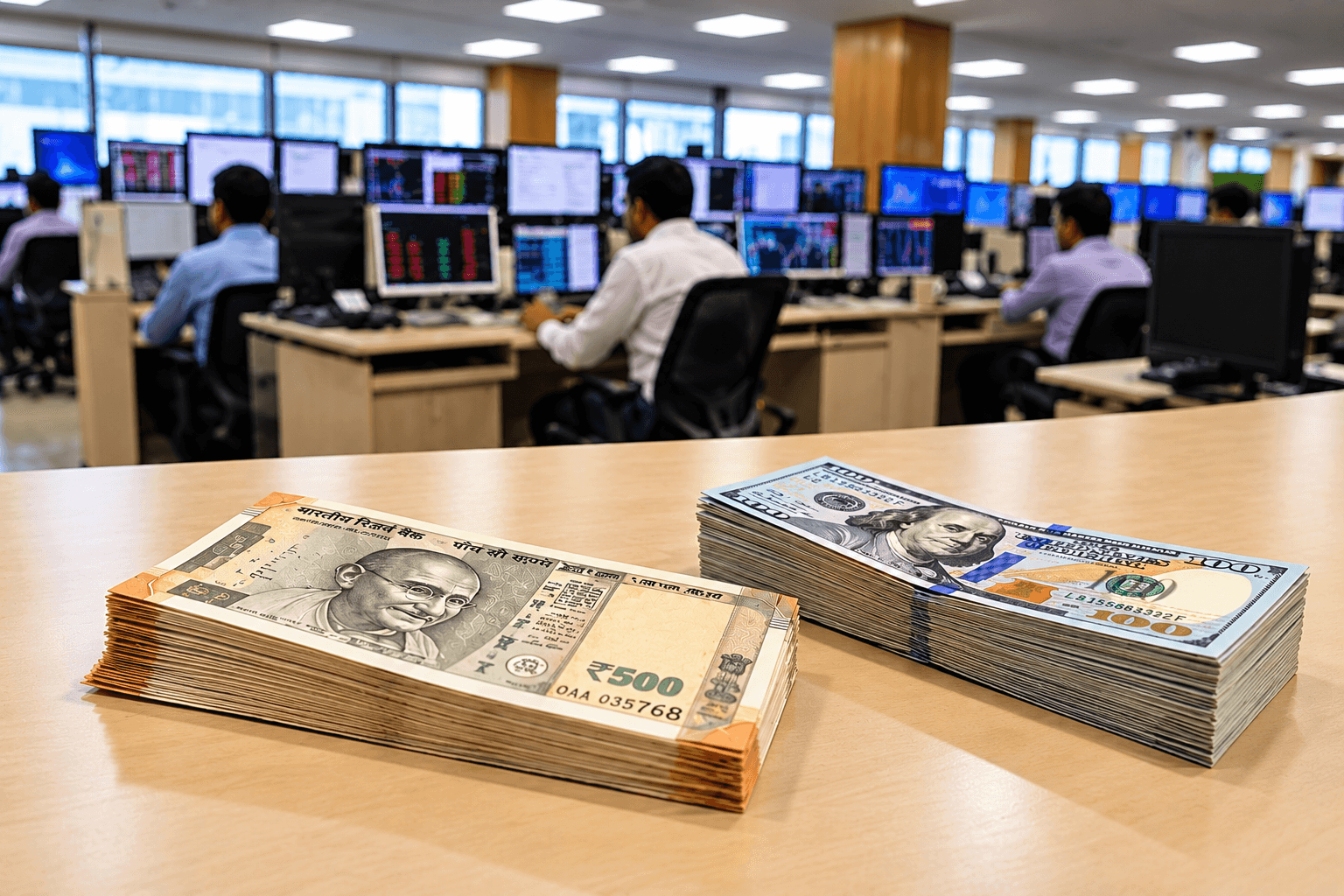
Indian equities are dealing with a difficult mix of global and domestic pressures.
Brent crude has remained above $105 a barrel, raising concerns over India’s import bill, inflation and corporate costs. At the same time, elevated U.S. Treasury yields are making fixed-income assets more attractive and adding pressure to emerging-market equities.
The impact was clear during Thursday’s session.
The Sensex fell 1,247.71 points, or 1.67%, to close at 73,580.54. The Nifty 50 dropped 383.70 points, or 1.64%, ending at 23,063.10.
Indian stocks recovered some ground on Friday, but the rebound was measured. Investors remain focused on whether the recent decline is simply a short-term correction or the start of a more prolonged period of weakness.
WHAT HAPPENED?
Indian benchmark indices came under heavy selling pressure after crude oil prices moved higher and global bond yields rose.
The combination created an uncomfortable environment for investors.
Higher oil prices increase India’s energy import costs, while higher global yields can make emerging-market assets relatively less attractive.
Financial stocks were among the sectors hit during Thursday’s sell-off. Both the Sensex and Nifty fell more than 1.5%, while broader market indices also recorded significant declines.
On Friday, bargain hunting helped the market recover part of those losses.
Still, the rebound has not eliminated the concerns that triggered the sell-off.
WHY OIL MATTERS TO INDIA
India relies heavily on imported crude oil, making global oil prices an important factor for both the economy and financial markets.
When crude becomes more expensive, several parts of the economy can feel the impact:
India’s import bill increases.
Pressure on the current account can rise.
Fuel and transportation costs can increase.
Inflation risks become more pronounced.
Corporate margins can come under pressure.
The rupee may face additional pressure.
With Brent crude trading around $105 a barrel on Friday, energy costs remain firmly in focus.
For investors, however, the bigger issue is not simply where oil trades today.
The real question is how long prices stay elevated.
If crude remains above $100 for weeks or months, the impact on inflation, corporate profitability and the currency could become more significant.
THE GLOBAL YIELD PROBLEM
Oil is only part of the story.
Global bond yields have also climbed sharply. The U.S. 10-year Treasury yield was around 5.1% during the latest market sell-off, while the 30-year yield reached levels not seen in many years.
Higher Treasury yields can affect emerging markets in several ways.
They can make U.S. government bonds more appealing to international investors. They can also increase global borrowing costs and put pressure on emerging-market currencies.
For India, that creates another headwind at a time when higher oil prices are already adding to economic uncertainty.
FOREIGN INVESTORS ARE WATCHING
Foreign portfolio flows are another concern for Indian equities.
Global uncertainty, high oil prices and expectations around interest rates have kept many overseas investors cautious.
Recent data showed substantial foreign selling in Indian equities during September.
Continued foreign outflows can put pressure on large-cap stocks and the major market indices.
Domestic institutional investors, however, have continued to provide some support.
That leaves the market caught between two opposing forces:
Foreign selling versus domestic buying.
If global conditions deteriorate further, domestic investors may have to absorb a much larger wave of overseas selling.
FINANCIAL STOCKS FEEL THE PRESSURE
Banks and other financial companies have also been affected by the recent market weakness.
Higher global yields can influence expectations for interest rates and funding costs. At the same time, domestic regulatory developments have added another layer of uncertainty for parts of the financial sector.
Concerns over proposed changes to insurance commission structures contributed to selling pressure in financial stocks during Thursday’s session.
As a result, investors are dealing with two different sets of risks.
Oil prices and global yields are driving the broader macroeconomic story, while sector-specific regulatory concerns are adding to volatility within the financial sector.
THE RUPEE QUESTION
Oil prices and the rupee are closely linked.
When India’s crude import bill rises, demand for U.S. dollars can increase. If other capital inflows do not offset that demand, the rupee can come under pressure.
A weaker rupee, in turn, makes imported energy more expensive and can add another layer of inflationary pressure.
The impact is not the same across every industry.
Export-oriented companies can sometimes benefit from a weaker rupee, while businesses that depend heavily on imported raw materials may face higher costs.
For investors, the effect therefore depends heavily on the sector.
CAN INDIA ABSORB THE SHOCK?
India enters this period of market stress with several sources of support.
Domestic economic activity remains an important driver of corporate earnings. Domestic investors have also become a much larger force in the Indian equity market.
And if oil prices fall, some of the current pressure could ease relatively quickly.
The situation becomes more challenging if the disruption lasts.
If crude remains above $100 for an extended period while global yields stay elevated, India could face additional pressure on inflation, the rupee and corporate earnings.
DIPLOMACY COULD CHANGE THE MARKET
One of the biggest potential catalysts is the situation in the Middle East.
Oil prices have reacted sharply to developments surrounding the Iran-U.S. conflict and the Strait of Hormuz.
Any credible diplomatic progress that improves shipping conditions could push crude prices lower and provide some relief to oil-importing economies such as India.
Lower oil prices could reduce pressure on the import bill and inflation while improving investor sentiment.
The opposite is also true.
A renewed escalation could send energy prices higher and put additional pressure on global markets.
For Indian investors, geopolitical developments are therefore becoming nearly as important as domestic economic data.
WHY THIS MATTERS
1. OIL IS A MAJOR MACROECONOMIC RISK
Sustained crude prices above $100 could increase India’s import costs and add to inflationary pressure.
2. GLOBAL YIELDS CAN REDUCE RISK APPETITE
Higher U.S. Treasury yields can make investors more cautious about emerging-market equities.
3. FOREIGN FLOWS COULD REMAIN VOLATILE
Continued foreign selling could weigh on Indian benchmarks even if domestic institutions continue buying.
4. FINANCIAL STOCKS ARE UNDER PRESSURE
Banks, insurers and other financial companies are facing both global interest-rate concerns and domestic regulatory uncertainty.
5. DIPLOMACY COULD PROVIDE RELIEF
Any meaningful reduction in Middle East tensions could bring oil prices down and improve sentiment across Indian markets.
FACT CHECK METER
AWX FACT CHECK
STATUS: DEVELOPING
CONFIRMED
The Sensex fell 1,247.71 points on Thursday, closing at 73,580.54.
The Nifty 50 fell 383.70 points to 23,063.10.
Brent crude remained above $105 a barrel around Friday trading.
U.S. Treasury yields remained elevated.
Indian financial stocks faced significant selling pressure.
Indian equities recovered modestly on Friday following Thursday’s sharp decline.
NOT INDEPENDENTLY VERIFIED
Whether the recent decline marks the beginning of a prolonged bear-market phase.
How long crude prices will remain above $100.
The eventual impact of Middle East disruptions on India’s full-year inflation and growth outlook.
Whether foreign investors will return to sustained buying in Indian equities.
MARKET RISK
A combination of high oil prices and elevated global yields creates a difficult backdrop for Indian equities by increasing inflation concerns and tightening financial conditions.
POTENTIAL RELIEF
A sustained decline in crude prices, lower global yields or meaningful progress toward de-escalation in the Middle East could improve investor sentiment.
AWX VERDICT
MARKET PRESSURE: CONFIRMED
OIL RISK: HIGH
GLOBAL YIELD PRESSURE: SIGNIFICANT
LONG-TERM MARKET DIRECTION: UNCERTAIN
WHAT TO WATCH NEXT
Crude oil
Will Brent remain above $100, or could easing Middle East tensions bring prices lower?
U.S. Treasury yields
Will global yields continue climbing, or begin to moderate?
Foreign investors
Will foreign portfolio investors continue reducing their exposure to Indian equities?
Rupee
Will higher oil prices create additional pressure on the Indian currency?
Inflation
Will rising energy costs begin to show up more clearly in India’s inflation data?
Banking and financial stocks
Can the sector stabilize after the recent sell-off?
Middle East diplomacy
Will developments involving Iran, the United States and the Strait of Hormuz reduce the risk premium in energy markets?
Nifty 50
Can the index recover the ground lost during Thursday’s sharp decline, or will selling pressure continue?
THE AWX BOTTOM LINE
India’s stock market is being squeezed by two powerful global forces:
Expensive oil.
Higher global yields.
Both can make conditions more difficult for an emerging economy and its financial markets.
India’s domestic economy and growing base of local investors provide an important cushion, but they cannot completely shield the market from global shocks.
If oil prices retreat and bond yields stabilize, the recent sell-off could prove temporary.
If crude stays elevated while global yields continue climbing, pressure on Indian equities could persist.
For now, investors are watching three numbers particularly closely:
The price of oil.
The level of global yields.
The direction of foreign capital.
Together, they could determine whether India’s latest market correction remains contained or becomes a deeper test for Dalal Street.
ATTLAS WIRE | AWX WORLD NEWS
Real Stories. Lasting Impact.




Comments
No comments yet.