

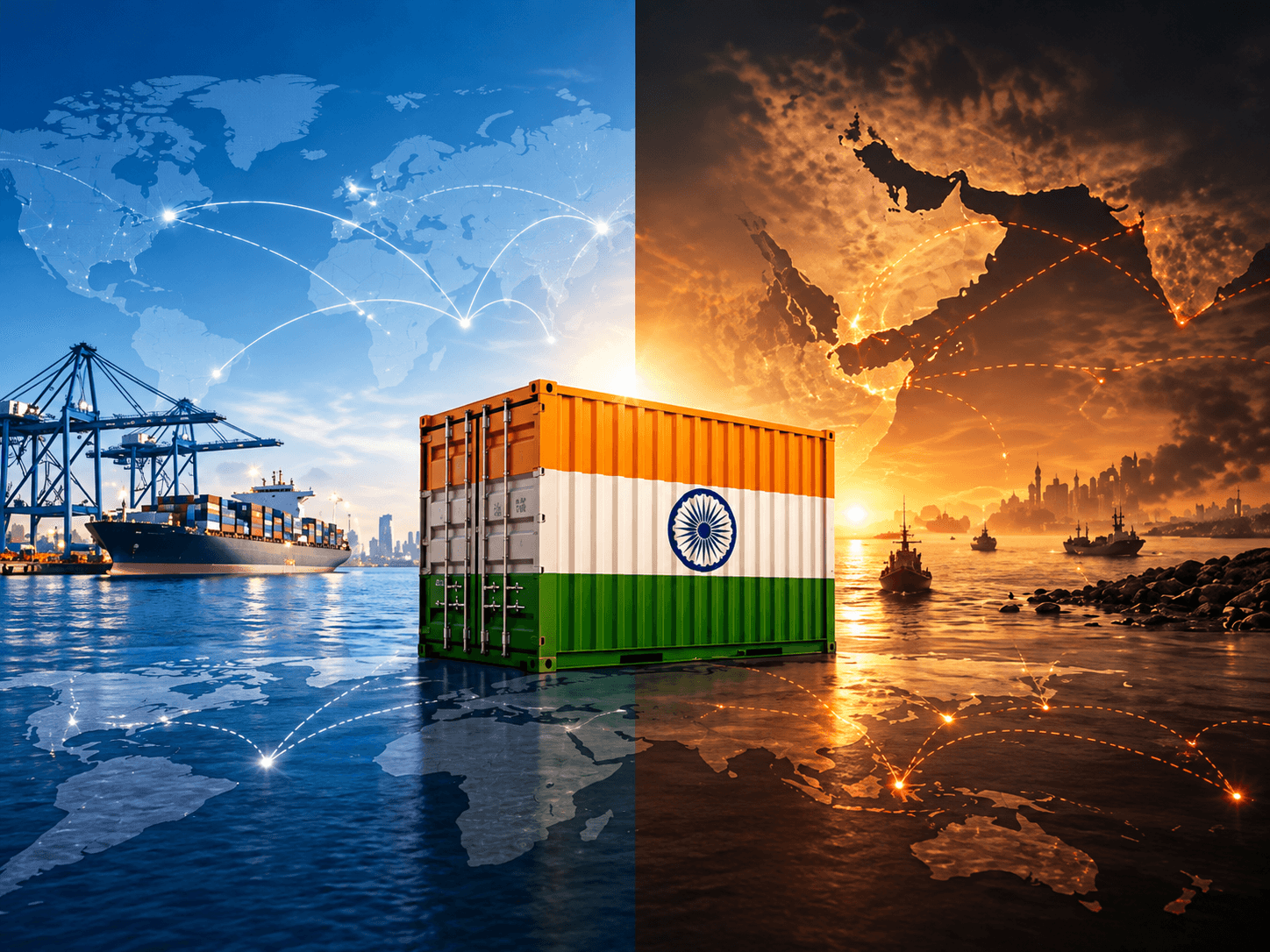
Several regions are becoming increasingly important to India's emerging trade strategy:
Europe.
The Gulf.
Southeast Asia.
The United States.
Africa.
And neighbouring South Asian markets.
The goal is relatively simple:
More markets. More suppliers. More investment. Less dependence on any single source.
WHAT IS INDIA TRYING TO CHANGE?
India's trade has long been closely tied to a relatively small group of major economic partners.
China remains an important source of imports.
The United States is one of India's biggest export markets.
The Gulf is vital for energy and is becoming an increasingly important source of investment.
Europe remains a major destination for Indian goods and services.
New Delhi is now trying to deepen these relationships while creating additional commercial links elsewhere.
At the heart of the approach is trade diversification.
Instead of relying too heavily on one country or region, India wants a broader network of economic relationships that can provide greater flexibility when global conditions change.
THE UNITED STATES — A KEY MARKET
The United States remains central to India's trade ambitions.
American demand supports a wide range of Indian exports, including information technology services, pharmaceuticals, engineering products, textiles and manufactured goods.
The two countries are also working to expand cooperation in areas such as technology, defence, energy and supply chains.
But the relationship has its challenges.
Tariffs, trade negotiations, market-access questions and regulatory differences can create friction.
For India, the challenge is to expand access to the American market while ensuring that its wider economic interests remain protected.
EUROPE — A MAJOR MARKET WITH ROOM TO GROW
Europe represents another significant opportunity.
The European Union is one of the world's largest trading blocs and offers Indian companies access to a large and relatively high-value consumer market.
India has been working to deepen trade and investment ties with European economies, with opportunities spanning several sectors.
These include:
• Pharmaceuticals
• Engineering goods
• Automobiles and components
• Textiles
• Chemicals
• Digital services
• Clean-energy technology
For India, stronger European trade could help broaden its export base.
For Europe, India offers a large consumer market and an increasingly important manufacturing and services partner.
THE GULF — TRADE, ENERGY AND CAPITAL
The Gulf has become an increasingly important part of India's economic strategy.
Countries such as the United Arab Emirates and Saudi Arabia are major energy suppliers and increasingly significant investment partners.
The relationship, however, goes well beyond oil.
India is seeking greater cooperation in areas including:
Logistics
Ports
Digital infrastructure
Food security
Renewable energy
Finance
Manufacturing
Technology
The Gulf's geographic position also gives India access to commercial networks stretching into Africa and Europe.
That makes the region strategically important not just because of energy, but because of its role in trade, investment and connectivity.
THE INDIA–MIDDLE EAST–EUROPE CONNECTION
India's trade strategy is also increasingly linked to major connectivity initiatives.
The India–Middle East–Europe Economic Corridor has been proposed as a way to connect South Asia with the Gulf and Europe through a combination of maritime and rail infrastructure.
For India, improved connectivity could potentially:
• Lower logistics costs
• Improve export access
• Strengthen links with European markets
• Deepen economic ties with Gulf countries
• Create additional trade routes
The larger idea is becoming increasingly important: trade routes themselves can be strategic assets.
SOUTHEAST ASIA — THE MANUFACTURING CONNECTION
India is also looking more closely toward Southeast Asia.
ASEAN economies are deeply connected to global manufacturing and supply chains.
Countries such as Vietnam, Indonesia, Malaysia, Singapore and Thailand have developed into important production, trade and logistics centres.
India wants closer economic ties with the region through trade, investment and supply-chain cooperation.
That could become particularly important as companies look for ways to diversify production beyond heavily concentrated manufacturing networks.
India and Southeast Asia could increasingly complement one another as manufacturing and logistics hubs.
AFRICA — THE LONG-TERM OPPORTUNITY
Africa is another important part of India's expanding trade strategy.
The continent's growing population and developing economies offer long-term opportunities for Indian companies.
Potential areas include:
• Pharmaceuticals
• Automobiles
• Agricultural products
• Digital services
• Machinery
• Infrastructure
• Financial technology
Indian companies already have a presence in several African markets.
For New Delhi, stronger economic ties with Africa could expand export opportunities while reinforcing India's broader engagement with the Global South.
CHINA — THE COMPLICATED PARTNER
China remains impossible to overlook when discussing India's trade strategy.
It continues to be one of India's most important sources of imports, with Indian industries relying on Chinese electronics, machinery, chemicals and industrial components.
At the same time, New Delhi wants to reduce excessive dependence on Chinese supply chains.
That leaves India pursuing two objectives at once:
Trade with China continues.
Supply-chain diversification continues.
Strategic competition remains.
India is therefore not simply trying to replace China.
It is trying to build alternatives.
WHY SUPPLY CHAINS MATTER
The COVID-19 pandemic exposed the vulnerabilities created by highly concentrated global production.
The war in Ukraine, disruptions in the Red Sea and rising geopolitical tensions have added further pressure on companies and governments to rethink how goods move around the world.
Businesses increasingly want supply chains capable of withstanding:
War
Sanctions
Tariffs
Shipping disruptions
Political disputes
Natural disasters
Export restrictions
India sees this shift as an opportunity.
If multinational companies want a second or third manufacturing base, New Delhi wants India to be among their preferred choices.
INDIA'S "CHINA+1" OPPORTUNITY
The China+1 strategy has become one of the defining ideas in global manufacturing.
The concept does not necessarily mean companies are leaving China.
Instead, many businesses are looking to add another production location to reduce concentration risk.
India wants to become one of those additional bases.
Its potential advantages include:
• A large domestic market
• A substantial workforce
• Expanding manufacturing capacity
• Government incentives
• Strong technology and services sectors
• Continued infrastructure investment
But India faces stiff competition from countries including Vietnam, Indonesia and Mexico.
The opportunity is significant, but capturing it will depend on India's ability to remain competitive on costs, infrastructure, logistics, skills and ease of doing business.
TRADE DEALS AS STRATEGIC TOOLS
India's trade negotiations are increasingly connected to its broader strategic interests.
Trade agreements can deliver:
Market access
Investment
Supply-chain integration
Technology partnerships
Export opportunities
They can also strengthen diplomatic relationships.
As a result, India's trade policy is becoming more closely connected to its foreign-policy priorities.
The countries India wants to trade with increasingly overlap with the countries it considers strategically important.
THE ENERGY QUESTION
Energy remains a major consideration in India's trade calculations.
India is one of the world's largest energy consumers and continues to rely heavily on imported crude oil and other energy products.
That makes the Gulf particularly important.
At the same time, India is seeking to diversify its energy sources and expand renewable-energy capacity.
The long-term challenge is to secure reliable and affordable energy while reducing vulnerability to disruptions.
TRADE ROUTES ARE BECOMING STRATEGIC
India's new trade map is not just about countries.
It is also about routes.
The Arabian Sea.
The Indian Ocean.
The Gulf.
The Suez Canal.
Southeast Asian shipping lanes.
European transport networks.
A disruption anywhere along these routes can quickly affect Indian exporters and importers.
That makes ports, railways, logistics centres and maritime security increasingly important components of India's trade strategy.
THE DIGITAL TRADE ADVANTAGE
India's export strength extends beyond physical goods.
Services remain one of the country's biggest links to the global economy.
Indian companies are deeply involved in technology, consulting, financial services and other business-services markets around the world.
Digital trade also allows Indian businesses to reach international customers without relying entirely on physical shipping networks.
That gives India another way to diversify its economic relationships.
THE RISK OF OVEREXTENSION
There is also a difficult balancing act.
Maintaining relationships with multiple economic powers requires significant diplomatic and economic effort.
The United States may seek stronger supply-chain alignment.
China remains an important trading partner.
The Gulf wants investment, technology and deeper commercial ties.
Europe is interested in market access and regulatory cooperation.
Russia remains relevant to India in areas such as energy and defence.
India therefore has to balance competing interests carefully.
The objective is to build partnerships without becoming excessively dependent on any one bloc.
INDIA'S STRATEGIC BET
The emerging approach can be summed up in one phrase:
Multi-alignment through trade.
India wants to maintain commercial relationships with several major economic centres rather than place all of its economic interests in one camp.
It wants American technology and demand.
European markets.
Gulf capital, energy and connectivity.
Asian manufacturing partnerships.
African growth markets.
And continued access to Chinese industrial supplies where necessary.
It is a complicated strategy.
But it also gives India greater room to manoeuvre.
WHY THIS MATTERS
1. INDIA WANTS MORE EXPORT MARKETS
A wider export base can reduce the impact of economic weakness, tariffs or restrictions in any single market.
2. GLOBAL COMPANIES ARE LOOKING FOR ALTERNATIVES
India wants to capture a larger share of manufacturing investment being diversified beyond traditional production hubs.
3. THE GULF IS BECOMING MORE IMPORTANT
Energy, investment, logistics and connectivity are bringing India and Gulf economies closer together.
4. EUROPE OFFERS A MAJOR CONSUMER MARKET
Stronger trade ties could create new opportunities for Indian exporters across several industries.
5. CHINA REMAINS TOO IMPORTANT TO IGNORE
Even as India diversifies its supply chains, Chinese imports remain embedded in many parts of Indian industry.
FACT CHECK METER
AWX FACT CHECK
FACT METER: 94%
STATUS: DEVELOPING
CONFIRMED
• India is pursuing broader international trade and investment relationships.
• The United States, European markets and Gulf economies remain important to India's trade strategy.
• China continues to be a major source of Indian imports.
• India is seeking greater domestic manufacturing capacity and stronger supply-chain resilience.
• Southeast Asia and Africa represent important areas for potential trade expansion.
• India is pursuing connectivity initiatives aimed at strengthening links with the Gulf, Europe and other markets.
IMPORTANT DISTINCTION
TRADE DIVERSIFICATION DOES NOT MEAN INDIA IS ABANDONING EXISTING PARTNERS.
The broader strategy is about maintaining multiple economic relationships at the same time while reducing excessive dependence on any single market or supplier.
DEVELOPING
• How quickly India can expand exports into new markets.
• Whether multinational companies will significantly increase manufacturing investment in India.
• The pace and scope of new trade agreements.
• The future role of China in India's industrial supply chains.
• Whether major connectivity projects can deliver meaningful reductions in logistics costs.
AWX VERDICT
TRADE DIVERSIFICATION: ACCELERATING
US RELATIONSHIP: STRATEGIC
EUROPE: MAJOR OPPORTUNITY
GULF: ENERGY + CAPITAL + CONNECTIVITY
CHINA: CRITICAL BUT COMPLICATED
INDIA'S STRATEGY: MULTI-ALIGNMENT
SITUATION: DEVELOPING
AWX FOCUS: WHO IS INDIA BETTING ON?
UNITED STATES
Technology, investment and a major export market.
EUROPE
High-value consumers, investment and advanced manufacturing opportunities.
GULF
Energy, capital, logistics and access to wider markets.
SOUTHEAST ASIA
Manufacturing partnerships and regional supply-chain integration.
AFRICA
Long-term consumer growth and infrastructure opportunities.
CHINA
Critical industrial supplies despite continuing strategic competition.
THE KEY QUESTION
Can India build a trade network broad enough to reduce dependence on any single economic power while maintaining strong relationships with all of them?
WHAT TO WATCH NEXT
Trade agreements:
New market-access deals involving Europe, the Gulf, Asia and other regions.
Manufacturing:
Fresh investment commitments from multinational companies operating in India.
China:
Changes in India's import dependence and domestic production of components.
Gulf:
New investments, energy agreements and logistics partnerships.
Europe:
Progress in India–EU trade and investment negotiations.
Supply chains:
Whether India captures a larger share of global China+1 manufacturing.
Connectivity:
Progress on major transport and economic-corridor projects.
THE AWX BOTTOM LINE
India's trade strategy is being reshaped.
New Delhi is not betting on one market.
It is betting on a network.
The United States offers technology and demand.
Europe offers scale and high-value consumers.
The Gulf offers energy, capital and connectivity.
Southeast Asia offers manufacturing links.
Africa offers long-term growth opportunities.
China remains a critical industrial partner, even as India works to reduce excessive dependence on Chinese supply chains.
The complexity is intentional.
India wants enough flexibility to operate in a world where trade, security and geopolitics are increasingly intertwined.
The new trade map is therefore not about choosing one side.
It is about creating enough options that India does not have to choose just one.
ATTLAS WIRE | AWX WORLD NEWS
Real Stories. Lasting Impact.




Comments
No comments yet.