

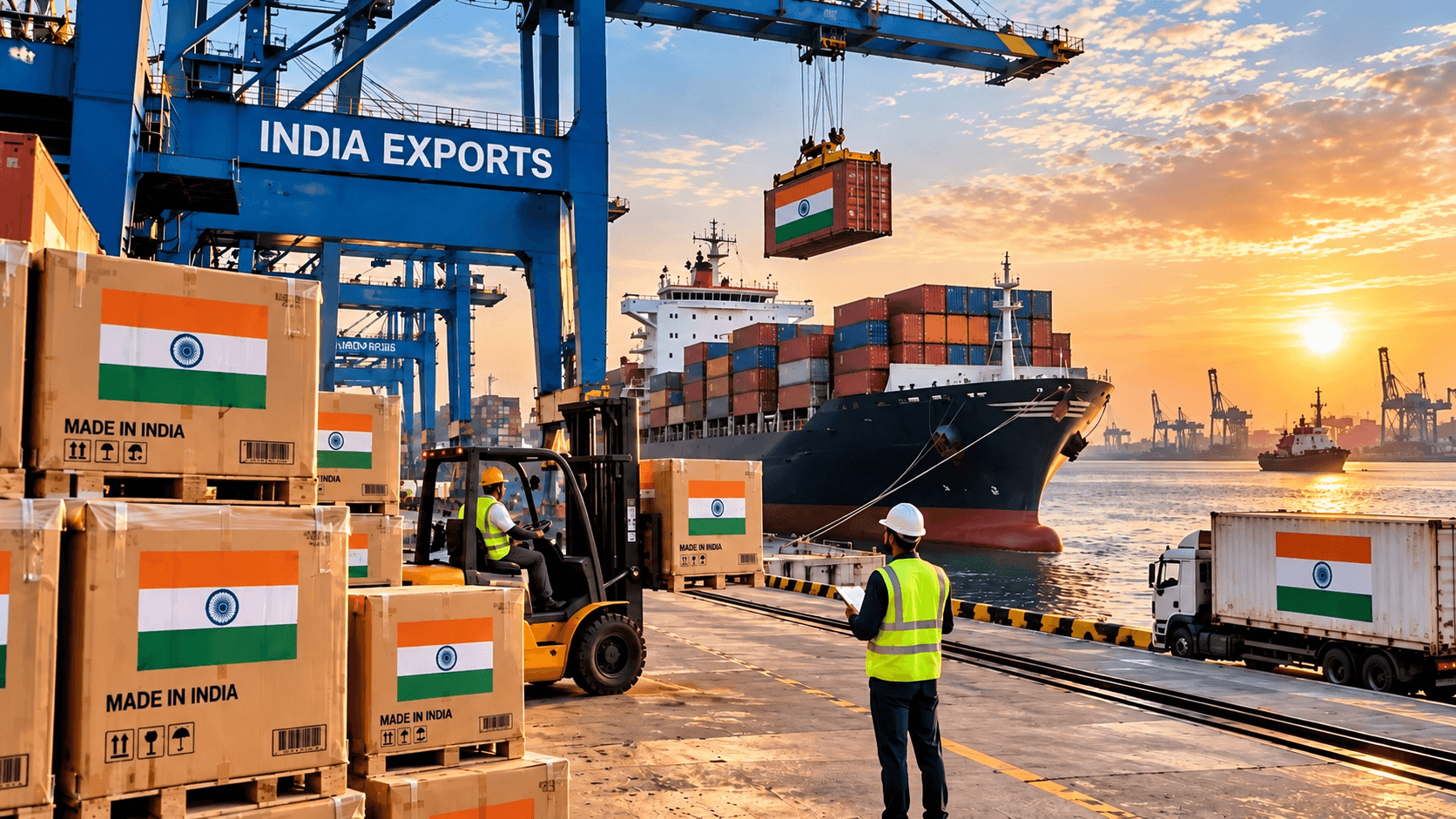
For India, the challenge is finding new suppliers and building domestic capacity without disrupting industries that currently rely on Chinese inputs.
For businesses, that means reassessing suppliers, investing in local production and finding ways to make logistics less vulnerable to disruption.
For China, India's changing procurement strategy presents a challenge — but also an opportunity to remain deeply involved in one of the world's largest and fastest-growing economies.
WHAT IS CHANGING?
China has been an important supplier to India's industrial economy for years.
Its role extends across:
• Electronics
• Machinery
• Chemicals
• Solar equipment
• Pharmaceutical inputs
• Electrical components
• Telecommunications equipment
• Industrial goods
India is now putting greater emphasis on developing alternative sources for strategically important products.
The problem is that Chinese manufacturers have built enormous production capacity and supplier networks. They can often deliver components at prices and volumes that are difficult for newer suppliers to match.
That leaves India facing a difficult balancing act:
How do you make supply chains more resilient without making production unnecessarily expensive?
TRADE REMAINS LARGE
Despite political and strategic tensions, India and China remain closely connected commercially.
India imports considerably more from China than it exports, leaving the country with a persistent trade deficit.
Chinese goods and components are also embedded in several Indian manufacturing industries. As a result, companies can continue to depend on Chinese suppliers even while the government pushes for greater domestic production.
That makes a sudden break unlikely.
For now, the shift is more likely to happen gradually, as businesses find alternative suppliers and Indian manufacturers expand their own capabilities.
INDIA'S MANUFACTURING PUSH
New Delhi has spent years trying to strengthen India's manufacturing base.
Government programs covering electronics, semiconductors, pharmaceuticals, renewable energy and other industries are aimed at expanding domestic production.
The broader ambition goes beyond serving India's huge consumer market.
India wants to become a significant manufacturing and export base for global companies.
That ambition has become even more important as multinational businesses look for additional production locations and try to reduce their exposure to concentrated supply chains.
The message from India is increasingly clear:
Build in India. Produce in India. Export from India.
But turning that ambition into reality requires more than assembling finished products.
THE CHINA DEPENDENCY PROBLEM
One of India's biggest challenges is that domestic manufacturing can still depend heavily on imported Chinese components.
An Indian factory may assemble a product locally while importing many of its most important parts from China.
That means higher domestic assembly does not necessarily mean lower foreign dependence.
The next step is moving deeper into the supply chain and producing more of the inputs locally.
That includes:
Components
Raw materials
Industrial machinery
Electronic parts
Specialised chemicals
Advanced technology
Building that wider ecosystem will take time and significant investment.
ELECTRONICS AT THE CENTRE
Electronics offer one of the clearest examples of India's changing supply-chain strategy.
India has rapidly expanded smartphone assembly and other electronics manufacturing, while major international companies have increased production in the country.
That has helped India become a more important manufacturing location.
But the picture is more complicated further down the supply chain.
Many components are still sourced through Asian manufacturing networks, with China playing a major role.
India's next challenge is therefore moving beyond assembly and increasing domestic production of components.
If that happens at scale, it could gradually reduce India's reliance on Chinese suppliers.
PHARMACEUTICALS ALSO MATTER
Pharmaceuticals present another example of the trade-off.
India is one of the world's major producers of generic medicines, but parts of the industry still rely on imported active pharmaceutical ingredients and chemical intermediates.
China is an important source for several of these inputs.
Reducing that dependence would require investment in domestic chemical and pharmaceutical manufacturing.
But replacing lower-cost imports with more expensive alternatives could increase production costs.
That is why supply-chain diversification is not simply a geopolitical decision.
It is also an economic one.
SOLAR AND CLEAN ENERGY
The clean-energy transition adds another layer to the debate.
India is rapidly expanding renewable-energy capacity, particularly solar power. But solar manufacturing depends on a large network of components, materials and equipment.
China remains a major force across much of the global solar supply chain.
India therefore faces a difficult choice.
It wants to expand renewable energy quickly while also building domestic manufacturing capacity.
Reducing dependence on Chinese suppliers could improve long-term supply security, but doing so too quickly could raise costs.
WHY COMPANIES ARE DIVERSIFYING
Governments are not the only ones reassessing supply chains.
Companies are doing it too.
The COVID-19 pandemic exposed the risks of relying too heavily on a single manufacturing location. Geopolitical tensions have added another layer of uncertainty.
As a result, businesses are considering strategies such as:
China + 1
China + India
Regional manufacturing
Dual sourcing
Local component production
The objective is not necessarily to leave China.
For many companies, the goal is simpler: make sure a disruption in one country does not bring the entire production chain to a halt.
CHINA'S ADVANTAGE REMAINS LARGE
China still has enormous advantages in manufacturing.
Its industrial base includes:
• Massive production capacity
• Extensive supplier networks
• Major ports and logistics infrastructure
• Experienced manufacturing labour
• Established export channels
• Deep component supply chains
Those advantages make China difficult to replace quickly.
India can become an important alternative manufacturing centre, but building an ecosystem comparable to China's scale will take years.
INDIA'S ADVANTAGE
India has a different set of strengths.
The country offers:
A huge domestic market
A large and growing workforce
Strong consumer demand
Expanding digital infrastructure
Government incentives for manufacturing
Increasing integration with global supply chains
For multinational companies, that combination is attractive.
India can potentially serve as both a production base and one of the world's biggest consumer markets.
That is one reason international manufacturers continue to evaluate India as part of their long-term supply-chain plans.
THE GEOPOLITICAL DIMENSION
The India–China relationship cannot be viewed purely through trade figures.
The two countries remain strategic competitors and have faced serious tensions along their disputed border.
Those security concerns inevitably influence economic policy.
India has increasingly treated certain technologies, infrastructure projects and critical supply chains as issues of national importance.
At the same time, China remains one of India's largest sources of imports.
The result is a complicated relationship in which two realities exist side by side:
Strategic competition and economic interdependence.
DECOUPLING OR DIVERSIFICATION?
The difference between the two matters.
Decoupling would involve substantially separating the two economies.
Diversification means reducing excessive dependence while continuing to trade.
India's current direction appears much closer to the second approach.
New Delhi can encourage alternative suppliers and domestic production without shutting the door on Chinese imports.
For Indian companies, that can provide greater flexibility while preserving access to competitively priced products.
THE COST QUESTION
Diversification comes with a price.
If a company replaces a lower-cost Chinese supplier with a more expensive alternative, its production costs may increase.
Those additional costs can eventually be passed on to consumers.
Indian policymakers therefore face a difficult equation:
Security + resilience + affordability.
The strongest supply chain is not necessarily the one with the least exposure to China.
It is the one that can remain reliable, competitive and operational when disruptions occur.
INDIA'S EXPORT AMBITION
Supply-chain diversification is also tied to India's larger export ambitions.
India wants to capture a bigger share of global manufacturing.
Doing that will require more than assembling imported parts. The country will need stronger domestic supplier networks and closer links between smaller manufacturers, large companies and global firms.
That transformation will not happen overnight.
But if India succeeds, it could significantly change its position in global trade.
CHINA'S RESPONSE
China is unlikely to simply give up its position in the Indian market.
Chinese companies remain competitive across a wide range of industries. Some may respond to India's changing industrial strategy through local production, partnerships, distribution networks and other forms of investment.
That could create a different kind of economic relationship.
Instead of India importing every product directly from China, Chinese companies could increasingly participate in manufacturing within India.
In that scenario, India's dependence on imports could decline without necessarily ending the commercial relationship between the two countries.
THE NEW SUPPLY-CHAIN MAP
Global manufacturing is becoming more diversified.
Companies are looking at India, Vietnam, Indonesia, Mexico and other production centres alongside established manufacturing hubs.
India is hoping to capture a significant share of that shift.
The competition, however, is intense.
Countries are offering tax incentives, infrastructure investment, skilled labour and other support to attract manufacturers.
India's success will depend partly on how quickly it can improve logistics, electricity reliability, workforce skills, industrial infrastructure and regulatory efficiency.
WHY THIS MATTERS
1. INDIA REMAINS DEPENDENT ON CHINESE INPUTS
Several industries still rely heavily on Chinese machinery, components and raw materials.
2. INDIA WANTS MORE CONTROL
Domestic manufacturing policies are increasingly aimed at building deeper supply chains rather than simply assembling imported products.
3. GLOBAL COMPANIES ARE DIVERSIFYING
Businesses want multiple production locations so that a disruption in one market does not threaten their entire operation.
4. CHINA REMAINS HARD TO REPLACE
China's scale, supplier networks and manufacturing infrastructure give it a major competitive advantage.
5. THE SHIFT COULD CHANGE ASIAN TRADE
If India succeeds in attracting large-scale manufacturing, the region's supply-chain map could gradually look very different.
FACT CHECK METER
AWX FACT CHECK
FACT METER: 94%
STATUS: DEVELOPING
CONFIRMED
• China remains a major trading partner and source of imports for India.
• India continues to pursue policies designed to strengthen domestic manufacturing.
• Electronics, pharmaceuticals, chemicals, machinery and renewable-energy equipment are important areas of supply-chain dependence.
• Global companies are increasingly exploring more diversified manufacturing networks.
• India's manufacturing ambitions are closely linked to its goal of becoming a larger global export hub.
IMPORTANT DISTINCTION
INDIA IS DIVERSIFYING ITS SUPPLY CHAINS — THAT DOES NOT MEAN INDIA AND CHINA ARE ECONOMICALLY DECOUPLING.
Chinese inputs remain important to many Indian industries.
DEVELOPING
• How quickly India can replace imported components with domestic production.
• Whether multinational companies will move significant additional production from China to India.
• Whether India's manufacturing costs can become competitive with established Asian supply chains.
• How Chinese companies respond to India's changing industrial strategy.
AWX VERDICT
INDIA–CHINA TRADE: DEEPLY CONNECTED
SUPPLY-CHAIN DIVERSIFICATION: ACCELERATING
DOMESTIC MANUFACTURING: EXPANDING
FULL DECOUPLING: NOT ESTABLISHED
CHINA'S ROLE: STILL SIGNIFICANT
SITUATION: DEVELOPING
AWX FOCUS: FROM DEPENDENCE TO DIVERSIFICATION
INDIA
Build domestic manufacturing capacity and attract more global production.
CHINA
Protect its position in one of the world's largest and fastest-growing markets.
GLOBAL COMPANIES
Spread manufacturing across multiple locations and reduce concentration risk.
CONSUMERS
Could benefit from more resilient supply chains, although diversification may increase costs in some industries.
THE KEY QUESTION
Can India become a major alternative manufacturing hub without breaking the supply chains that currently connect it to China?
WHAT TO WATCH NEXT
Electronics
Whether India can expand domestic production of advanced components.
Manufacturing
New investments by global companies in Indian factories.
China
Whether Chinese manufacturers increase local production, partnerships or investment in India.
Trade
Whether India's trade deficit with China begins to narrow or remains persistent.
Critical sectors
Developments in semiconductors, pharmaceuticals, batteries, solar equipment and industrial machinery.
Global supply chains
Whether more multinational companies adopt India as a major China+1 manufacturing base.
THE AWX BOTTOM LINE
The India–China economic relationship is changing, but it is not a clean break.
India wants greater control over critical supply chains, more domestic manufacturing and a larger role in global production.
China, meanwhile, remains deeply embedded in India's industrial ecosystem and continues to offer scale, competitive prices and established supplier networks.
For now, the bigger story is diversification rather than decoupling.
India will continue looking for alternatives.
Companies will spread their production risks.
China will work to protect its position.
And global manufacturers will increasingly ask whether India can become one of the next major links in the world's supply-chain network.
The answer could shape Asian trade for years to come.
ATTLAS WIRE | AWX WORLD NEWS
Real Stories. Lasting Impact.




Comments
No comments yet.