

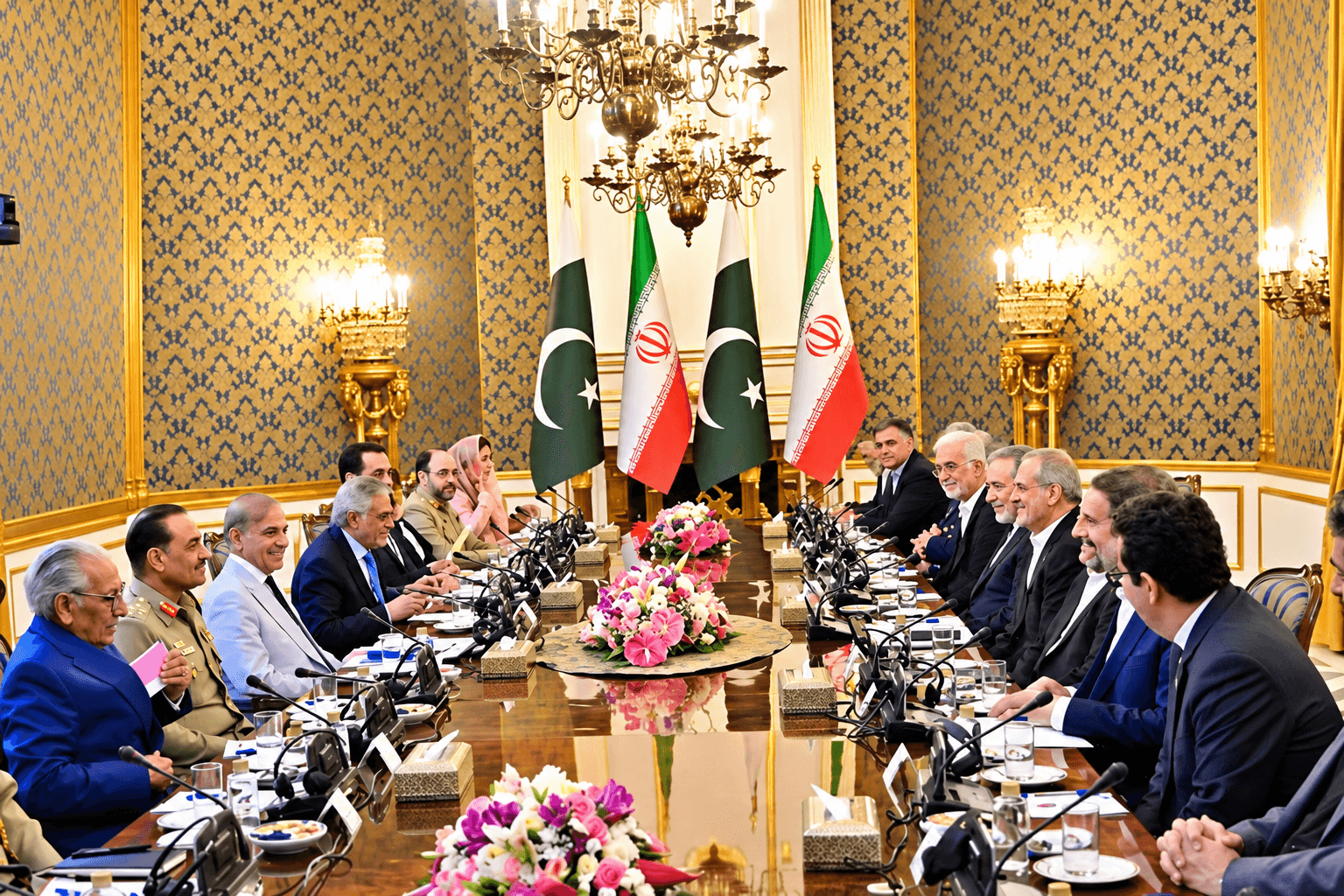
The visit should not be mistaken for a revival of full-fledged India–Pakistan dialogue.
Dimri's trip was part of the SCO's multilateral proceedings, and Pakistani officials have also described it in those terms. There was no announcement of a separate bilateral negotiating process.
Still, the visit carries political weight.
After months of strained relations and limited official contact, an Indian senior official has once again travelled to Islamabad.
That alone has put diplomacy back in the conversation.
WHAT HAPPENED?
India sent Additional Secretary Alok Dimri to Islamabad for the SCO Council of National Coordinators meeting, held from September 28 to 30.
Pakistan is currently holding the SCO chairmanship for the 2026–27 period.
Dimri's presence marked the first visit by an Indian official delegation to Pakistan since Operation Sindoor last year.
The discussions covered issues including regional cooperation, connectivity, trade and transit.
Formally, the meeting was multilateral. But given the recent history between India and Pakistan, the setting made the visit far more significant than an ordinary SCO gathering.
WHY THIS VISIT MATTERS
India and Pakistan have remained locked in a difficult relationship since the military confrontation of 2025.
Direct diplomatic engagement has been extremely limited, with major disagreements continuing over security, terrorism, Kashmir and other bilateral issues.
That makes even a meeting under a multilateral forum noteworthy.
The visit shows that official communication between the two countries has not completely disappeared. More importantly, it gives both sides a way to maintain contact without having to announce a formal resumption of bilateral talks.
That distinction is important.
This is engagement — but it is not reconciliation.
INDIA'S POSITION
New Delhi's participation appears to have been driven primarily by its commitments as an SCO member.
Regional connectivity, transit and trade remain important parts of the organisation's agenda, and India has an interest in maintaining its role within the grouping despite its strained relationship with Pakistan.
Dimri also highlighted the SCO's growing role in South Asia and India's participation in the organisation's activities.
For New Delhi, the arrangement offers a way to engage within a multilateral setting without reopening a separate India–Pakistan negotiating channel.
PAKISTAN'S RESPONSE
Islamabad welcomed the Indian official's participation.
Pakistan's Foreign Office described the visit as part of the SCO's multilateral process and presented it as a positive development.
A Pakistani spokesperson pointed to shared regional interests involving peace, development, connectivity, trade and transit.
But Islamabad also made clear that the visit was not a bilateral engagement.
That means expectations of an immediate diplomatic breakthrough should remain restrained.
The two countries may be sharing the same room again, but they are not yet back at the negotiating table.
IS THIS THE RETURN OF DIALOGUE?
Not yet.
India and Pakistan continue to disagree sharply on major security and political questions.
Pakistan has repeatedly called for dialogue on outstanding disputes, while India has maintained a firm position on terrorism and cross-border security.
The latest development is therefore better understood as a limited diplomatic opening than a return to traditional peace talks.
Still, major diplomatic processes often begin with smaller steps.
Officials meet.
Communication becomes easier.
Practical issues are discussed.
Only later, if conditions permit, can those contacts develop into political negotiations.
THE BACKCHANNEL QUESTION
The Indian official's visit has also revived speculation about whether informal or backchannel contacts could eventually become more active.
Earlier this year, more than 100 Indian and Pakistani public figures called on Prime Minister Narendra Modi and Prime Minister Shehbaz Sharif to restore diplomatic engagement.
That reflects a wider recognition that prolonged confrontation carries its own risks.
But there is no public confirmation that a new formal backchannel between the two governments has been established.
That distinction matters.
Calls for dialogue are not the same thing as government-to-government negotiations.
SECURITY REMAINS THE BIGGEST OBSTACLE
Security remains the central challenge.
India continues to place terrorism and cross-border militancy at the heart of its concerns regarding Pakistan.
Pakistan rejects India's accusations and maintains that outstanding disputes should be addressed through dialogue.
The result is a difficult cycle: diplomacy requires a degree of trust, while years of security tensions have steadily eroded it.
Without progress on those concerns, wider political and economic engagement will remain difficult.
THE INDUS WATERS ISSUE
Water has added another layer of tension to the relationship.
The Indus Waters Treaty remains one of the most sensitive issues between India and Pakistan.
Pakistan continues to challenge India's position on the treaty and has referred to recent arbitration proceedings in its legal and diplomatic arguments.
The water dispute means any future diplomatic process would have to deal with far more than security alone.
Trade, travel, water management and other longstanding bilateral issues would all eventually have to come into the discussion.
WHY THE SCO MATTERS
The SCO provides an unusual diplomatic setting for India and Pakistan.
Both countries are members, alongside major powers such as China and Russia and several Central Asian states.
That gives New Delhi and Islamabad a framework for maintaining limited official contact even when direct bilateral relations remain frozen.
In that sense, the SCO can act as a diplomatic bridge without becoming a bilateral negotiation platform.
That may be precisely why the latest meeting matters.
MODI'S FUTURE PAKISTAN VISIT?
The Islamabad meeting has inevitably raised questions about whether Prime Minister Narendra Modi could eventually travel to Pakistan for a future SCO summit.
But India's participation in one SCO meeting does not automatically signal a future prime ministerial visit.
Indian officials have reportedly indicated that attendance at one SCO event does not determine the prime minister's future travel plans.
For now, any Modi visit to Pakistan remains uncertain.
TRADE AND CONNECTIVITY ENTER THE CONVERSATION
Economic ties could eventually provide another opening.
India and Pakistan have historically been linked by trade routes and regional supply chains, although political tensions have severely restricted those connections.
The SCO's focus on connectivity, transit and trade provides a relatively less politically sensitive area for interaction.
Even modest cooperation in these areas could give both sides a practical reason to keep communication channels open.
A SMALL STEP — NOT A RESET
The biggest risk now is reading too much into one visit.
An Indian official travelling to Islamabad does not mean relations have been normalised.
It does not mean the security dispute has been resolved.
And it certainly does not confirm that bilateral peace talks have formally restarted.
But it does demonstrate one important thing:
The diplomatic door is not completely closed.
In India–Pakistan relations, even a partially open door can matter.
WHY THIS MATTERS
1. INDIA HAS RETURNED TO ISLAMABAD
An Indian senior official has participated in an SCO meeting in Pakistan after a prolonged period of limited official engagement.
2. THE ENGAGEMENT IS MULTILATERAL
The visit took place under the SCO framework rather than as a formal bilateral mission.
3. REGIONAL CONNECTIVITY IS BACK IN THE DISCUSSION
Trade, transit and connectivity featured prominently in the SCO engagement.
4. SECURITY DISPUTES REMAIN UNRESOLVED
Terrorism, Kashmir and the Indus Waters Treaty continue to complicate relations.
5. DIPLOMATIC CONTACT COULD CREATE SPACE FOR FUTURE TALKS
The visit is not a breakthrough, but it shows that official contact between the two countries remains possible.
FACT CHECK METER
AWX FACT CHECK
FACT METER: 96%
STATUS: DEVELOPING
CONFIRMED
• India sent senior official Alok Dimri to Islamabad for an SCO meeting.
• The meeting took place under Pakistan's SCO chairmanship.
• It was the first Indian official delegation visit to Pakistan since Operation Sindoor.
• Discussions included regional connectivity, transit and trade.
• Pakistan welcomed India's participation in the SCO process.
IMPORTANT DISTINCTION
THE VISIT WAS MULTILATERAL, NOT A FORMAL INDIA–PAKISTAN BILATERAL SUMMIT.
There is no confirmed announcement that full bilateral peace negotiations have restarted.
NOT ESTABLISHED
• A formal India–Pakistan peace process has resumed.
• Prime Minister Narendra Modi will visit Pakistan.
• A new bilateral agreement has been reached.
• A formal backchannel negotiation mechanism has been publicly confirmed.
AWX VERDICT
INDIAN OFFICIAL IN PAKISTAN: CONFIRMED
SCO ENGAGEMENT: CONFIRMED
DIPLOMATIC CONTACT: INCREASING
FORMAL BILATERAL TALKS: NOT CONFIRMED
RELATIONS RESET: PREMATURE
SITUATION: DEVELOPING
AWX FOCUS: DIPLOMACY WITHOUT A RESET
INDIA
Participates in the SCO while continuing to emphasise concerns over terrorism and regional security.
PAKISTAN
Welcomes India's participation while continuing to call for dialogue and regional cooperation.
SCO
Provides a multilateral setting in which the two countries can maintain official contact.
SECURITY
Remains the biggest obstacle to a broader diplomatic breakthrough.
THE KEY QUESTION
Can limited multilateral contact eventually develop into a wider India–Pakistan diplomatic channel?
WHAT TO WATCH NEXT
ISLAMABAD
Whether additional Indian officials travel to Pakistan for future SCO-related events.
NEW DELHI
Whether India signals any greater willingness toward structured diplomatic engagement.
PAKISTAN
Whether Islamabad pushes for formal bilateral talks alongside multilateral contact.
SECURITY
Any new developments involving terrorism or cross-border tensions.
INDUS WATERS
Whether the water dispute becomes part of any renewed diplomatic discussions.
MODI'S TRAVEL
Whether India confirms participation at a future SCO summit in Pakistan.
THE AWX BOTTOM LINE
India has walked into Pakistan again — but carefully.
The visit by senior official Alok Dimri to Islamabad is not a diplomatic reset. It is not a peace agreement, and it is not proof that bilateral negotiations have resumed.
What it does show is that official contact has not disappeared from a relationship long dominated by confrontation and distrust.
The SCO provided the platform. Regional connectivity and cooperation provided common ground. Security remains the major unresolved obstacle.
For now, perhaps the most significant part of the story is simply that Indian and Pakistani officials are once again sharing the same diplomatic room.
The door to dialogue is open — but only slightly.
ATTLAS WIRE | AWX WORLD NEWS
Real Stories. Lasting Impact.




Comments
No comments yet.