

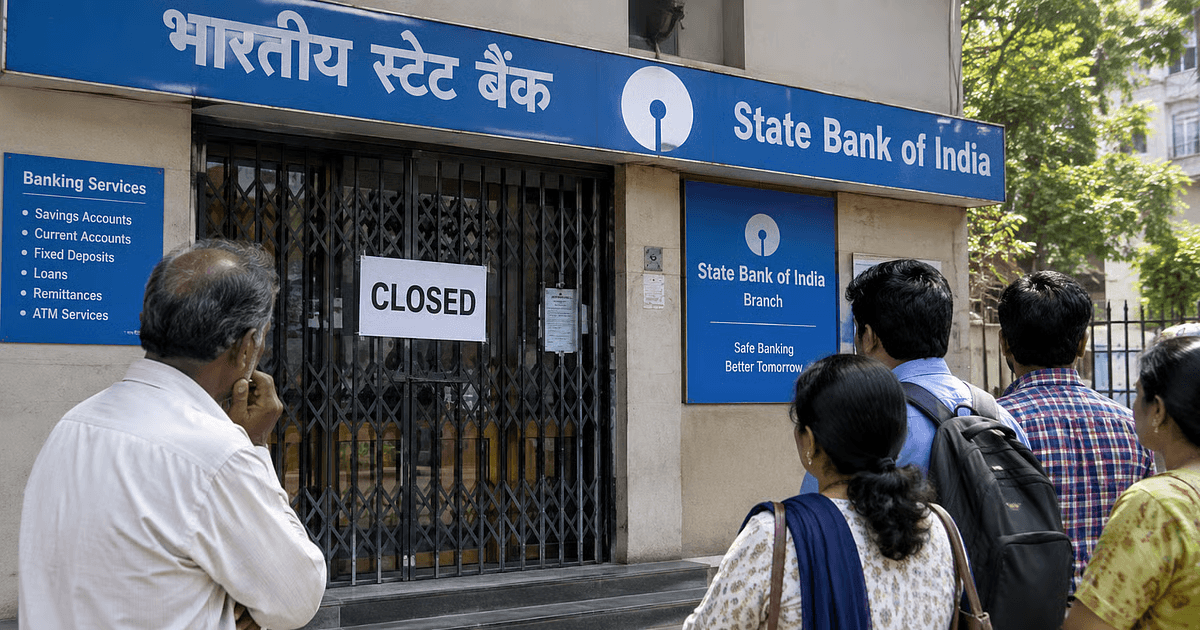
India's banking sector is facing a three-day disruption as employees and officers affiliated with participating bank unions take part in industrial action.
The immediate impact is expected to be felt most strongly at physical bank branches, where services such as cash handling, cheque processing, account-related requests and document verification may slow down.
But the strike does not mean India's banking system has come to a standstill.
UPI, mobile banking, internet banking, ATMs and card-based payments can continue to operate, allowing millions of routine transactions to go through without requiring a visit to a branch.
That leaves customers dealing with a very different banking environment during the strike: branches may be disrupted, while digital payments continue to function.
For customers and businesses, the key question is therefore not whether banking has stopped, but which services are still available and which may take longer than usual.
WHAT IS HAPPENING?
Employees and officers taking part in the strike are raising a number of concerns related to working conditions and the future of the banking workforce.
Issues raised in the wider banking-sector labour debate include:
Staffing levels
Workload
Recruitment
Outsourcing
Working conditions
Employee-related demands
The impact will not necessarily be the same everywhere. Service levels can vary depending on the bank, location and number of employees participating.
As a result, one branch may experience significant disruption while another may continue offering limited services.
WHICH SERVICES COULD BE DELAYED?
Branch-based services are likely to feel the greatest pressure during the strike.
Customers may face longer waiting times for:
Cash deposits and withdrawals
Cheque deposits and processing
Account-related requests
Demand drafts and similar services
Document verification
Certain customer complaints
Requests requiring manual processing
Businesses that rely heavily on cash handling or cheque transactions could also feel the effects.
And the disruption may not end the moment the strike does. If requests build up during the three days, branches could have a backlog to clear afterward.
WHICH SERVICES CAN CONTINUE?
India's growing reliance on digital banking provides some protection against a complete disruption.
Customers can generally continue using:
UPI
Mobile banking
Internet banking
ATMs
Card payments
Digital fund transfers
Online bill payments
These services rely largely on automated digital infrastructure rather than requiring an employee to process every transaction manually.
Still, availability can vary from bank to bank, and technical or operational problems could affect individual services.
WILL UPI STOP?
No. A bank strike does not automatically shut down UPI.
UPI transactions operate through India's digital payments infrastructure and can continue even when physical branches are closed or operating with reduced staff.
That means customers can still use UPI for many everyday transactions at shops, restaurants, online platforms, service providers and other participating merchants.
The important limitation is that digital payments cannot solve every banking problem.
If a customer needs a dispute resolved, documents verified or an account issue handled manually, the request may have to wait until bank staff are available.
WHY DIGITAL BANKING MATTERS
The strike comes at a time when India's banking system looks very different from what it did a decade ago.
Routine transactions that once required a trip to a branch can now be completed from a phone or computer.
Money can be transferred, bills can be paid and merchants can receive payments without customers ever entering a bank.
That digital infrastructure provides an important buffer during periods of disruption.
The current strike also offers a real-world demonstration of how much everyday economic activity can continue even when normal branch operations are affected.
WHAT ABOUT ATMs?
ATMs can continue operating during a bank strike because they are largely automated.
But that does not guarantee that every ATM will always be available or adequately stocked.
Availability can depend on:
Cash levels
Network connectivity
Technical issues
Replenishment schedules
Local operating conditions
If more customers turn to ATMs because of branch disruption, demand could rise at individual locations.
For that reason, customers should not assume that every ATM will have sufficient cash throughout the strike.
BUSINESSES COULD FACE A DIFFERENT KIND OF PRESSURE
Digital payments may help businesses maintain day-to-day transactions during the strike.
UPI, cards and online transfers can allow companies to continue receiving payments from customers.
The situation is more difficult for businesses that depend heavily on physical cash or cheques.
Even a short delay in cash management or cheque processing can affect working capital, particularly for smaller businesses operating with tight cash flows.
Companies may therefore rely more heavily on digital payment channels while branch services are disrupted.
WHY ARE BANK EMPLOYEES STRIKING?
The industrial action reflects broader concerns about the changing nature of banking work.
Employee groups have raised concerns around staffing levels, workloads and the growing use of outsourcing.
At the same time, banks are undergoing rapid digital transformation.
Technology has automated many routine processes, but employees are also dealing with increasingly complex responsibilities involving:
Compliance
Fraud monitoring
Customer verification
Cybersecurity
Regulatory reporting
Digital-service support
Unions argue that staffing levels need to keep pace with these responsibilities.
Outsourcing remains another area of disagreement, with employee groups raising concerns about the increasing use of third-party workers for banking-related functions.
WHAT DOES IT MEAN FOR CUSTOMERS?
For most customers, the biggest issue is likely to be delay rather than a complete loss of banking access.
Someone making a UPI payment may notice little or no difference.
Someone waiting for a document to be verified or trying to resolve a complicated account issue may have to wait longer.
The impact could be greater for:
Senior citizens
Customers with limited access to digital banking
People dealing with documentation
Cash-dependent businesses
Customers with unresolved account issues
In other words, the disruption will not be felt equally by everyone.
THE WIDER ECONOMIC IMPACT
Banks are a critical part of the economy, so even temporary disruptions can affect the movement of money between households, businesses and institutions.
Potential pressure points include:
Cash management
Cheque clearing
Business settlements
Branch-based financial services
Loan-related documentation
Customer support
However, India's widespread adoption of digital payments reduces the likelihood of a complete interruption to routine economic activity.
The more everyday transactions move online, the more resilient the payments system becomes when physical banking operations are disrupted.
WHAT HAPPENS AFTER THE STRIKE?
The end of the three-day action may not immediately bring every branch back to normal.
Banks could return to work with accumulated requests involving:
Pending cheques
Customer applications
Documentation
Account-related requests
Cash-management activities
This could create a temporary backlog even after employees return.
Banks may prioritize urgent requests and gradually work through the remaining workload.
WHY THIS MATTERS
1. BRANCHES ARE MOST VULNERABLE
Physical banking depends directly on employees being available to serve customers.
2. DIGITAL BANKING PROVIDES A BUFFER
UPI, mobile banking, internet banking and ATMs can keep many routine transactions moving.
3. MANUAL SERVICES MAY TAKE LONGER
Requests that require employee intervention are more likely to face delays.
4. BUSINESSES MAY FEEL THE PRESSURE
Cash-intensive and cheque-dependent businesses are more exposed to branch disruption.
5. INDIA'S DIGITAL SHIFT IS CLEAR
The ability of digital payments to continue during a branch disruption highlights how important technology has become to the country's financial system.
AWX FACT CHECK
FACT METER: 92%
STATUS: DEVELOPING
CONFIRMED
A three-day bank strike involving participating employees and officers is underway.
Physical banking operations are expected to face disruption.
Branch-dependent services are more vulnerable to delays than automated digital services.
UPI and other digital payment channels can continue operating during a bank strike.
ATMs and online banking may remain available, subject to individual bank systems and technical conditions.
Staffing, workload, recruitment and outsourcing are among the broader issues involved in banking-sector labour disputes.
NEEDS FURTHER VERIFICATION
The exact number of employees participating.
The number of branches affected nationwide.
The total value of transactions delayed during the strike.
The level of disruption at individual banks and locations.
IMPORTANT DISTINCTION
THE BANK STRIKE DOES NOT MEAN INDIA'S ENTIRE DIGITAL PAYMENT SYSTEM HAS SHUT DOWN.
Digital channels can continue to handle routine transactions, while services requiring manual intervention may take longer.
AWX VERDICT
BANK STRIKE: CONFIRMED
THREE-DAY DISRUPTION: DEVELOPING
BRANCH SERVICES: AFFECTED
UPI & DIGITAL BANKING: GENERALLY AVAILABLE
CUSTOMER DELAYS: LIKELY FOR STAFF-DEPENDENT SERVICES
OVERALL IMPACT: DEVELOPING
AWX FOCUS: WHAT REMAINS AVAILABLE?
GENERALLY AVAILABLE
UPI — Routine digital payments can continue.
MOBILE BANKING — Transfers and other supported services can remain operational.
INTERNET BANKING — Online banking services can continue.
ATMs — Cash withdrawals and other supported services can remain available.
CARD PAYMENTS — Card transactions can continue, subject to bank and network availability.
MORE LIKELY TO FACE DELAYS
BRANCH CASH SERVICES
CHEQUE-RELATED SERVICES
DOCUMENT VERIFICATION
ACCOUNT-RELATED MANUAL REQUESTS
SPECIALIZED CUSTOMER SUPPORT
OTHER SERVICES REQUIRING EMPLOYEE INTERVENTION
WHAT TO WATCH NEXT
BANKS
Whether branch backlogs grow during the strike and how quickly they are cleared afterward.
DIGITAL PAYMENTS
Whether UPI and other digital channels see unusually high transaction volumes.
ATMs
Whether increased demand creates cash shortages at individual locations.
BUSINESSES
Whether companies report problems with cash management, settlements or cheque processing.
UNIONS
Whether the three-day strike ends as scheduled or further industrial action is announced.
CUSTOMERS
Whether banks issue additional guidance on branch operations and pending requests.
GOVERNMENT & BANK MANAGEMENT
Whether negotiations resume and whether the issues raised by employee groups are addressed.
THE AWX BOTTOM LINE
India's three-day bank strike is disrupting parts of the banking system, but it is not bringing the country's entire financial network to a halt.
The biggest impact is being felt where banking still depends on people — physical branches, manual processing and specialized customer services.
At the same time, India's digital infrastructure is providing an important safety net.
UPI can keep everyday payments moving.
Mobile banking can keep customers connected.
Internet banking can handle many routine transactions.
ATMs can continue providing cash where available.
But technology cannot replace every banking interaction.
Customers dealing with documentation, account disputes or other branch-dependent services may still need to wait until normal operations resume.
The strike highlights two realities of modern Indian banking:
The branch still matters.
But the digital network has become indispensable.
For customers, the practical takeaway is straightforward:
Use digital channels where possible, and expect delays for services that require branch staff.
ATTLAS WIRE | AWX WORLD NEWS
Real Stories. Lasting Impact.




Comments
No comments yet.