

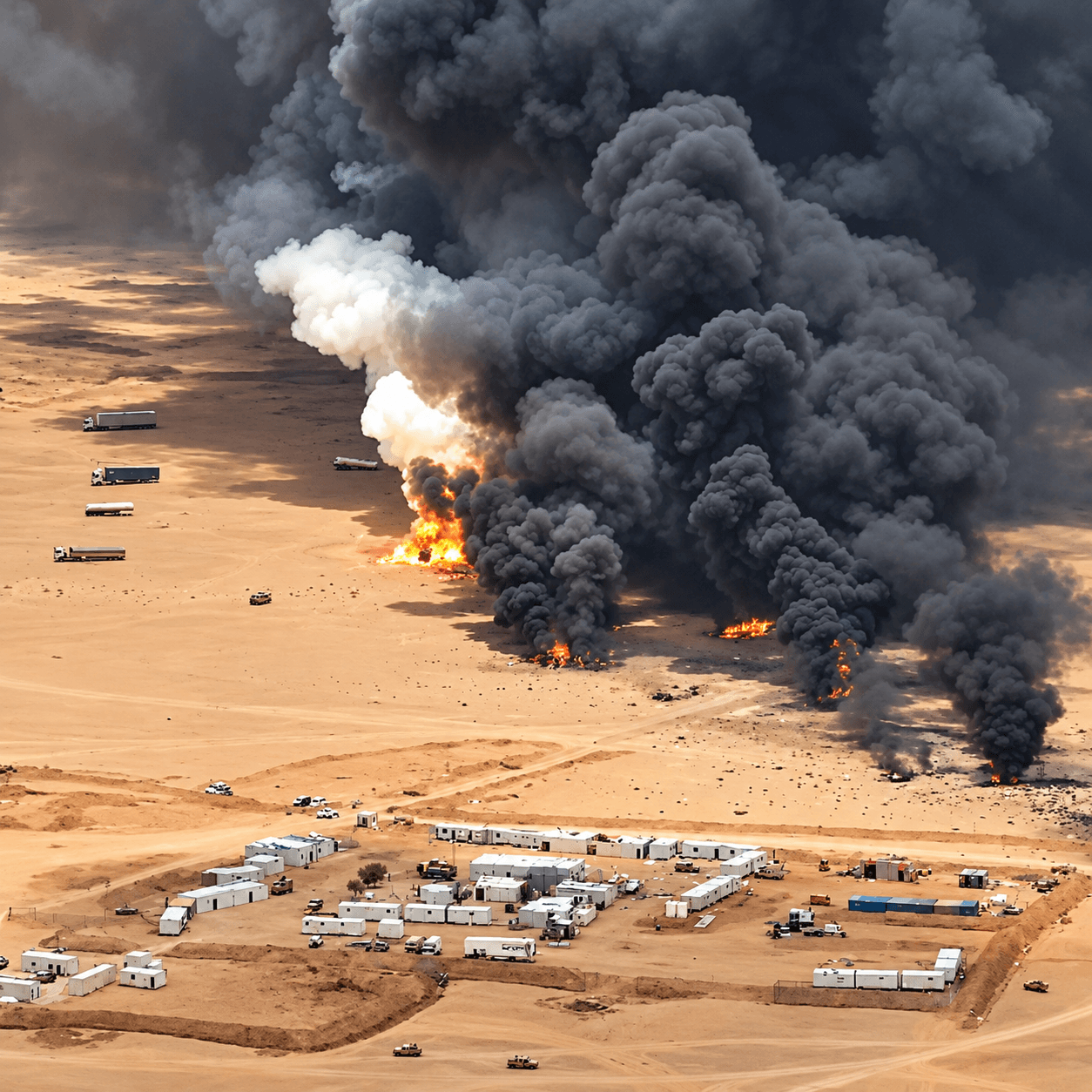
Saudi Arabia is once again facing increased security pressure as Houthi attacks intensify.
The Saudi-led coalition said on September 26 that its air defences intercepted and destroyed two drones heading toward the Riyadh region. It also said a ballistic missile aimed toward Khamis Mushait in southern Saudi Arabia had been intercepted.
The reports follow a series of missile and drone incidents involving Saudi territory, including previous alerts and reported attacks around Riyadh, Taif, Yanbu and other areas.
The latest developments show that the conflict in and around Yemen is once again spilling beyond the country’s borders.
For Saudi Arabia, the immediate priority is protecting major cities and critical infrastructure.
For the wider region, however, the stakes are much higher:
Could the renewed Houthi campaign put Saudi energy infrastructure, Red Sea shipping and global oil supplies under greater pressure?
WHAT HAPPENED?
Saudi military authorities said two drones launched by the Houthis were detected heading toward the Riyadh area.
According to the Saudi-led coalition, both drones were intercepted and destroyed before reaching their intended destination.
The same operation also involved a ballistic missile aimed toward Khamis Mushait.
Saudi officials said their forces continue to monitor missile and drone threats directed at the kingdom.
There was no immediate independent confirmation of the drones’ intended targets or any significant damage caused by the incident.
That distinction is important.
The interceptions were reported by Saudi authorities, while the full details surrounding the targets and operation remain subject to competing military claims.
WHY IS THE THREAT RISING?
The latest incidents are part of a broader escalation involving Saudi Arabia and the Houthis.
After a period when Houthi attacks on Saudi territory had largely eased, tensions have risen again in recent months.
The Houthis have continued to use drones and missiles against targets they associate with Saudi Arabia and its allies, while Saudi forces have carried out military operations against Houthi positions in Yemen.
The conflict is also unfolding against a much wider regional backdrop involving Iran, the Red Sea and competing security alliances.
That has created a more unpredictable security environment across the Arabian Peninsula.
RIYADH IS NOW PART OF THE BATTLEFIELD
One of the most significant concerns is the continued threat to Riyadh.
The Saudi capital is far from Yemen’s northern border, so attacks or attempted attacks reaching the Riyadh area highlight the range of the weapons being used.
Earlier in September, Saudi authorities issued security alerts around Riyadh following Houthi threats. Smoke and flames were also reported near the city’s airport area, while the Houthis claimed attacks on sensitive sites in the capital.
The repeated focus on Riyadh raises the stakes considerably.
Any successful attack affecting the capital could have consequences well beyond physical damage.
It could affect:
Financial markets
Air travel
Business confidence
Foreign investment
Energy infrastructure
Public security
WHY SAUDI ENERGY INFRASTRUCTURE MATTERS
Saudi Arabia is one of the world’s most important energy producers.
That makes its oil production, storage and export infrastructure strategically important far beyond the kingdom itself.
Any sustained threat to those facilities could quickly affect global energy markets.
The concern is particularly serious because the wider region is already dealing with disruption and uncertainty around major energy and shipping routes.
Even when an incoming attack is intercepted, markets can react to the possibility of a future successful strike.
That can push up:
Oil prices
Insurance costs
Shipping rates
Risk premiums
Market volatility
A successful attack on a major energy facility would have consequences far beyond Saudi Arabia.
THE RED SEA CONNECTION
The Houthi threat is not limited to Saudi territory.
The movement operates along Yemen’s Red Sea coastline and has repeatedly targeted shipping linked to Saudi Arabia and its regional adversaries.
The Red Sea is a major trade route connecting the Indian Ocean with the Mediterranean through the Suez Canal.
When shipping through the area becomes too risky, vessels may be forced to take longer routes around Africa.
That means higher:
Fuel costs
Travel times
Insurance expenses
Shipping capacity pressures
For global businesses, those additional costs can eventually feed into wider supply chains.
WHY THE OIL MARKET IS WATCHING
The latest escalation comes at a sensitive moment for global energy markets.
Saudi Arabia is already facing increased regional security risks. If attacks begin to threaten oil production, storage or export facilities, markets could respond quickly.
But physical damage is not necessarily required for markets to react.
Investors can begin pricing in the possibility of supply disruption as soon as the perceived risk increases.
That is why every escalation involving Saudi energy infrastructure is being watched closely.
THE HOUTHI CALCULATION
The Houthis have demonstrated their ability to use both drones and ballistic missiles.
Drones can provide a relatively inexpensive way to threaten high-value targets, while ballistic missiles can add another layer of pressure to air-defence systems.
Using different types of weapons can make detection and interception more complicated and force an opponent to commit significant resources to defence.
The Houthis have repeatedly presented their attacks as part of a broader confrontation with Saudi Arabia and its regional partners.
Saudi Arabia, meanwhile, considers the attacks a direct threat to its sovereignty and national security.
That leaves both sides with limited room for error.
THE IRAN FACTOR
The Houthis are closely aligned with Iran and are widely viewed as part of Tehran’s wider network of regional partners.
For Saudi Arabia, Houthi military capabilities have long been connected to the broader question of Iranian influence in the region.
That gives the current escalation another dimension.
An attack launched by the Houthis can quickly become part of the wider Saudi-Iranian strategic rivalry.
The greater the number of regional actors involved, the harder it becomes to prevent a conflict centred on Yemen from developing into a broader Gulf crisis.
SAUDI DEFENCES UNDER PRESSURE
Saudi Arabia has invested heavily in air-defence systems designed to protect its cities and strategic infrastructure.
The latest interceptions show those systems remain active and capable of responding to incoming threats.
But repeated attacks create another challenge:
Saturation.
The larger the number of missiles and drones launched at the same time, the greater the pressure on detection, tracking and interception systems.
A high interception rate does not mean the underlying threat has disappeared.
Saudi authorities therefore face the challenge of preparing for attacks that could be larger, more coordinated or more sophisticated.
THE PAKISTAN AND TURKEY CONNECTION
The renewed threat is also affecting Saudi defence diplomacy.
Saudi Arabia has held discussions with military leaders from Pakistan and Turkey as Riyadh seeks to strengthen regional defence cooperation.
The three countries are linked through the Makkah Joint Defence Agreement, which provides for mutual defence cooperation.
Pakistan has also pledged to support Saudi Arabia against Houthi attacks using available means, although the precise operational role Pakistan could play remains unclear.
For Riyadh, the priority appears to be building a wider security network as regional threats increase.
THE UAE QUESTION
The Houthi escalation is also influencing Saudi-UAE relations.
Saudi Arabia and the UAE have had significant differences over Yemen, despite their broader strategic partnership.
The renewed security pressure, however, could create an incentive for the two Gulf powers to improve coordination.
UAE Vice President Sheikh Mansour bin Zayed’s recent visit to Riyadh and meeting with Crown Prince Mohammed bin Salman came amid the latest wave of Houthi attacks.
The security situation may therefore be creating new pressure for greater coordination between Riyadh and Abu Dhabi.
WHAT ABOUT CIVILIANS?
Missile and drone attacks pose risks to civilians even when defensive systems successfully intercept them.
Saudi authorities have issued security alerts in several locations as the threat has increased.
Earlier attacks resulted in injuries in cities including Khamis Mushait, Abha and Taif, according to Saudi authorities.
The threat becomes particularly serious when attacks approach densely populated areas.
For residents, the impact is not limited to physical damage. Repeated air alerts and incoming attacks can also create a significant sense of insecurity.
WHY THIS MATTERS
1. RIYADH IS UNDER DIRECT THREAT
The interception of drones heading toward the capital shows that the conflict continues to reach Saudi Arabia’s political and economic centre.
2. MISSILE AND DRONE ATTACKS ARE INTENSIFYING
The latest incident follows a series of reported attacks involving multiple weapons systems.
3. ENERGY INFRASTRUCTURE REMAINS A CONCERN
Saudi oil facilities remain among the region’s most strategically important potential targets.
4. THE RED SEA COULD FACE MORE DISRUPTION
Continued Houthi activity could place additional pressure on maritime trade routes already affected by regional instability.
5. REGIONAL ALLIANCES ARE SHIFTING
Saudi Arabia is strengthening defence relationships while also reopening channels of communication with the UAE.
FACT CHECK METER
AWX FACT CHECK
FACT METER: 91%
STATUS: DEVELOPING
CONFIRMED
Saudi authorities said two Houthi-launched drones heading toward the Riyadh region were intercepted and destroyed.
Saudi authorities also reported intercepting a ballistic missile directed toward Khamis Mushait.
The incidents are part of a wider series of reported missile and drone attacks.
Houthi activity has created continuing security concerns for Saudi cities, infrastructure and regional shipping.
Earlier September incidents prompted security alerts around Riyadh and other parts of Saudi Arabia.
NOT INDEPENDENTLY ESTABLISHED
The exact intended targets of the intercepted drones.
The full operational details of each reported attack.
The extent of any damage connected to individual incidents.
Whether the current escalation will develop into a prolonged regional conflict.
HOUTHI POSITION
The Houthis have claimed responsibility for attacks against Saudi targets while disputing aspects of Saudi and regional accounts of their operations and intentions.
SAUDI POSITION
Saudi Arabia describes the attacks as a threat to its sovereignty, civilian population and critical economic infrastructure.
AWX VERDICT
DRONE INTERCEPTIONS: CONFIRMED BY SAUDI AUTHORITIES
HOUTHI ESCALATION: CONFIRMED
RIYADH THREAT: SIGNIFICANT
OIL INFRASTRUCTURE RISK: DEVELOPING
REGIONAL ESCALATION: HIGH RISK
AWX FOCUS: HOW SERIOUS IS THE HOUTHI THREAT?
TO RIYADH
HIGH
The Saudi capital has increasingly appeared in Houthi targeting claims and Saudi security alerts.
TO OIL INFRASTRUCTURE
HIGH
Any successful strike against major energy facilities could have consequences for international energy markets.
TO THE RED SEA
HIGH
Continued Houthi activity could further disrupt maritime trade and increase shipping costs.
TO REGIONAL SECURITY
VERY HIGH
The attacks are taking place alongside wider tensions involving Iran, Saudi Arabia and other regional powers.
TO GLOBAL MARKETS
WATCH
A sustained threat to Saudi oil production or exports could quickly influence global energy prices.
WHAT TO WATCH NEXT
Saudi Arabia
Whether Riyadh reports further missile or drone interceptions and whether additional security measures are introduced.
Houthis
Whether the group launches further attacks or expands its target list.
Oil markets
Whether continued attacks begin to affect crude prices, shipping costs or insurance premiums.
Red Sea
Whether attacks on Saudi-linked or regional shipping increase.
UAE
Whether Abu Dhabi and Riyadh deepen their security coordination.
Pakistan and Turkey
Whether defence cooperation with Saudi Arabia develops beyond diplomatic commitments into practical or operational coordination.
Iran
Whether Tehran comments on the escalation or attempts to influence Houthi actions.
International diplomacy
Whether regional and international powers push for de-escalation.
THE AWX BOTTOM LINE
Saudi Arabia says it has successfully intercepted drones heading toward Riyadh.
But the bigger story is not simply whether the latest attack reached its target.
It is the growing frequency and geographic reach of the Houthi threat.
Riyadh is facing increasing pressure.
Saudi energy infrastructure remains a potential target.
The Red Sea remains vulnerable to further disruption.
And each new attack raises the possibility of a wider regional confrontation.
The successful interceptions show that Saudi air defences can respond to incoming threats. But they do not eliminate the underlying security challenge.
The question is no longer whether the Houthis can threaten Saudi Arabia.
The bigger question is how far the escalation will go — and whether Riyadh and its partners can contain it before the conflict expands into a much wider regional crisis.
ATTLAS WIRE | AWX WORLD NEWS
Real Stories. Lasting Impact.


Comments
No comments yet.