

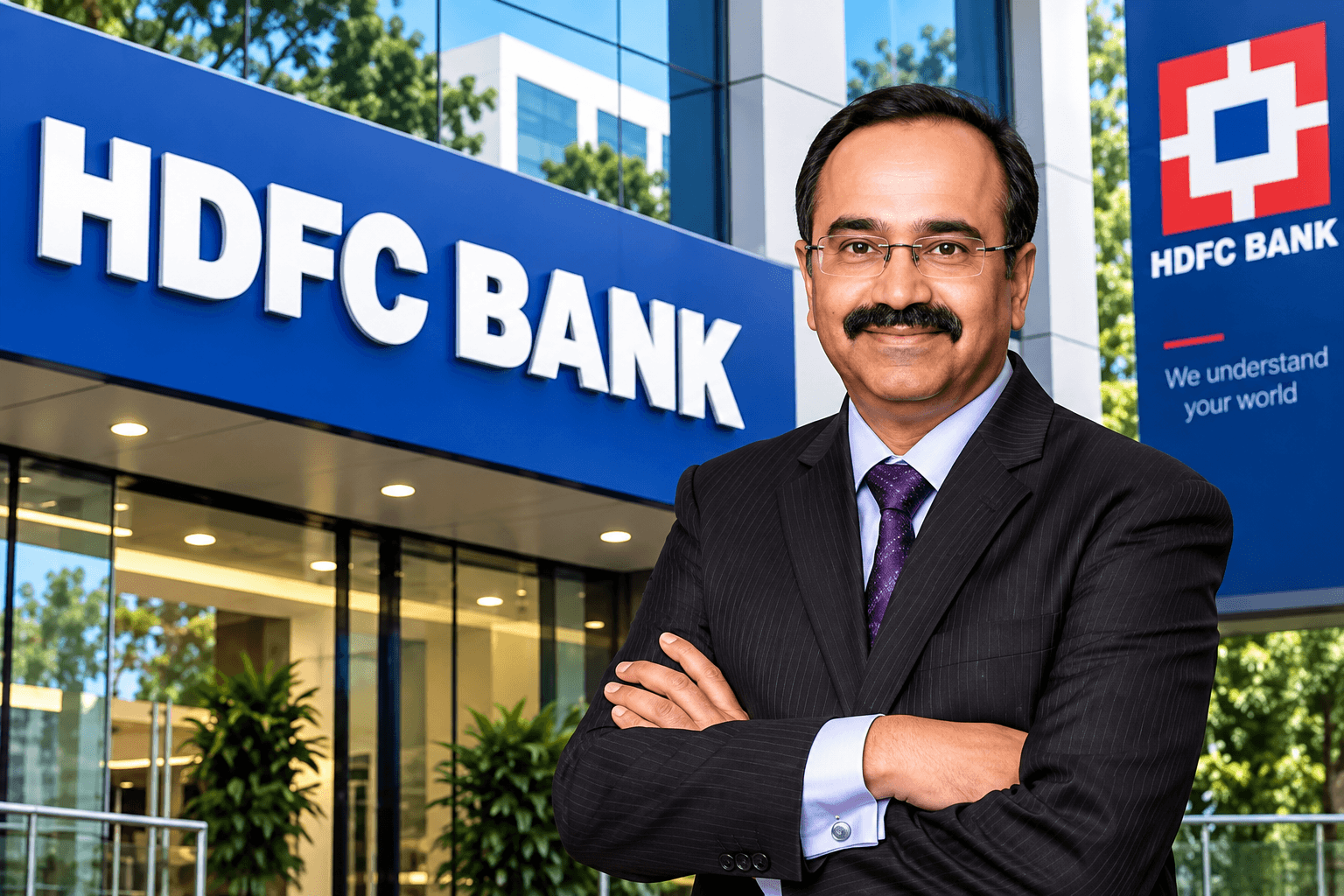
HDFC Bank is preparing for a change in leadership, with Anup Bagchi set to take over as Managing Director and Chief Executive Officer on 27 October 2026. The Reserve Bank of India (RBI) approved his appointment on 1 October, paving the way for a three-year term, subject to the required shareholder approval.
Bagchi, who currently heads ICICI Prudential Life Insurance, will succeed Sashidhar Jagdishan, whose tenure ends on 26 October. With more than three decades of experience across banking, capital markets, wealth management and insurance, he brings a broad understanding of India's financial services industry to the role.
His appointment comes at an important time for HDFC Bank. The lender must continue growing its business while attracting deposits, managing borrowing costs, maintaining credit quality and meeting rising customer expectations. Investors will also be looking for signs that the leadership transition can deliver stability while keeping the bank competitive.
Bagchi's experience gives him a strong starting point. However, his success will ultimately depend on how effectively he turns that experience into results.
WHAT HAPPENED?
HDFC Bank received RBI approval for Bagchi's appointment on 1 October. The bank's board subsequently approved him as an additional director from 2 October, pending the required shareholder approval.
His three-year term as MD and CEO is scheduled to begin on 27 October, one day after Jagdishan's tenure ends.
Jagdishan decided not to seek another term, opening the door for a leadership change at one of India's most closely watched financial institutions.
The transition matters because HDFC Bank serves millions of customers and plays a significant role in lending to households, businesses and large institutions. Its decisions on deposits, loans, technology and risk management can influence not only its own performance but also broader sentiment across the banking sector.
For now, the handover is planned for later this month. Until then, Jagdishan remains in charge, with Bagchi preparing to take over.
The move also brings a change in leadership background. Bagchi has spent much of his career with the ICICI Group, building experience across several financial services businesses before moving to the helm of HDFC Bank.
WHO IS ANUP BAGCHI?
Bagchi has more than 30 years of experience in financial services. He joined the ICICI Group in 1992 and has worked across treasury operations, retail and wholesale banking, investment banking, capital markets and digital financial services.
His career includes several senior leadership positions:
CEO and Managing Director of ICICI Securities: He led the company's capital markets business.
Executive Director at ICICI Bank from 2017 to 2023: He held responsibilities spanning retail, business and rural banking before moving to wholesale banking.
Chairman of ICICI Prudential Asset Management Company: He held the position until May 2023.
Managing Director and CEO of ICICI Prudential Life Insurance: He took charge in June 2023, overseeing the insurer's business and growth strategy.
Bagchi holds an engineering degree from the Indian Institute of Technology, Kanpur, and a management degree from the Indian Institute of Management, Bangalore.
His experience across banking, insurance and investment services could be useful in running a lender as large as HDFC Bank. The job requires balancing several competing priorities, from expanding the loan book and attracting deposits to investing in technology and maintaining strong risk controls.
Still, a long career in financial services does not guarantee an easy transition. Customers will judge the bank on the quality of its services, while investors will focus on financial performance, risk management and the consistency of its strategy.
WHY DOES THE LEADERSHIP CHANGE MATTER?
1. A NEW CHAPTER FOR INDIA'S LARGEST PRIVATE-SECTOR BANK
HDFC Bank holds an important position in India's financial system. Its extensive customer base and lending operations make its performance relevant to households, businesses and investors alike.
Bagchi will take charge of an established banking franchise, but maintaining that position will require continued investment and careful execution. Competition from other banks and digital financial service providers is forcing lenders to improve convenience, pricing and customer service.
The challenge is to grow without weakening lending standards. An overly aggressive approach can create credit problems down the line, while excessive caution can limit business opportunities.
Finding the right balance between expansion and financial discipline will be one of the new CEO's central responsibilities.
2. KEEPING GROWTH PROFITABLE
Loan growth is only part of the equation for a bank. It also needs a dependable deposit base to fund that lending at a sustainable cost.
When loans grow faster than deposits, banks may have to offer more attractive deposit rates or turn to alternative funding sources. Either option can put pressure on profitability.
Bagchi will need to keep a close eye on deposit mobilisation, loan growth and funding costs. Investors will want to see whether HDFC Bank can continue expanding while protecting its margins and maintaining disciplined underwriting.
The goal is not simply to increase the size of the business. It is to ensure that growth translates into sustainable earnings without exposing the bank to unnecessary risks.
3. IMPROVING DIGITAL BANKING AND CUSTOMER SERVICE
Customers increasingly expect banking services to be fast, reliable and easy to access. Mobile banking, instant payments and responsive customer support have become important parts of the everyday banking experience.
For HDFC Bank, continued investment in technology will be important, but reliability and security must remain priorities. Digital expansion can make services more convenient, yet it also brings challenges involving cybersecurity, fraud prevention and the protection of customer information.
Bagchi's experience across different financial services businesses may offer useful perspectives on how the bank develops its services. What matters most, however, is whether customers see practical improvements and whether those investments strengthen the bank's operations.
GOVERNANCE AND TRUST WILL REMAIN UNDER SCRUTINY
A change at the top gives HDFC Bank an opportunity to reinforce its commitment to sound governance and accountability.
As a major regulated lender, the bank must maintain effective internal controls, manage credit risks and meet its regulatory obligations. Its leadership also needs to ensure that business expansion does not outpace the systems designed to monitor and control risk.
Bagchi will have to work closely with the board and senior management to maintain operational stability while assessing where improvements may be needed.
A smooth handover can help prevent uncertainty from distracting the organisation. Clear communication with employees, customers, regulators and shareholders will also be important as the new leadership settles in.
His appointment does not, by itself, resolve every operational or governance challenge. Instead, it places responsibility for the bank's next phase in new hands.
Investors will be watching for consistent disclosures, clear strategic priorities, effective risk management and evidence that the bank can respond to problems before they become larger concerns.
WHAT HAPPENS TO OUTGOING CEO SASHIDHAR JAGDISHAN?
Jagdishan's tenure as MD and CEO is due to end at the close of business on 26 October 2026. His decision not to seek another term has cleared the way for Bagchi's appointment.
The handover involves more than a change in title. A bank of HDFC's size must maintain continuity across customer relationships, lending decisions, regulatory engagement and major technology and business programmes.
Investors will therefore be looking for reassurance that the transition will not disrupt day-to-day operations or leave uncertainty around the bank's direction.
Bagchi will inherit an established management team and an existing business strategy. He will need to understand what is working well, identify areas that require attention and decide where changes would make a meaningful difference.
Maintaining continuity where it makes sense, while making targeted improvements where necessary, could help the bank navigate the transition without unnecessary disruption.
WHAT COULD BAGCHI FOCUS ON FIRST?
Several issues are likely to attract attention during his first months in office. His actual priorities will become clearer through official statements, management decisions and subsequent financial results.
DEPOSIT GROWTH: Building a stable funding base that can support lending without putting excessive pressure on deposit costs.
CREDIT QUALITY: Maintaining disciplined lending standards and monitoring risks across retail, commercial and corporate loans.
PROFITABILITY: Balancing loan pricing, funding expenses and operating costs to protect sustainable earnings.
DIGITAL BANKING: Improving the customer experience while maintaining reliable systems, strong cybersecurity and effective fraud prevention.
GOVERNANCE: Ensuring that internal controls, regulatory compliance and disclosures keep pace with the bank's operations.
STRATEGIC EXECUTION: Reviewing existing priorities and identifying opportunities to improve efficiency, service quality and business performance.
These are the broader challenges facing a large bank, rather than a confirmed list of Bagchi's immediate plans.
WHAT DOES THE APPOINTMENT MEAN FOR CUSTOMERS AND INVESTORS?
For customers, the leadership change is unlikely to mean an immediate shift in everyday banking arrangements. Interest rates, loan terms, account conditions and service policies will continue to depend on the bank's decisions, market conditions and applicable regulations.
For investors, the appointment is worth watching, but it should not be treated as a guarantee of stronger returns.
Bagchi brings experience across several financial services businesses, yet HDFC Bank has its own scale, funding requirements and competitive pressures. The real measure of his leadership will be the bank's performance over time.
Investors will likely focus on loan and deposit growth, net interest margins, asset quality, operating expenses and capital strength. They will also assess whether the bank can maintain growth without taking on excessive risk.
A new CEO can bring fresh ideas and a different perspective. But markets will need to see those ideas reflected in the bank's financial results and day-to-day performance before drawing firm conclusions.
FACT CHECK METER
FACT METER: 98%
STATUS: APPOINTMENT APPROVED — TRANSITION AWAITED
CONFIRMED DETAILS
The RBI approved Anup Bagchi's appointment as HDFC Bank's MD and CEO on 1 October 2026.
His three-year term is scheduled to begin on 27 October 2026.
Sashidhar Jagdishan's tenure is due to end on 26 October 2026.
Bagchi has held senior positions at ICICI Securities, ICICI Bank and ICICI Prudential Life Insurance.
The appointment remains subject to the required shareholder approval.
IMPORTANT DISTINCTIONS
As of 12 October, Bagchi has been approved for the role but has not yet reached his scheduled start date.
His professional background does not guarantee a particular outcome for the bank's profits, share price or future growth.
The potential priorities outlined in this report reflect the challenges facing a large lender; they should not be interpreted as confirmed policy announcements from Bagchi.
AWX VERDICT
The leadership transition marks an important development for HDFC Bank. The focus now shifts to the handover and the decisions Bagchi makes once he takes charge. His experience is relevant, but the longer-term outcome will depend on execution, financial discipline and the bank's ability to maintain customer and investor confidence.
WHAT TO WATCH NEXT
27 October handover: Whether Bagchi assumes office as scheduled after Jagdishan's tenure ends.
Shareholder approval: Completion of the remaining formal requirements.
First leadership statements: Any indication of the new CEO's priorities for growth, profitability, governance and customer service.
Deposit mobilisation: Whether the bank can maintain a stable funding base as lending demand changes.
Credit quality: Developments in loan performance, provisioning and lending standards.
Quarterly results: Evidence of how the bank balances growth, margins and operating expenses.
Investor reaction: How the market responds to the leadership transition and the new CEO's early decisions.
The appointment sets the stage for a new leadership phase, but its significance will become clearer as Bagchi begins making decisions and the bank's results provide evidence of their impact.
THE AWX BOTTOM LINE
HDFC Bank is preparing for a leadership change, with Anup Bagchi set to take over as MD and CEO on 27 October 2026, following RBI approval. His background across banking, capital markets and insurance gives him experience in several areas relevant to running one of India's largest private-sector lenders.
The challenge now is to turn that experience into consistent performance. Bagchi will need to balance lending growth with deposit mobilisation, manage funding costs, maintain credit quality and ensure that customer service keeps pace with changing expectations.
For investors, his appointment opens a new chapter but offers no automatic promise of better returns. For customers, reliable service, secure transactions and responsible lending will remain the priorities.
HDFC Bank has its next leader lined up. The real test will be what Anup Bagchi delivers once he takes charge.
ATTLAS WIRE | AWX WORLD NEWS
Real Stories. Lasting Impact.




Comments
No comments yet.