

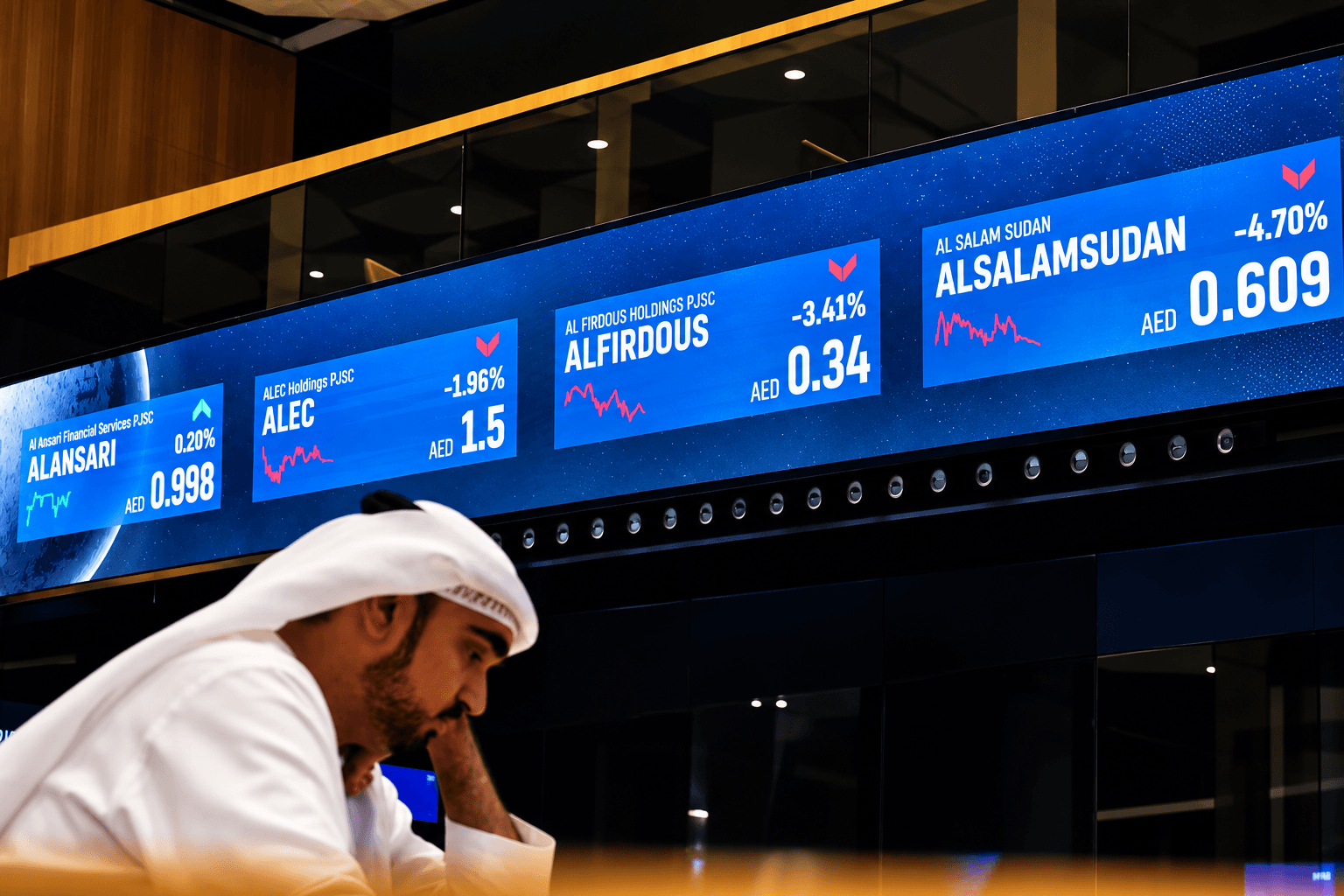
The moves underline the caution gripping regional investors as they wait to see whether diplomatic efforts between Washington and Tehran can lead to a broader easing of tensions.
US and Iranian officials have been communicating through mediators as efforts continue to find a way out of the conflict and ease pressure around the Strait of Hormuz.
For markets, however, there is still no clear sign of a lasting settlement.
Shipping disruptions and uncertainty around regional energy flows remain major concerns, leaving investors reluctant to make strong bets on a rapid improvement in conditions.
The result was a broad pullback across major Gulf exchanges.
Saudi Arabia posted the steepest decline among the markets highlighted in the latest session, while Qatar came under additional pressure from concerns over LNG shipments. Dubai and Abu Dhabi were more resilient, but still ended in negative territory.
The market is caught between two competing possibilities: a diplomatic breakthrough could reduce geopolitical risk, but uncertainty over whether talks will succeed is itself keeping investors on edge.
WHAT HAPPENED IN THE MARKETS?
Saudi Arabia's benchmark TASI index fell 1.2%, with Saudi Aramco shares down 1.4%, adding to the pressure on the broader market.
Qatar's benchmark index declined 1.1%, while Qatar National Bank lost around 1%.
In the UAE, the declines were smaller.
Dubai's main index fell 0.2%.
Abu Dhabi's benchmark slipped 0.3%.
The moves were not dramatic across every market, but they pointed to a common theme: investors are becoming more cautious while the regional outlook remains difficult to assess.
WHY ARE INVESTORS WORRIED?
The concern goes beyond the conflict itself.
Investors are trying to assess several possible outcomes at the same time.
If US–Iran diplomacy succeeds, markets could benefit from:
Lower geopolitical risk
More stable shipping conditions
Greater certainty around energy exports
Lower insurance and transport costs
Improved investor confidence
But if negotiations fail, those risks could move in the opposite direction.
That makes it harder for investors to value companies and markets that are exposed to regional trade, energy and economic activity.
THE US–IRAN DIPLOMACY FACTOR
Washington and Tehran have continued communicating through mediators as efforts continue to find a way forward.
The discussions reportedly involve issues including the Strait of Hormuz, sanctions and Iran's nuclear programme.
But major differences remain.
The United States is seeking stronger guarantees over Iran's nuclear activities and other security concerns, while Tehran wants relief from economic pressure and restrictions affecting its economy.
For investors, that means a diplomatic breakthrough cannot yet be taken for granted.
The talks may eventually ease tensions, but until there is more clarity, markets are likely to remain sensitive to every new development.
THE STRAIT OF HORMUZ PROBLEM
The Strait of Hormuz remains at the centre of the market's concerns.
The waterway is a crucial route for global energy shipments, meaning any prolonged disruption can have consequences well beyond the Gulf.
Investors are watching closely for its impact on:
Oil shipments
LNG deliveries
Shipping costs
Insurance premiums
Global energy prices
The issue is particularly important for Qatar, one of the world's leading LNG exporters.
Continued disruption has affected QatarEnergy's ability to deliver some LNG cargoes, adding another layer of uncertainty for the country's economy and financial markets.
SAUDI ARABIA: OIL AND MARKET PRESSURE
Saudi Arabia's stock market remains closely linked to expectations around oil prices and exports.
The fall in Saudi Aramco shares contributed to the broader decline in the TASI.
There was, however, some encouraging news on the physical oil-export side.
Saudi Arabia has resumed oil loadings from the Red Sea port of Yanbu after restoring operations on the East-West Pipeline, according to shipping and trade data cited by Reuters.
The route could provide an alternative pathway for some Saudi crude exports and help reduce the impact of disruptions elsewhere.
Even so, investors remain focused on the wider geopolitical picture.
If tensions ease, concerns around energy exports could diminish quickly. If the conflict escalates, sentiment could deteriorate just as quickly.
QATAR: LNG RISK TAKES CENTRE STAGE
Qatar faces a somewhat different energy challenge.
While Saudi Arabia is primarily associated with oil, Qatar is a major global LNG supplier. That makes shipping conditions through the Gulf particularly important for the country's energy sector.
QatarEnergy has extended force majeure notices affecting some LNG deliveries while disruption around the waterway continues, according to Reuters.
The uncertainty has also weighed on major Qatari companies.
Qatar National Bank, the country's largest lender, fell around 1% in the latest session.
UAE MARKETS HOLD UP BETTER — FOR NOW
The UAE's markets performed better than those in Saudi Arabia and Qatar, although both still finished lower.
Dubai's index fell 0.2%, while Abu Dhabi's benchmark declined 0.3%.
The smaller losses suggest that investors may see the UAE as somewhat less directly exposed to the immediate energy-export risks facing Saudi Arabia and Qatar.
But the UAE is not insulated from a prolonged regional crisis.
Its economy is heavily connected to:
International trade
Aviation
Tourism
Logistics
Financial services
Real estate
Energy
Dubai, in particular, relies heavily on its position as a regional business, tourism and transport hub. A prolonged period of instability could therefore affect investor confidence even if direct disruptions remain limited.
OIL PRICES SEND A MIXED SIGNAL
Oil prices are an important indicator for Gulf economies, but their relationship with stock markets is not always straightforward.
Higher oil prices can boost revenues for producing countries. At the same time, a sharp rise caused by geopolitical disruption can create new economic problems.
Those can include:
Higher inflation
Rising transport costs
Supply-chain disruption
Higher insurance costs
Weaker consumer confidence
Greater pressure on interest rates
Recent movements in oil markets have reflected both concerns about Middle Eastern supply and signs that some exports are recovering.
For Gulf investors, the key question is therefore not simply whether oil prices rise or fall, but why they are moving.
WHY BANKS ARE UNDER THE SPOTLIGHT
Banks are among the biggest components of many Gulf stock markets, making them an important indicator of investor confidence.
They are particularly sensitive to:
Economic growth
Interest rates
Credit demand
Liquidity
Business activity
Investor sentiment
When geopolitical uncertainty rises, investors can become more cautious about financial stocks. A prolonged disruption could eventually affect corporate activity, investment and borrowing demand.
That helps explain why banks and other large financial institutions were among the stocks under pressure during the latest session.
DIPLOMACY COULD ALSO BECOME A MARKET CATALYST
The latest declines should not be interpreted as a rejection of Gulf economies or their long-term prospects.
In fact, the market reaction could reverse quickly if diplomacy produces a credible breakthrough.
If Washington and Tehran reach an agreement that reduces military tensions and allows shipping through the Strait of Hormuz to become more predictable, investors could reassess Gulf assets.
Potential beneficiaries could include:
Airlines
Tourism companies
Banks
Logistics firms
Real estate companies
Consumer businesses
Energy companies
A meaningful reduction in geopolitical risk could therefore become a powerful catalyst for the region's markets.
THE BIGGER INVESTOR QUESTION
Investors are effectively weighing two scenarios.
SCENARIO ONE: DIPLOMATIC BREAKTHROUGH
US–Iran negotiations make meaningful progress.
Shipping conditions improve.
Energy flows become more predictable.
Risk premiums decline.
Gulf equities recover.
SCENARIO TWO: TALKS BREAK DOWN
Negotiations stall or fail.
Military tensions increase.
Hormuz disruption continues.
Oil and shipping risks rise.
Gulf markets face another period of volatility.
For now, investors appear to be positioning somewhere between the two.
WHY THIS MATTERS
1. GULF MARKETS REMAIN HIGHLY SENSITIVE TO GEOPOLITICS
Security developments in the region can quickly affect stocks, commodities and investor sentiment.
2. DIPLOMACY HAS BECOME A MARKET VARIABLE
Any meaningful progress — or setback — in US–Iran negotiations could move Gulf markets.
3. HORMUZ REMAINS CRITICAL
The waterway continues to influence energy markets, shipping costs and the outlook for Gulf economies.
4. QATAR FACES LNG PRESSURE
Continued disruption creates particular risks for Qatar's gas-export sector.
5. SAUDI OIL FLOWS ARE BEING WATCHED
The restoration of alternative export routes could ease some concerns around crude shipments.
6. THE UAE IS NOT IMMUNE
Dubai and Abu Dhabi may face less direct exposure to energy-export disruptions, but regional instability can still affect trade, tourism, logistics and investment.
FACT CHECK METER
AWX FACT CHECK
FACT METER: 91%
STATUS: DEVELOPING
CONFIRMED
Saudi Arabia's benchmark index fell 1.2% in the latest session.
Qatar's benchmark index fell 1.1%.
Dubai's main index declined 0.2%.
Abu Dhabi's index fell 0.3%.
US and Iranian officials have engaged in renewed diplomatic discussions through mediators.
Uncertainty surrounding the Strait of Hormuz continues to weigh on regional investor sentiment.
Saudi Arabia has resumed oil loadings from Yanbu after restoring the East-West Pipeline.
Qatar continues to face disruption affecting some LNG deliveries.
STILL DEVELOPING
Whether US–Iran negotiations lead to a lasting agreement.
When commercial shipping through the Strait of Hormuz can return to normal.
Whether Gulf markets recover if diplomatic efforts gain momentum.
The longer-term impact of the regional conflict on Gulf economic growth.
IMPORTANT DISTINCTION
A FALL IN GULF STOCK MARKETS DOES NOT MEAN THE REGION'S ECONOMIES ARE IN COLLAPSE.
The latest declines are primarily a reflection of investor caution and uncertainty surrounding the regional conflict.
AWX VERDICT
GULF MARKET DECLINE: CONFIRMED
US–IRAN DIPLOMATIC EFFORTS: CONFIRMED
REGIONAL UNCERTAINTY: HIGH
HORMUZ RISK: SIGNIFICANT
MARKET OUTLOOK: DEVELOPING
AWX FOCUS: WHAT ARE INVESTORS PRICING?
GEOPOLITICAL RISK
Markets are assessing the possibility of further escalation and its potential impact on regional economies.
DIPLOMATIC PROGRESS
A credible breakthrough could improve market sentiment quickly.
OIL AND GAS FLOWS
Energy exports remain central to the Gulf's economic outlook.
SHIPPING
The Strait of Hormuz remains one of the biggest sources of uncertainty for investors.
INTEREST RATES
Persistent energy-price pressure could complicate the global inflation and interest-rate outlook.
CORPORATE EARNINGS
Companies exposed to tourism, logistics, energy and consumer spending could experience very different outcomes depending on how long the disruption lasts.
WHAT TO WATCH NEXT
US–Iran talks
Whether mediators announce concrete progress toward a settlement.
Strait of Hormuz
Whether commercial shipping begins returning to more normal levels.
Saudi Arabia
Whether oil exports through alternative routes continue to recover.
Qatar
Whether LNG shipments can resume normally.
UAE
Whether Dubai and Abu Dhabi markets stabilise as investors reassess regional risks.
Oil prices
Whether geopolitical concerns continue to keep crude prices elevated.
Gulf banks
Whether financial stocks recover as risk appetite improves.
Global investors
Whether international capital begins returning to Gulf equities as signs of de-escalation emerge.
THE AWX BOTTOM LINE
Gulf stock markets are sending a straightforward message: investors remain cautious.
Saudi Arabia, Qatar and the UAE all ended lower as markets weighed renewed US–Iran diplomatic efforts against continued uncertainty over energy supplies, shipping and regional security.
The irony is that diplomacy itself has become a source of market volatility.
A successful agreement could lower geopolitical risk and trigger a recovery in Gulf equities. A breakdown in negotiations could bring another wave of uncertainty.
For Saudi Arabia, the security of oil exports remains critical.
For Qatar, LNG shipments and access through the Strait of Hormuz are central to the outlook.
For the UAE, the risks extend beyond energy to trade, tourism, logistics and financial markets.
The next major move in Gulf equities may therefore depend less on company earnings and more on developments far beyond the stock exchanges themselves.
The question investors are waiting to answer is simple:
Can Washington and Tehran turn diplomatic contact into a lasting reduction in regional tensions?
Until there is a clearer answer, volatility is likely to remain part of the Gulf market story.
ATTLAS WIRE | AWX WORLD NEWS
Real Stories. Lasting Impact.



Comments
No comments yet.