

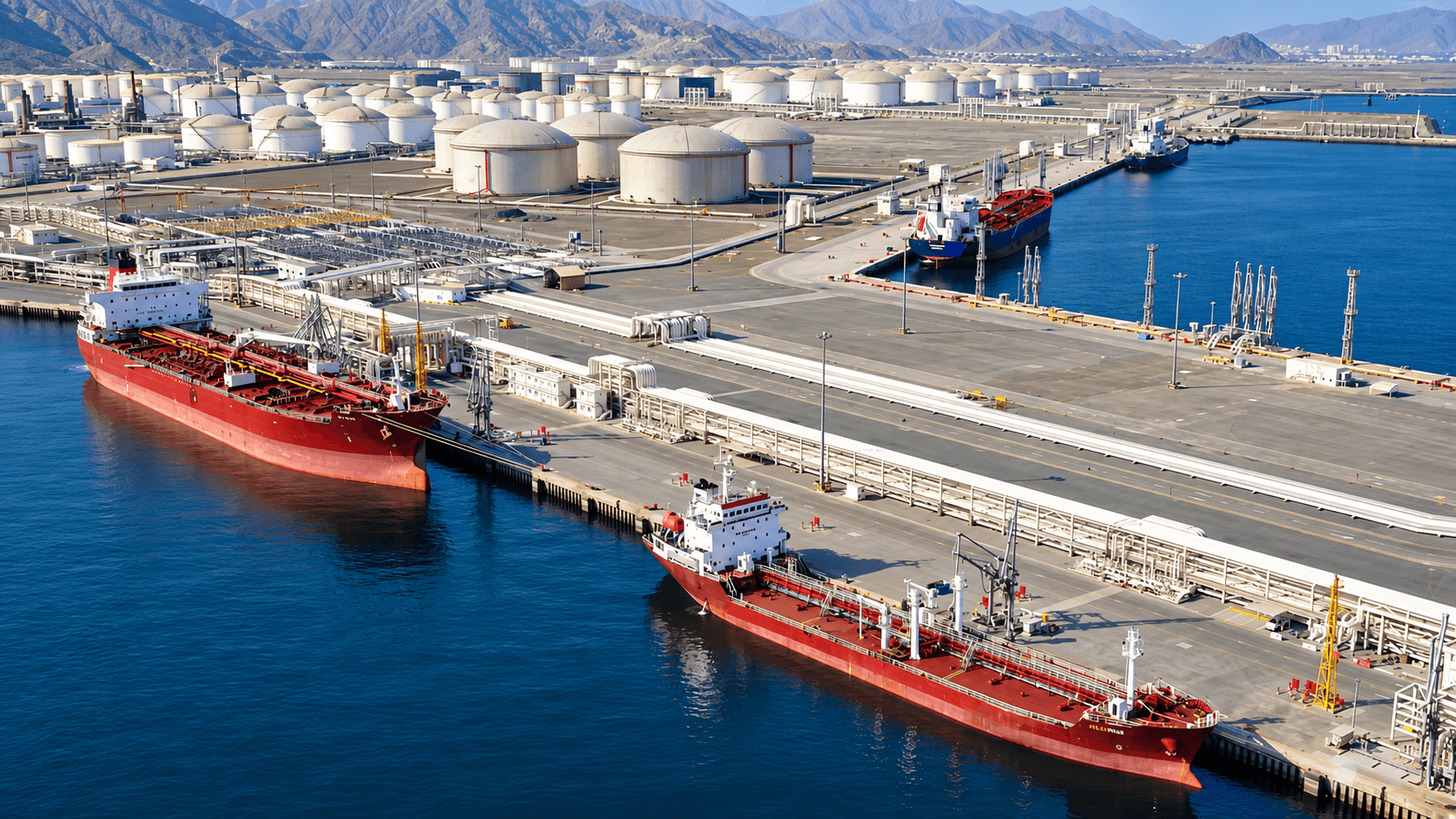
Fujairah is rebuilding.
After months of disruption linked to the Iran war and the pressure on shipping through the Strait of Hormuz, the UAE’s major fuel and bunkering hub is beginning to find its footing again.
More cargoes are arriving. Ships are returning for fuel. And larger volumes of fuel oil are once again moving toward Asian markets.
The recovery is visible in the numbers.
The UAE imported around 2.6 million metric tonnes of fuel oil in the third quarter, up sharply from 845,000 tonnes in the second quarter, according to Kpler data cited by Reuters.
September alone accounted for about 856,000 tonnes, compared with 715,000 tonnes in August.
Exports have also picked up. UAE fuel-oil exports topped 1.4 million tonnes in September, the highest level in more than a year, with much of the volume heading to Southeast Asia.
But Fujairah is not back to normal yet.
Onshore residual-fuel inventories averaged around 4.5 million barrels a week in September, still well below the roughly 9 million barrels a week recorded before the conflict.
The message from the market is straightforward:
Fujairah is moving again — but the recovery is still underway.
WHAT HAPPENED?
The conflict highlighted just how important Fujairah has become to the Gulf's energy network.
Located on the UAE’s eastern coast and outside the Strait of Hormuz, Fujairah has long been one of the world’s major marine-fuel and bunkering centres.
When the conflict intensified in late February, however, supplies feeding the hub were disrupted.
Fuel-oil arrivals dropped.
Bunker sales weakened.
Inventories fell.
Shipping companies also had to navigate a much more difficult and uncertain operating environment.
That picture has gradually improved.
Higher refinery output across the Middle East, alternative supply routes and changes in shipping patterns have helped fuel return to Fujairah.
The result has been a strong rebound in both imports and exports.
FUJAIRAH’S SUPPLY PIPELINE IS BEING REBUILT
The recovery has not come from a single source.
Saudi Arabia became Fujairah’s largest fuel-oil supplier in July and August, replacing Kuwait, which had been the leading supplier before the war.
Saudi Aramco’s trading arm has also offered additional fuel oil through tenders for October loading.
Russia has become another important source, while cargoes from several other origins are also reaching the market.
Reuters-cited data showed that some shipments of uncertain origin reached Fujairah through ship-to-ship transfers in the Gulf of Oman.
Additional cargoes from Nigeria and Pakistan were also expected in October.
That has created a more diverse supply network.
And diversification matters.
The conflict has shown how exposed energy hubs can become when they depend heavily on a limited number of suppliers and shipping routes.
UAE RECLAIMS THE REGIONAL EXPORT CROWN
The recovery at Fujairah is also reshaping the regional fuel-export market.
As supplies have improved, the UAE has once again become the Middle East’s largest fuel-oil exporter.
Kpler data showed UAE fuel-oil exports exceeding 1.4 million tonnes in September, with most of the cargoes heading to Southeast Asia.
That is more than a simple monthly increase.
It shows that the UAE’s trading and logistics network is adapting to the disruption and finding ways to keep fuel moving.
For Asian buyers, that matters.
Fuel markets across Southeast Asia remain sensitive to refinery outages, shipping disruptions and changes in Chinese exports.
The UAE’s ability to provide additional supply gives buyers another source of flexibility when regional markets tighten.
BUNKERING STARTS TO RECOVER
Fujairah is more than an export terminal.
It is one of the world’s major bunkering hubs, supplying marine fuel to ships operating across one of the busiest maritime regions in the world.
That business was hit hard during the second quarter.
Now, bunker activity is beginning to recover.
S&P Global data showed sales rebounding in July after reaching record lows during Q2, although activity remained below pre-war levels.
The improvement has come alongside a gradual rebuilding of fuel inventories.
Fujairah’s average onshore residual-fuel stocks rose from approximately 3.9 million barrels a week in August to 4.5 million barrels in September.
That is a positive sign.
But the gap with the pre-war average of around 9 million barrels remains significant.
There is still a long way to go.
THE VLSFO PROBLEM
Not every part of the market is recovering at the same pace.
Very-low-sulphur fuel oil, or VLSFO, remains relatively tight.
VLSFO is widely used by commercial shipping because it meets international sulphur-emissions requirements.
Before the conflict, Fujairah’s VLSFO supply was supported by the local Vitol refining facility, along with supplies from Kuwait and Europe.
With some of those flows disrupted, prompt availability remains constrained.
Industry supplier Dan-Bunkering has warned that VLSFO premiums have been edging higher as cargo availability remains limited.
Additional October shipments could ease some of that pressure.
High-sulphur fuel oil, meanwhile, remains more comfortably supplied.
FUJAIRAH’S BIGGER ADVANTAGE
Fujairah’s recovery is not happening in isolation.
The port has one structural advantage that has become particularly valuable during the crisis:
It can operate outside the Strait of Hormuz.
The UAE has spent years developing energy infrastructure aimed at reducing its dependence on the chokepoint.
One of the most important pieces is the Habshan–Fujairah pipeline, which allows Abu Dhabi crude to reach the UAE’s eastern coast without passing through Hormuz.
That infrastructure helped the UAE maintain significant crude-export capacity during earlier stages of the conflict.
By June, UAE crude and condensate exports had climbed close to record levels, with Fujairah playing an important role in the recovery.
The broader lesson is becoming increasingly clear.
Fujairah is not simply a backup port.
It is becoming a central part of the UAE’s longer-term energy-security strategy.
WHY THE UAE NEEDS FUJAIRAH
The war has exposed a basic challenge facing Gulf energy exporters.
Producing oil and fuel is only one part of the equation.
Getting those products to international customers is the other.
When the Strait of Hormuz becomes dangerous or difficult to use, exporters need alternative infrastructure.
That is where Fujairah becomes strategically important.
The UAE can rely on pipelines, storage facilities, eastern-coast terminals and shipping infrastructure to keep part of its international energy trade moving even when Gulf shipping routes come under pressure.
Energy executives have made a similar argument.
TotalEnergies chief executive Patrick Pouyanné said the crisis had highlighted the need to move away from a “just-in-time” model and toward a “just-in-case” approach, with greater investment in alternative export routes.
He specifically pointed to infrastructure linking the UAE’s energy system with Fujairah.
ASIA IS WATCHING
A large share of Fujairah’s recovering fuel-oil exports is heading toward Southeast Asia.
That makes the UAE’s recovery increasingly relevant to Asian fuel markets.
The timing is important.
China has suspended fuel exports beyond Hong Kong and Macau during October, tightening supplies for some Asian buyers and putting pressure on regional refining margins.
That creates an opportunity for other suppliers to fill part of the gap.
The UAE, along with India and other major refining and trading centres, could become increasingly important as Asian buyers look for alternative sources.
For Fujairah, that could translate into stronger demand for both exported fuel and marine bunkering services.
THE BIGGER ENERGY STORY
Fujairah’s recovery is part of a much wider shift in Gulf energy logistics.
The conflict initially pushed regional exports sharply lower.
Producers and traders have since adapted.
Pipelines are being used more heavily.
Tankers are changing routes.
Ship-to-ship transfers have increased.
Some vessels have also used limited or disrupted tracking practices.
Alternative ports have taken on a greater role.
By September, Gulf oil flows excluding Iran had recovered to roughly 81% of their pre-war level, although refined-fuel exports remained considerably weaker than crude flows.
That distinction is important.
Crude exports are recovering faster.
Refined products — particularly diesel and some marine fuels — remain under greater pressure.
That makes Fujairah’s recovery especially significant.
WHY THIS MATTERS
Fujairah sits at the intersection of three major energy stories.
THE HORMUZ STORY
The UAE needs alternatives to a strategic chokepoint.
THE ASIA STORY
Asian markets need reliable fuel supplies.
THE SHIPPING STORY
Global shipowners need dependable bunkering services.
If Fujairah continues rebuilding inventories and increasing exports, the port could become an even more important regional shock absorber.
But another escalation in regional tensions could quickly create a fresh supply squeeze.
The recovery is therefore about more than economics.
It is also about geopolitics and energy security.
FACT CHECK METER
FACT METER: 96%
STATUS: DEVELOPING
CONFIRMED
Fujairah fuel-oil supplies have increased significantly.
UAE fuel-oil imports reached approximately 2.6 million tonnes in Q3.
September imports reached about 856,000 tonnes.
UAE fuel-oil exports exceeded 1.4 million tonnes in September.
Most September exports were directed toward Southeast Asia.
Fujairah bunker activity has recovered from Q2 lows.
Fuel inventories remain below pre-war levels.
IMPORTANT DISTINCTION
“Rebuilds” does not mean Fujairah has completely returned to its pre-war position.
Inventories remain roughly half their pre-war level, while VLSFO availability is still relatively tight.
AWX VERDICT
Fujairah is clearly recovering — but the hub is rebuilding rather than fully restored.
The direction is positive.
The resilience is real.
But the energy market remains vulnerable to another disruption.
AWX FOCUS
Fujairah has become one of the clearest examples of how energy infrastructure can change the balance of power during a regional crisis.
The UAE cannot control every development around the Strait of Hormuz.
But it can control how dependent its energy economy is on that chokepoint.
Every additional barrel stored at Fujairah, every fuel cargo delivered and every ship refuelled strengthens that resilience.
The recovery also gives Asian buyers another source of supply at a time when global fuel markets are already facing disruption.
Fujairah’s comeback is therefore bigger than the port itself.
It is part of the UAE’s broader strategy to make its energy network harder to isolate.
WHAT TO WATCH NEXT
1. OCTOBER FUEL-OIL ARRIVALS
Will new Saudi, Nigerian, Pakistani and other cargoes push inventories higher?
2. VLSFO PRICES
Will additional October supplies ease the current tightness?
3. BUNKER SALES
Can Fujairah return to pre-war refuelling volumes?
4. UAE EXPORTS
Will fuel-oil exports remain above 1.4 million tonnes a month?
5. ASIAN DEMAND
Could China’s reduced fuel exports create additional demand for UAE cargoes?
6. HORMUZ SECURITY
Any renewed disruption could quickly change the supply picture.
THE AWX BOTTOM LINE
Fujairah is bouncing back.
Fuel-oil imports have surged. UAE exports climbed above 1.4 million tonnes in September. Bunkering activity has recovered from wartime lows, and Asian buyers are once again receiving larger volumes from the UAE.
But the numbers tell another story too.
Inventories are still below half their pre-war level.
VLSFO remains tight.
And the region’s shipping network continues to operate under geopolitical pressure.
Fujairah is not simply recovering lost business.
It is becoming an increasingly important part of the UAE’s energy-security strategy.
The war disrupted the route.
Fujairah is rebuilding the alternative.
ATTLAS WIRE | AWX WORLD NEWS
Real Stories. Lasting Impact.


Comments
No comments yet.