

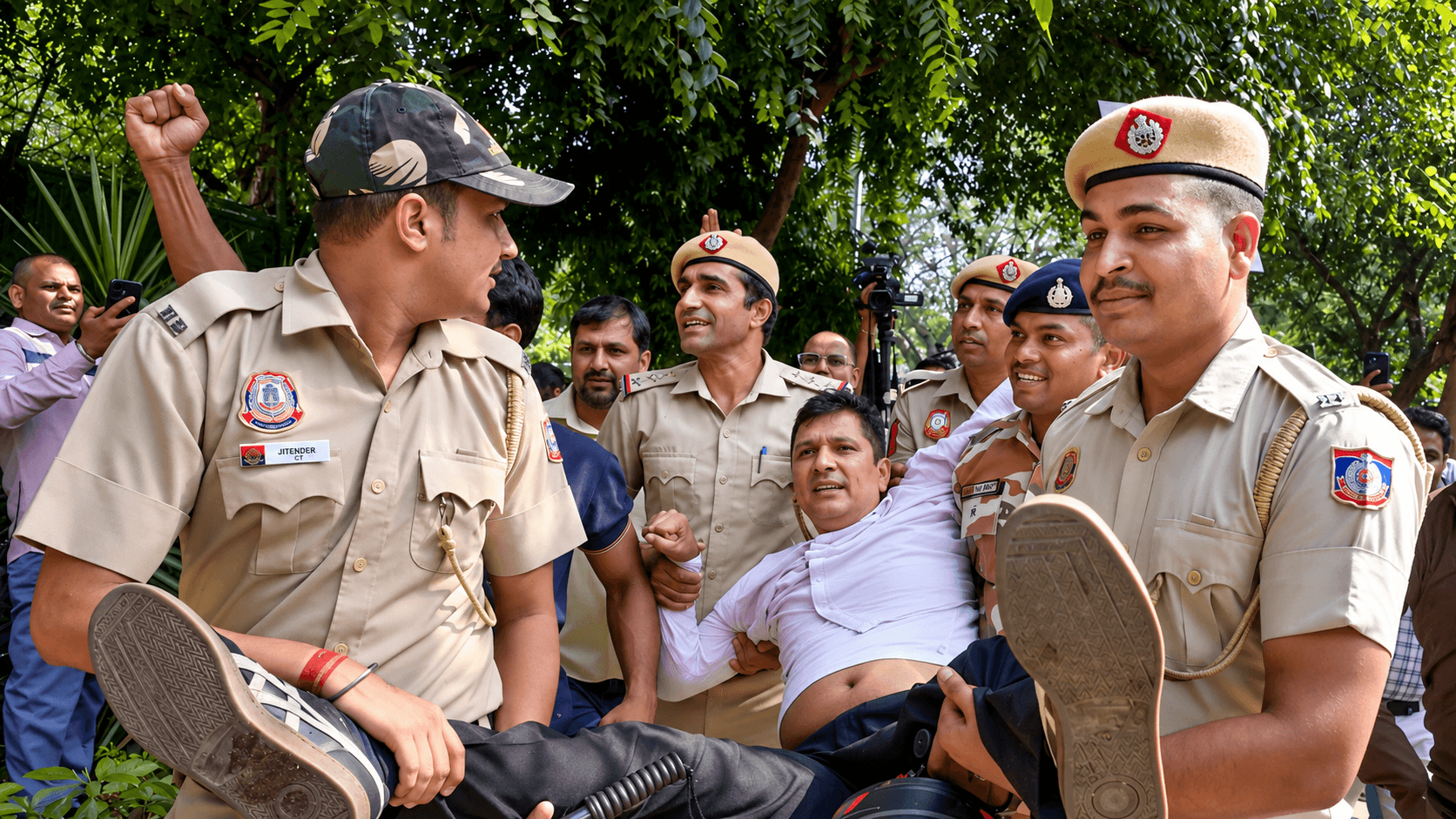
Tensions rose in central Delhi on Monday as Aam Aadmi Party leaders and workers gathered at Jantar Mantar to protest over electoral-roll issues, with police detaining several demonstrators as security was tightened around the site.
The protest is part of a wider political dispute over the Special Intensive Revision (SIR) of electoral rolls and allegations raised by opposition parties about the way the process is being carried out.
AAP has questioned the transparency of the exercise and called for greater accountability from election authorities. The Election Commission, meanwhile, has rejected allegations of wrongdoing and maintained that electoral-roll revisions are necessary to keep voter lists accurate.
The confrontation at Jantar Mantar adds another layer to an increasingly heated political debate over voter registration and electoral credibility.
The key question now is whether Monday's confrontation will remain a one-day protest or lead to a broader political campaign over voter rolls.
WHAT HAPPENED AT JANTAR MANTAR?
AAP leaders and supporters gathered at Jantar Mantar to raise concerns over the electoral-roll revision process and the functioning of the Election Commission.
Police were deployed around the protest area as authorities sought to keep the gathering within designated limits. Several protesters, including AAP leaders and workers, were detained during the demonstration.
Jantar Mantar has long been one of Delhi's main venues for political protests, making it a natural focal point for the latest confrontation.
The detentions came amid heightened security in central Delhi, where authorities have been preparing for demonstrations and attempting to limit disruption around sensitive areas.
WHY IS AAP PROTESTING?
The Aam Aadmi Party has been increasingly vocal about the revision of electoral rolls.
Its leaders have raised concerns about eligible voters potentially being removed from the lists and have demanded greater transparency in the process.
AAP argues that any change to voter records must ensure that legitimate voters are not left out of elections.
Election authorities, however, have maintained that updating electoral rolls is a routine part of election administration and is intended to identify duplicate, outdated or otherwise ineligible entries.
That difference in position lies at the centre of the current dispute.
WHAT IS THE SIR ISSUE?
The Special Intensive Revision, or SIR, is an exercise aimed at reviewing and updating electoral rolls.
The process can involve checking voter information and identifying records that may need to be corrected or removed.
Supporters say such revisions can help address problems including:
Duplicate voter entries
Incorrect information
Records belonging to deceased voters
Registrations that do not meet eligibility requirements
Critics, however, are concerned that legitimate voters could face difficulties during the verification process or find their names missing from the final electoral rolls.
As a result, what is essentially an electoral-administration exercise has become a major political issue.
WHY JANTAR MANTAR MATTERS
Jantar Mantar has for decades been a prominent venue for political demonstrations in the capital.
Its location in central Delhi, close to major government institutions, gives protests there considerable visibility. But large gatherings in the area also create security and traffic challenges.
Authorities have to manage issues involving:
Traffic movement
Public transport
Access to government offices
Crowd control
Emergency movement
Security restrictions are therefore common when large demonstrations are planned.
POLICE RESPONSE
Police officers moved to control the gathering and prevent protesters from moving into restricted areas.
Barricades were used to manage the crowd and regulate movement around the protest site. Several people were detained as authorities sought to prevent the demonstration from expanding beyond designated areas.
For the authorities, the immediate concern was maintaining public order and avoiding disruption in central Delhi.
The police action, however, quickly became part of the political debate, with AAP leaders questioning whether the response was proportionate.
AAP CRITICISES DETENTIONS
AAP leaders condemned the detentions and argued that political parties must be able to protest peacefully.
The party said the demonstration was intended to draw attention to concerns surrounding voter lists and electoral rights.
AAP leaders also accused authorities of attempting to restrict opposition voices and called for greater scrutiny of the electoral-roll revision process.
The party's broader argument is that voters should not lose their right to participate in elections because of errors or problems in the revision process.
ELECTION COMMISSION'S POSITION
The Election Commission has defended the need for accurate and updated electoral rolls.
Election authorities have rejected allegations that the revision process is intended to target particular political parties or groups.
The commission's position is that maintaining reliable voter lists is essential to the credibility of elections.
The disagreement with opposition parties is therefore less about whether electoral rolls should be updated and more about how the process is conducted and how potential exclusions are handled.
WHY THIS MATTERS TO VOTERS
For ordinary voters, the issue is ultimately straightforward: their names need to appear on the electoral roll if they are to cast their ballots.
A missing or incorrect entry can create difficulties at election time.
At the same time, inaccurate or duplicate records can also undermine confidence in the electoral system.
Election authorities therefore face a delicate task — keeping voter lists clean and accurate without inadvertently excluding people who are legally entitled to vote.
That balance is at the heart of the current political argument.
DELHI'S SECURITY ENVIRONMENT
Monday's protest comes against a backdrop of heightened security in central Delhi.
Authorities have introduced restrictions around sensitive locations and taken steps to manage crowds and traffic during demonstrations.
During periods of heightened security, restrictions can also affect metro services and commuters travelling through central Delhi.
For residents and office workers, the consequences can extend well beyond the protest site itself.
FROM INSTITUTIONS TO THE STREETS
The latest confrontation reflects a familiar pattern in Indian politics: issues that begin inside election offices, courts or government institutions can quickly move into the streets.
For opposition parties, public demonstrations provide a way to put pressure on institutions and bring political attention to issues they believe are being overlooked.
For authorities, the challenge is to protect the right to protest while ensuring that demonstrations do not create wider public-order problems.
The Jantar Mantar confrontation brings that tension into sharp focus.
THE BROADER POLITICAL PICTURE
The controversy is not limited to AAP.
Other opposition parties have also questioned aspects of electoral-roll revisions and the functioning of election authorities.
If opposition groups coordinate their campaigns, the issue could develop into a larger political movement, putting additional pressure on the Election Commission to explain how the revision process is being conducted.
For now, however, the political response remains fluid.
WHAT COULD HAPPEN NEXT?
SCENARIO ONE: THE PROTEST REMAINS CONTAINED
The demonstration ends after the detentions, with no major escalation in the days ahead.
SCENARIO TWO: POLITICAL MOBILISATION GROWS
AAP could announce additional demonstrations, potentially drawing support from other opposition parties.
SCENARIO THREE: THE DISPUTE MOVES TO COURT
Political parties, organisations or individual voters could pursue legal challenges over disputed changes to electoral rolls.
SCENARIO FOUR: A NATIONAL CAMPAIGN EMERGES
The issue could become part of a wider opposition campaign focused on electoral transparency and voter rights.
Which path the dispute takes will depend largely on the response from political parties, election authorities and the courts.
WHY THIS MATTERS
1. ELECTORAL TRUST IS UNDER SCRUTINY
The dispute goes directly to public confidence in the process of registering voters and conducting elections.
2. AAP IS TURNING THE ISSUE INTO A POLITICAL CAMPAIGN
The party is using public demonstrations to press its objections to the electoral-roll revision process.
3. POLICE ACTION COULD FUEL FURTHER DEBATE
While detentions may help authorities control a demonstration in the short term, they can also trigger further criticism from opposition parties.
4. JANTAR MANTAR REMAINS A SYMBOLIC POLITICAL SPACE
The protest site has repeatedly served as a focal point for demonstrations on major national and political issues.
5. THE NEXT BATTLE COULD BE LEGAL
If disagreements over voter lists continue, courts could become another important arena for the dispute.
AWX FACT CHECK METER
FACT METER: 91%
STATUS: DEVELOPING
CONFIRMED
AAP leaders and workers participated in a protest in Delhi concerning electoral issues.
Police detained protesters during the demonstration.
Jantar Mantar remains a major venue for political demonstrations.
The Special Intensive Revision of electoral rolls has become a significant political issue.
Opposition parties have raised concerns about the possible exclusion of eligible voters.
Election authorities have defended the need for accurate and updated electoral rolls.
IMPORTANT DISTINCTION
DETENTION DOES NOT NECESSARILY MEAN FORMAL ARREST OR CRIMINAL CHARGES.
Being detained during a protest can be a crowd-control measure. The legal status of individual detainees can vary depending on the circumstances.
CONTESTED
Claims that electoral-roll revisions could systematically exclude eligible voters.
Allegations that the process is politically motivated.
The scale and potential electoral impact of disputed voter deletions.
AWX VERDICT
AAP PROTEST: CONFIRMED
POLICE DETENTIONS: REPORTED
ELECTORAL-ROLL DISPUTE: CONFIRMED
POLITICAL TENSION: HIGH
LEGAL CONSEQUENCES: DEVELOPING
SITUATION: DEVELOPING
AWX FOCUS: THE JANTAR MANTAR STANDOFF
AAP
Demanding greater transparency and challenging the electoral-roll revision process.
POLICE
Seeking to control the demonstration and prevent unauthorised movement or wider disruption.
ELECTION COMMISSION
Defending the importance of accurate electoral rolls and rejecting allegations of wrongdoing.
OPPOSITION PARTIES
Increasing pressure on election authorities over concerns surrounding voter lists.
VOTERS
Watching closely to see whether changes to electoral rolls could affect their ability to vote.
THE KEY QUESTION
Can the dispute over electoral rolls be resolved through institutional and legal channels, or will street protests become the main political battleground?
WHAT TO WATCH NEXT
POLICE
Whether additional protesters are detained, released or face further legal action.
AAP
Whether the party announces another demonstration or broader mobilisation.
ELECTION COMMISSION
Whether officials provide further clarification about the electoral-roll revision process.
OPPOSITION
Whether other political parties join the campaign.
COURTS
Whether petitions challenging aspects of the electoral-roll process are filed or expanded.
PROTEST ACTIVITY
Whether demonstrations spread beyond Delhi.
PUBLIC REACTION
Whether concerns over voter lists develop into wider political mobilisation.
THE AWX BOTTOM LINE
The confrontation at Jantar Mantar is about more than a single protest.
At its core is a growing political dispute over electoral rolls, voter rights and the role of India's election authorities.
For AAP, the issue is about transparency and electoral accountability.
For police, the immediate priority is maintaining public order.
For the Election Commission, the challenge is to maintain accurate voter lists while addressing concerns about possible exclusion.
And for voters, the question is much simpler:
Will their names be on the electoral roll when they go to vote?
Monday's protest may end with the release or further processing of those detained. But the political argument behind the demonstration is unlikely to disappear quickly.
As the debate over electoral rolls moves from election offices and political institutions onto the streets, Jantar Mantar has once again become a flashpoint in India's wider debate over electoral trust.
ATTLAS WIRE | AWX WORLD NEWS
Real Stories. Lasting Impact.




Comments
No comments yet.