

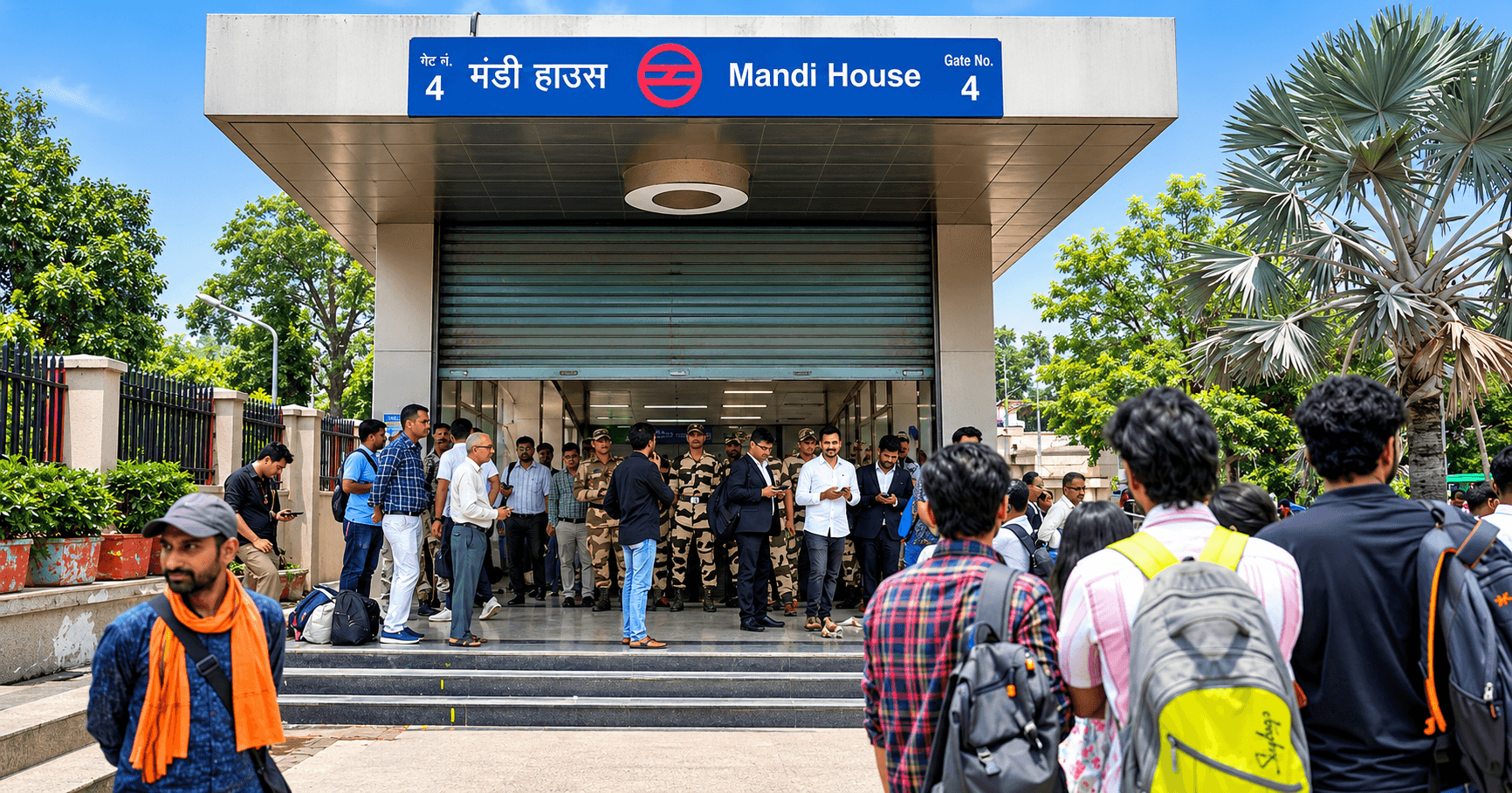
Delhi's Metro network is facing temporary restrictions as security is tightened across central Delhi ahead of planned political demonstrations at Jantar Mantar.
Entry and exit facilities have been restricted at 11 stations in and around the central Delhi area. The move is part of a wider security operation aimed at managing crowds and preventing large groups from converging on the protest site.
For commuters, the impact is immediate. Some passengers may have to use alternative stations or routes, while those travelling through central Delhi could face longer journey times.
For political groups, the restrictions have added another point of tension to an already heated dispute over electoral-roll issues.
The bigger question is whether authorities can maintain security around a politically sensitive protest without creating wider disruption for the capital's daily commuters.
WHAT IS HAPPENING?
Entry and exit facilities at 11 Metro stations have been temporarily restricted as part of security preparations around Jantar Mantar.
This does not mean the entire Delhi Metro network has been shut down.
In affected areas, trains may continue to pass through stations even when passengers are not allowed to enter or exit. The restrictions are primarily intended to control the movement of large crowds toward sensitive areas.
For commuters, however, the distinction may offer little comfort if their usual station is inaccessible.
WHICH STATIONS ARE AFFECTED?
The stations facing restrictions include:
Janpath
Patel Chowk
Central Secretariat
Rajiv Chowk
Seva Teerth
Mandi House
Lok Kalyan Marg
INA
Chawri Bazar
Ramakrishna Ashram Marg
New Delhi
Several of these are busy stations and major interchange points. Restrictions at such locations can therefore affect passenger movement well beyond the immediate Jantar Mantar area.
WHY ARE THE STATIONS CLOSED?
The restrictions come as police prepare for political demonstrations in central Delhi.
Jantar Mantar is a designated location for protests, but large gatherings in the area can create significant challenges for security agencies.
Authorities have to consider crowd control, traffic movement, emergency access and the security of nearby government buildings.
Restricting Metro access can reduce the number of people arriving in the area at the same time and give police greater control over crowd movement.
THIS IS NOT A COMPLETE METRO SHUTDOWN
One distinction is important.
Delhi Metro services have not been completely suspended.
The restrictions mainly concern passenger entry and exit at selected stations. Trains may continue operating through affected locations, depending on the security instructions in force.
For commuters, this means the network remains operational in many areas, but normal travel patterns may be disrupted.
WHY JANTAR MANTAR MATTERS
Jantar Mantar has long been one of Delhi's most prominent locations for political demonstrations.
Its central location, proximity to government offices and connections to major roads make it an important protest site — but also a sensitive area for security agencies.
A large gathering there can quickly affect surrounding roads, public transport and nearby commercial areas.
That is why security measures around the site often extend beyond the protest zone itself.
THE POLITICAL BACKDROP
The latest security measures come amid a broader dispute over electoral-roll revisions.
Political groups have raised concerns about aspects of the Special Intensive Revision process, arguing that eligible voters could face difficulties if their names are removed or if they are unable to establish their eligibility.
Election authorities, meanwhile, have maintained the importance of keeping electoral rolls accurate and up to date.
The disagreement has moved beyond political statements and into street demonstrations, bringing the issue into the centre of Delhi.
THE COMMUTER IMPACT
For ordinary Delhi residents, the political dispute has a very practical consequence: getting around the city may become more difficult.
Passengers using affected stations may need to:
Exit at another station
Change their Metro route
Use buses, taxis or auto-rickshaws
Walk from nearby stations
Allow extra time for their journey
Stations such as Rajiv Chowk, Central Secretariat and New Delhi normally handle heavy passenger traffic. Even temporary restrictions can therefore push additional commuters toward nearby stations and roads.
WHY RAJIV CHOWK MATTERS
Rajiv Chowk is one of the busiest interchange points on the Delhi Metro network.
Restrictions there can quickly alter passenger flows, with commuters forced to change routes or use nearby stations.
The result can be secondary congestion elsewhere on the network, even if Metro trains themselves continue to run.
The same concern applies to other major stations affected by the restrictions.
POLICE WANT TO CONTROL CROWD FLOW
From the police perspective, the Metro is one of the fastest ways for large numbers of people to reach central Delhi.
Restricting access at selected stations gives authorities greater control over how crowds approach the protest area.
The objective is not necessarily to stop Metro operations altogether. Instead, it is to prevent an uncontrolled flow of people toward a sensitive location.
PROTESTERS' CONCERNS
Political activists and supporters, however, may view the restrictions differently.
They argue that security arrangements should not make it unnecessarily difficult for people to participate in peaceful demonstrations.
For political groups, transport restrictions can therefore become part of the wider debate over the right to protest and the limits of preventive security measures.
POLICE FACE A DIFFICULT BALANCING ACT
Authorities have to manage several competing priorities at the same time.
They must protect:
Public safety
Government buildings
Emergency routes
Transport infrastructure
while also trying to minimise disruption for ordinary commuters.
That balance becomes harder as the size of a demonstration increases.
CENTRAL DELHI TRAFFIC COULD ALSO BE AFFECTED
Metro restrictions can have a knock-on effect on road traffic.
If passengers cannot enter or exit certain stations, some will naturally switch to buses, taxis, auto-rickshaws or private vehicles.
That could place additional pressure on already busy roads.
Traffic diversions and security barricades around Jantar Mantar could add to the congestion.
THE SECTION 163 CONNECTION
The Metro restrictions come against a broader security backdrop involving preventive measures around sensitive areas.
Section 163 of the Bharatiya Nagarik Suraksha Sanhita allows authorities to issue preventive orders in specified circumstances where immediate action is considered necessary to maintain public order.
The precise restrictions depend on the orders issued by the competent authority.
WHY THIS IS MORE THAN A TRANSPORT STORY
At first glance, closing Metro gates may look like a commuter issue.
But the impact goes beyond public transport.
When a political demonstration takes place near major transport hubs, security decisions can quickly affect roads, businesses, commuters and residents across a much wider part of the city.
That creates a difficult balance between security requirements and normal urban life.
WHAT COULD HAPPEN NEXT?
SCENARIO ONE: RESTRICTIONS ARE LIFTED
If the protest remains peaceful and security concerns ease, the affected stations could return to normal operations.
SCENARIO TWO: RESTRICTIONS ARE EXTENDED
If crowds remain large or tensions increase, authorities could keep the restrictions in place for longer.
SCENARIO THREE: MORE PREVENTIVE ACTION
If protesters attempt to enter restricted areas, police could take further preventive measures, including detentions.
SCENARIO FOUR: WIDER DISRUPTION
If passengers shift heavily from Metro to road transport, congestion could spread beyond central Delhi.
WHY THIS MATTERS
1. MILLIONS RELY ON THE METRO
Even short-term restrictions can disrupt the daily journeys of a large number of commuters.
2. CENTRAL DELHI IS A MAJOR TRANSPORT HUB
Restrictions at key stations can quickly push passengers toward alternative routes.
3. THE PROTEST IS POLITICALLY SENSITIVE
The demonstrations are linked to a wider dispute over electoral-roll revisions.
4. SECURITY MEASURES CAN CREATE SECONDARY DISRUPTION
Passengers displaced from the Metro may add pressure to already busy roads and other transport services.
5. THE RESPONSE COULD SHAPE FUTURE PROTEST SECURITY
How authorities handle the current demonstrations could influence security arrangements for future political gatherings in the capital.
FACT CHECK METER
AWX FACT CHECK
FACT METER: 95%
STATUS: DEVELOPING
CONFIRMED
Entry and exit restrictions have been imposed at 11 Delhi Metro stations amid heightened security in central Delhi.
The measures are connected to preparations around a planned political protest at Jantar Mantar.
The affected locations include major stations such as Rajiv Chowk, Central Secretariat and New Delhi.
The restrictions do not mean the entire Delhi Metro network has stopped operating.
The wider security situation is connected to political demonstrations concerning electoral-roll issues.
IMPORTANT DISTINCTION
"STATIONS CLOSE THEIR GATES" DOES NOT MEAN THE ENTIRE METRO SYSTEM IS SHUT DOWN.
The main restriction concerns passenger entry and exit at selected stations, while Metro services can continue through parts of the network.
CONTESTED
Whether the scale of the restrictions is proportionate to the anticipated protest.
Whether the measures unnecessarily affect peaceful demonstrators.
The broader political allegations surrounding electoral-roll revisions.
AWX VERDICT
11 STATION RESTRICTIONS: CONFIRMED
METRO-WIDE SHUTDOWN: NO
SECURITY TIGHTENED: CONFIRMED
JANTAR MANTAR PROTEST: ACTIVE
COMMUTER DISRUPTION: SIGNIFICANT
SITUATION: DEVELOPING
AWX FOCUS: DELHI'S METRO SECURITY STANDOFF
POLICE
Using transport restrictions to manage movement toward sensitive areas.
DMRC
Managing passenger movement while security instructions remain in effect.
PROTESTERS
Seeking access to Jantar Mantar despite heightened security.
COMMUTERS
Looking for alternative stations and routes as restrictions disrupt normal journeys.
POLITICAL PARTIES
Using the demonstrations to raise concerns over electoral-roll revisions.
THE KEY QUESTION
How long can access to major transport hubs be restricted before a security measure becomes a wider public-transport problem?
WHAT TO WATCH NEXT
METRO
Whether the 11 affected stations reopen or restrictions are extended.
PROTEST
How large the gathering at Jantar Mantar becomes and whether tensions increase.
POLICE
Whether additional barricades, restrictions or preventive detentions are introduced.
TRAFFIC
Whether displaced Metro passengers lead to heavier congestion on central Delhi roads.
POLITICAL RESPONSE
Whether opposition parties challenge the restrictions or demand changes to the security arrangements.
ELECTION COMMISSION
Whether officials issue further clarification on the electoral-roll dispute.
PUBLIC REACTION
Whether commuters and residents raise concerns about the wider disruption.
THE AWX BOTTOM LINE
Delhi's latest Metro restrictions show how quickly a political protest can affect everyday life across a major capital.
The immediate aim is to manage crowds around Jantar Mantar and prevent uncontrolled movement toward the protest site.
But the effects do not stop there.
When gates close at major Metro stations, commuters have to change routes, nearby stations can become busier and more passengers may move onto already crowded roads.
For protesters, the restrictions raise questions about access to peaceful demonstrations.
For police, they are a preventive security measure.
For commuters, they are another disruption to an already heavily used transport network.
The protest may be centred on Jantar Mantar — but its impact is being felt across Delhi's transport system.
ATTLAS WIRE | AWX WORLD NEWS
Real Stories. Lasting Impact.




Comments
No comments yet.