

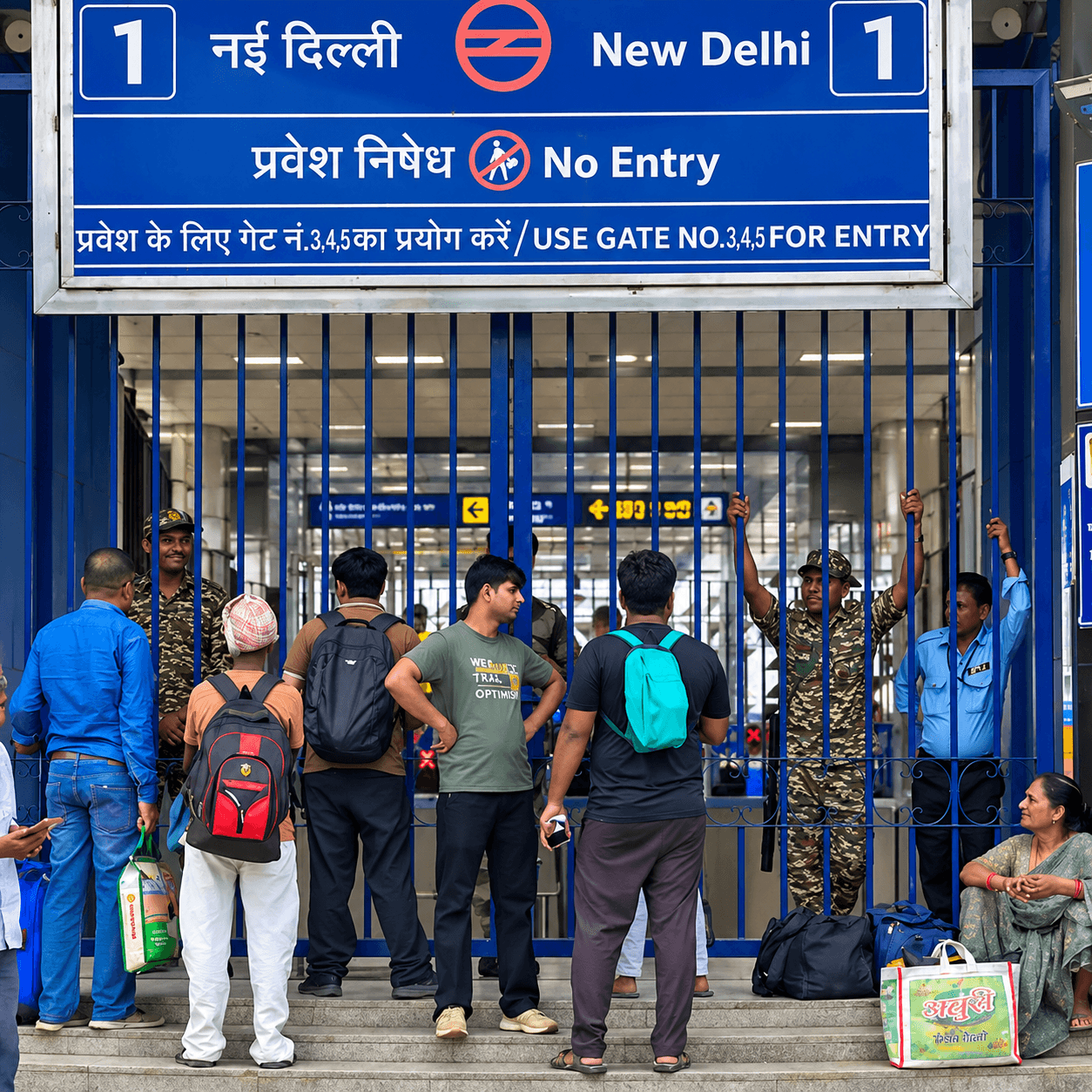
New Delhi was placed under heightened security ahead of a planned protest at Jantar Mantar, with entry and exit facilities at 11 Delhi Metro stations temporarily closed.
The demonstration, involving student groups, political activists and opposition supporters, is focused on the Election Commission and its ongoing Special Intensive Revision (SIR) of electoral rolls. Protesters are also demanding action against Chief Election Commissioner Gyanesh Kumar.
Delhi Police did not grant permission for the demonstration and introduced restrictions on public gatherings in the New Delhi district.
The immediate question is:
Will the security measures contain the protest, or will they push the dispute over electoral rolls into a wider political confrontation?
WHAT IS HAPPENING?
Security has been stepped up across central Delhi as groups prepare to demonstrate at Jantar Mantar.
The Delhi Metro Rail Corporation temporarily closed entry and exit facilities at 11 stations. Interchange services, however, remained available at several locations, meaning the wider Metro network continued to operate.
The affected stations are:
Janpath
Patel Chowk
Central Secretariat
Rajiv Chowk
Seva Teerth
Mandi House
Lok Kalyan Marg
INA
Chawri Bazar
Ramakrishna Ashram Marg
New Delhi
The restrictions were introduced as part of the security arrangements surrounding the planned protest and other events taking place in central Delhi.
WHY ARE PEOPLE PROTESTING?
At the heart of the demonstration is a growing dispute over the Election Commission and its handling of the Special Intensive Revision of electoral rolls.
Protest organisers have raised allegations about the voter-list revision process and are demanding the resignation of Chief Election Commissioner Gyanesh Kumar.
The Election Commission and the BJP have rejected allegations of wrongdoing.
What began as a disagreement over the mechanics of voter registration has now developed into a broader political dispute involving electoral integrity, voter rights and the independence of election institutions.
WHAT IS THE SIR DEBATE?
The Special Intensive Revision, or SIR, is intended to review and update electoral rolls.
Supporters of the exercise say regular verification is necessary to identify inaccurate, duplicate or otherwise invalid entries and keep voter lists reliable.
Critics, however, fear that legitimate voters could be removed from the rolls or face difficulties proving their eligibility.
Those competing concerns have turned SIR into one of the most politically sensitive issues surrounding India's electoral system.
WHY JANTAR MANTAR?
Jantar Mantar has long been associated with public demonstrations in Delhi.
The designated protest site has hosted campaigns on political, social and economic issues for years. Its location near major government and commercial districts also means that large gatherings require extensive security and traffic planning.
In this case, police denied permission for the proposed demonstration while preparing for the possibility of a significant turnout.
WHY CLOSE METRO STATIONS?
The Metro restrictions are primarily intended to control movement around sensitive areas.
Central Delhi includes some of the city's busiest transport hubs. A large influx of protesters could quickly create congestion, making crowd management more difficult.
By restricting entry and exit at selected stations, authorities can limit the number of people moving directly into areas under tighter security.
The entire Metro network, however, was not shut down.
Passengers could still use the network and interchange at several stations, although travel through central Delhi was expected to be more difficult.
CENTRAL DELHI UNDER PRESSURE
The security operation extends well beyond the Metro system.
Additional police personnel have been deployed around Jantar Mantar and nearby areas, with barricades placed at strategic points. Traffic diversions and restrictions have also been introduced.
People travelling through areas around Parliament Street, Connaught Place and other parts of central Delhi were advised to consider alternative routes and allow extra travel time.
The security arrangements also come as the capital prepares for Gandhi Jayanti-related events.
POLICE AND PROTESTERS
Delhi Police has made clear that permission was not granted for the proposed demonstration.
Organisers, meanwhile, have indicated that they intend to continue with their mobilisation.
That leaves authorities facing the possibility of large groups attempting to enter areas where restrictions are in place.
Police priorities are expected to include preventing unauthorised gatherings, managing crowds, protecting government buildings, keeping key roads open and avoiding clashes.
How both sides respond on the ground could determine whether the protest remains largely peaceful or becomes more confrontational.
POLITICAL OPPOSITION JOINS THE ISSUE
The campaign has drawn participation from student organisations, political activists and opposition groups.
The All India Students' Association has been involved in mobilisation, while opposition politicians have also criticised the Election Commission's handling of the electoral-roll revision.
As a result, the issue is moving beyond student activism and becoming part of a broader political campaign over India's electoral institutions.
WHY THE ELECTION COMMISSION IS UNDER SCRUTINY
Election commissions play a central role in maintaining public confidence in democratic elections.
Their responsibilities include maintaining electoral rolls, conducting elections and enforcing election rules.
That makes disputes over voter eligibility especially sensitive.
Supporters of the revision process argue that accurate voter lists are essential for credible elections. Critics say the process must be carried out carefully so that legitimate voters are not inadvertently excluded.
That disagreement lies at the centre of the current political confrontation.
THE YOUTH FACTOR
Student groups and younger activists have become increasingly visible in the latest mobilisation.
For many young voters, the debate is not simply about administrative changes to electoral rolls. It touches on their ability to participate in future elections and their confidence in the political system.
If student organisations and youth groups continue to expand their involvement, the controversy could develop into a broader youth-led campaign.
FROM JANTAR MANTAR TO A NATIONAL ISSUE
The dispute is already attracting attention beyond Delhi.
Political groups are discussing further demonstrations and marches in other parts of the country, raising the possibility that what began as a Delhi protest could develop into a wider campaign.
That would create a different challenge for authorities.
Managing one demonstration is largely a local security task. Coordinated protests across several cities would require a much broader response.
THE COMMUTER IMPACT
For Delhi residents, the immediate consequences are straightforward: getting across central Delhi may take longer.
Metro users may need to:
Use alternative stations
Change routes
Allow additional travel time
Avoid central Delhi where possible
Follow traffic and Metro advisories
Stations such as Rajiv Chowk, Central Secretariat and New Delhi are particularly important because they handle large passenger volumes and connect multiple parts of the Metro network.
THE FREEDOM-OF-ASSEMBLY QUESTION
The restrictions also raise a broader question about the balance between public order and the right to protest.
Authorities have a responsibility to prevent violence, protect public infrastructure and manage security risks.
At the same time, peaceful assembly remains an important part of democratic political expression.
The debate is therefore not simply about whether a protest should take place. It is also about how far restrictions can go before they begin to limit legitimate political activity.
That tension is likely to remain part of the controversy.
WHAT COULD HAPPEN NEXT?
Several outcomes remain possible.
SCENARIO ONE: CONTROLLED PROTEST
Demonstrators remain peaceful while police prevent large gatherings from entering restricted areas.
SCENARIO TWO: DETENTIONS
Authorities detain protesters who attempt to cross barricades or gather in prohibited locations.
SCENARIO THREE: WIDER MOBILISATION
Additional political parties, student organisations and activists join the campaign.
SCENARIO FOUR: NATIONAL ESCALATION
Demonstrations spread to more cities and develop into a sustained campaign focused on electoral reforms.
Much will depend on the response from both protesters and authorities.
WHY THIS MATTERS
1. ELECTORAL TRUST IS AT STAKE
Arguments over voter lists can have a direct impact on public confidence in elections.
2. DELHI'S SECURITY RESPONSE IS SIGNIFICANT
The temporary closure of entry and exit facilities at 11 Metro stations reflects the scale of the security preparations.
3. THE ISSUE IS BECOMING MORE POLITICAL
Student groups, activists and opposition parties are increasingly involved.
4. PUBLIC TRANSPORT IS AFFECTED
Commuters travelling through central Delhi face restrictions, diversions and possible delays.
5. THE PROTEST COULD GROW
If demonstrations spread beyond Delhi, the electoral-roll dispute could become a much larger national political issue.
FACT CHECK METER
AWX FACT CHECK
FACT METER: 95%
STATUS: DEVELOPING
CONFIRMED
• Entry and exit facilities at 11 Delhi Metro stations were closed as part of security arrangements surrounding the planned Jantar Mantar protest.
• Interchange facilities remained available at several major stations.
• Delhi Police denied permission for the proposed demonstration.
• Protesters raised demands involving the Election Commission, Chief Election Commissioner Gyanesh Kumar and the SIR electoral-roll exercise.
• Security and traffic restrictions were introduced in parts of central Delhi.
IMPORTANT DISTINCTION
THE METRO WAS NOT COMPLETELY SHUT DOWN.
The restrictions mainly affected entry and exit at the listed stations. Train services and interchange facilities continued across parts of the network.
CONTESTED
• Allegations that the electoral-roll revision could remove eligible voters.
• Claims that the Election Commission's actions were politically motivated.
• Wider political allegations surrounding the SIR exercise.
AWX VERDICT
METRO RESTRICTIONS: CONFIRMED
SECURITY TIGHTENED: CONFIRMED
PROTEST PERMISSION: DENIED
ELECTORAL-ROLL DISPUTE: ACTIVE
POLITICAL TENSION: HIGH
SITUATION: DEVELOPING
AWX FOCUS: DELHI'S PROTEST STANDOFF
POLICE
Trying to prevent unauthorised gatherings while maintaining public order across central Delhi.
PROTESTERS
Seeking greater accountability from the Election Commission and raising concerns about the electoral-roll revision.
METRO
Restricting entry and exit at selected stations in sensitive areas while keeping much of the wider network operational.
COMMUTERS
Facing diversions, delays and the need to consider alternative routes.
POLITICAL PARTIES
Using the controversy to challenge the Election Commission and demand greater accountability.
THE KEY QUESTION
Can authorities contain the demonstrations without allowing the dispute over electoral rolls to develop into a much larger political confrontation?
WHAT TO WATCH NEXT
Protest turnout
The number of people who attempt to reach Jantar Mantar will indicate the scale of the mobilisation.
Police response
Any further detentions, barricading or crowd-control measures could signal a change in the situation.
Metro
Watch for changes to station restrictions, including any extension or early withdrawal of the measures.
Political parties
The response of opposition parties and student organisations could determine whether the campaign expands.
Election Commission
Any new clarification on the SIR process could influence the political debate.
Courts
Legal challenges could emerge over electoral-roll revisions or restrictions on demonstrations.
Public reaction
The wider response will show whether the controversy remains concentrated among political and student groups or gains broader public support.
THE AWX BOTTOM LINE
The decision to restrict entry and exit at 11 Delhi Metro stations highlights the level of security surrounding the planned Jantar Mantar demonstration.
But the Metro closures are only the visible part of a much larger dispute.
At its centre is a political battle over electoral rolls, the Election Commission and public confidence in India's election process.
For commuters, the issue means closed station gates, traffic diversions and longer journeys.
For protesters and opposition groups, it is about electoral accountability and the right to challenge institutions they believe are failing.
For authorities, the challenge is more immediate: maintain public order without allowing a politically sensitive protest to spiral into a wider confrontation.
The demonstration may last only a few hours.
The debate behind it is unlikely to disappear so quickly.
When questions about who gets to vote become questions about whether elections can be trusted, a protest in Delhi can quickly become a national political story.
ATTLAS WIRE | AWX WORLD NEWS
Real Stories. Lasting Impact.




Comments
No comments yet.