

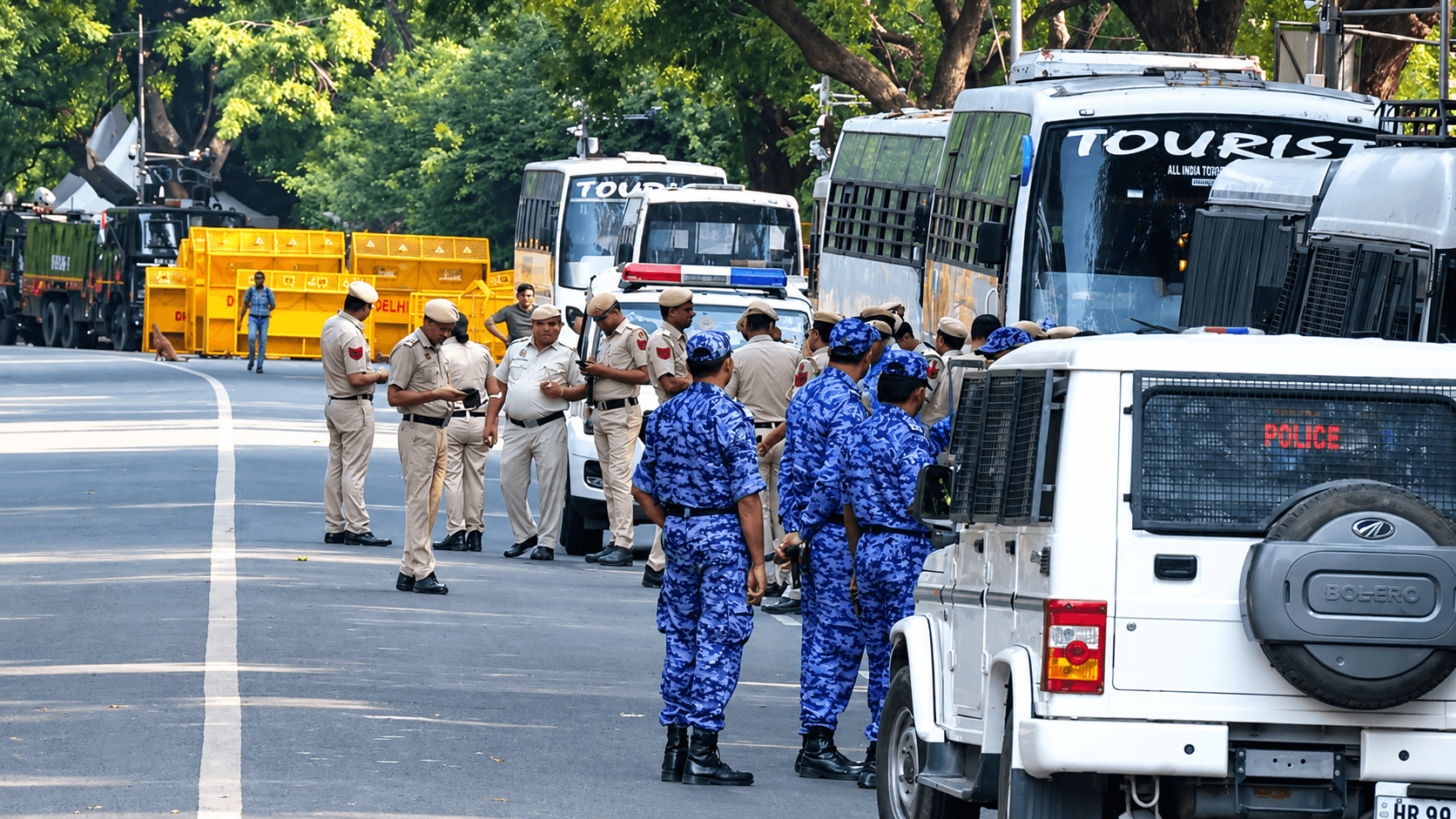
Security has been stepped up around Jantar Mantar as Delhi Police impose restrictions on public gatherings amid preparations for political demonstrations in the capital.
The move comes against the backdrop of a growing political dispute over electoral-roll revisions and criticism of the Election Commission.
Police say the restrictions are intended to prevent disruption, maintain public order and manage crowds in one of central Delhi's most sensitive areas.
Opposition parties and political activists, however, say security measures should not come at the expense of the right to hold peaceful demonstrations.
The key question now is whether authorities can maintain order around Jantar Mantar without turning the security response itself into another political flashpoint.
WHAT IS HAPPENING?
Delhi Police have tightened security around Jantar Mantar as political organisations and supporters prepare for demonstrations linked to electoral-roll issues and the functioning of the Election Commission.
Additional personnel have been deployed, while barricades and checkpoints are being used to regulate movement in and around sensitive areas.
Restrictions on gatherings are part of the broader security arrangements in central Delhi.
WHAT IS SECTION 163?
Section 163 of the Bharatiya Nagarik Suraksha Sanhita (BNSS) gives authorities the power to issue preventive orders when immediate action is considered necessary to address potential threats to public order.
Depending on the circumstances, such orders can address issues including obstruction, danger to human life, public disturbance, rioting or other situations that could threaten public tranquillity.
The provision replaced the earlier Section 144 of the Code of Criminal Procedure.
Importantly, Section 163 does not automatically mean that an area is under a general curfew. The restrictions depend on the specific order issued by the competent authority.
WHY JANTAR MANTAR?
Jantar Mantar has long been one of Delhi's main venues for political demonstrations.
Its location in central Delhi, close to government offices and other important institutions, gives protests there added political visibility. At the same time, large gatherings can quickly affect traffic, public transport, emergency access and security arrangements.
That is why police often introduce additional crowd-control measures when major demonstrations are expected.
THE POLITICAL BACKDROP
The security measures come as political parties continue to challenge aspects of electoral-roll revisions.
Critics have raised concerns about whether eligible voters could be left off electoral lists during the revision process.
Election authorities, meanwhile, have defended the need for accurate and updated voter databases and the procedures involved in maintaining electoral rolls.
What began as an administrative exercise has increasingly become a political issue, with the disagreement now spilling onto the streets.
WHY AUTHORITIES ARE CONCERNED
Large political demonstrations can become difficult to manage when several groups gather in the same area.
Police have to consider crowd size, traffic flows, protest routes, emergency access and the possibility of clashes between opposing groups.
The restrictions are intended to keep gatherings from spreading into surrounding roads or restricted areas and to prevent a situation from becoming difficult to control.
SECURITY DEPLOYMENT
Additional security personnel have been positioned around Jantar Mantar and nearby roads.
Barricades are being used to regulate pedestrian and vehicle movement, while police are monitoring potential gathering points in central Delhi.
The immediate objective is to prevent unauthorised movement into restricted areas and keep important roads open.
THE IMPACT ON COMMUTERS
Security measures around Jantar Mantar can have consequences well beyond the protest site.
Central Delhi connects several important destinations, including:
Connaught Place
Parliament Street
India Gate
Central Secretariat
New Delhi railway station
Commuters travelling through the area could face diversions, delays and additional security checks depending on how the situation develops.
METRO SECURITY
The Delhi Metro is also an important part of the security arrangements during major demonstrations.
Authorities can temporarily restrict entry or exit at selected stations near sensitive locations when large crowds are expected.
Such measures can help limit the movement of large groups while allowing train services to continue.
For commuters, however, station restrictions can mean longer journeys, crowded alternative routes and additional delays.
PROTESTERS' POSITION
Political activists say peaceful protest is an essential part of democratic life.
They argue that concerns over electoral rolls and election administration should be open to public debate and political mobilisation.
Opposition groups have criticised what they describe as excessive restrictions and say authorities should distinguish between peaceful demonstrations and genuine threats to public order.
POLICE'S POSITION
Police maintain that the restrictions are preventive rather than an attempt to stop political debate.
Their stated objective is to avoid situations that could lead to violence, traffic disruption, unauthorised gatherings or clashes between groups.
That leaves authorities with a difficult task: protecting public safety while ensuring that legitimate political expression is not unnecessarily restricted.
THE LEGAL BALANCE
Orders restricting public gatherings can be challenged through legal channels.
The broader legal question is whether restrictions are necessary, proportionate, supported by credible concerns and limited in their scope and duration.
The tension between maintaining public order and protecting freedom of assembly is not new in India. It has repeatedly been examined through political debate and the courts.
WHY ELECTORAL ROLLS HAVE BECOME A FLASHPOINT
Voter lists are central to the electoral process.
For eligible citizens, being removed from an electoral roll can create serious difficulties when it comes time to vote.
At the same time, election authorities have a responsibility to identify duplicate, fraudulent or otherwise invalid entries and keep voter databases accurate.
The current dispute centres on whether that balance is being handled properly during the revision process.
FROM ADMINISTRATIVE EXERCISE TO POLITICAL BATTLE
The Special Intensive Revision was introduced as an electoral-administration exercise.
Political parties, however, have increasingly presented it as a broader question of democratic representation.
That has brought several groups into the debate, including:
Election authorities
Political parties
Civil society groups
Voters
Courts
The demonstrations at Jantar Mantar are the latest expression of that wider dispute.
COULD SECURITY MEASURES ESCALATE THE POLITICAL DISPUTE?
There is a possibility.
Restrictions may help police prevent immediate disruption, but they can also become politically contentious if demonstrators believe their ability to protest peacefully is being curtailed.
That can create a familiar cycle:
Protest planned → restrictions imposed → protesters challenge the restrictions → police intervene → political criticism intensifies.
Whether that happens in this case will depend largely on how the demonstrations unfold and how authorities respond.
WHAT HAPPENS IF PROTESTERS IGNORE THE ORDER?
Authorities can take action against individuals who violate legally issued restrictions.
Depending on the circumstances, enforcement could involve:
Detention
Removal from restricted areas
Preventive action
Registration of cases
The exact response will depend on the wording of the order and the conduct of those involved.
WHY THIS MATTERS
1. CENTRAL DELHI IS A HIGH-SENSITIVITY ZONE
Jantar Mantar is close to major government, commercial and transport hubs, making crowd management particularly important.
2. THE PROTEST HAS POLITICAL SIGNIFICANCE
The demonstrations are connected to the larger dispute over electoral-roll revisions and the Election Commission.
3. SECTION 163 GIVES AUTHORITIES PREVENTIVE POWERS
The provision allows authorities to impose specific restrictions when they believe immediate intervention is necessary to protect public order.
4. COMMUTERS COULD BE AFFECTED
Road diversions, checkpoints and possible Metro restrictions could cause delays across central Delhi.
5. THE LEGAL DEBATE MAY CONTINUE
If political groups or individuals challenge the restrictions, questions about their necessity and proportionality could move into the courts.
FACT CHECK METER
AWX FACT CHECK
FACT METER: 94%
STATUS: DEVELOPING
CONFIRMED
Security has been tightened around central Delhi amid planned political demonstrations.
Jantar Mantar remains a major venue for protests.
Authorities can use Section 163 of the BNSS to issue preventive orders under specified circumstances.
Electoral-roll revisions have become a significant political issue.
Police restrictions can include limits on public gatherings and movement, depending on the order issued.
IMPORTANT DISTINCTION
SECTION 163 IS NOT A GENERAL "CURFEW" BY ITSELF.
The exact restrictions depend on the written order issued by the competent authority.
CONTESTED
Whether the security measures are proportionate to the anticipated threat.
Whether the restrictions could unnecessarily affect peaceful political demonstrations.
Political allegations surrounding the electoral-roll revision process.
AWX VERDICT
SECURITY TIGHTENED: CONFIRMED
SECTION 163 RESTRICTIONS: REPORTED
JANTAR MANTAR: SECURITY FLASHPOINT
ELECTORAL-ROLL DISPUTE: ACTIVE
PUBLIC-ORDER CONCERNS: HIGH
SITUATION: DEVELOPING
AWX FOCUS: CAPITAL UNDER WATCH
POLICE
Deploying personnel and restricting gatherings as part of efforts to maintain public order.
PROTESTERS
Seeking to demonstrate over electoral-roll revisions and concerns involving the Election Commission.
ELECTION COMMISSION
Facing political scrutiny over the voter-list revision process.
COMMUTERS
Potentially facing road diversions, security checks and disruption to normal travel through central Delhi.
COURTS
Could become the next arena if restrictions or electoral-roll decisions are challenged legally.
THE KEY QUESTION
Where does legitimate public-order protection end and unnecessary restriction on peaceful protest begin?
WHAT TO WATCH NEXT
SECURITY
Whether police expand, maintain or ease restrictions around Jantar Mantar.
PROTESTS
Whether political groups attempt to gather despite the restrictions.
DETENTIONS
Whether protesters are detained for violating the order.
METRO
Whether additional stations face temporary entry or exit restrictions.
COURTS
Whether petitions are filed challenging the restrictions.
ELECTION COMMISSION
Whether officials respond to political allegations surrounding the electoral-roll revision.
POLITICAL PARTIES
Whether opposition groups announce larger demonstrations in Delhi or elsewhere.
THE AWX BOTTOM LINE
The heightened security around Jantar Mantar reflects the growing sensitivity of the political dispute over electoral-roll revisions.
For authorities, Section 163 is a preventive measure intended to reduce the risk of disorder.
For protesters, however, restrictions raise a different question: how freely can political dissent be expressed when security measures are in place?
For now, the challenge is one of balance.
Delhi has to manage the streets without allowing the security response itself to become the next political flashpoint.
ATTLAS WIRE | AWX WORLD NEWS
Real Stories. Lasting Impact.




Comments
No comments yet.